Nagelfluh & Moraine
Soils
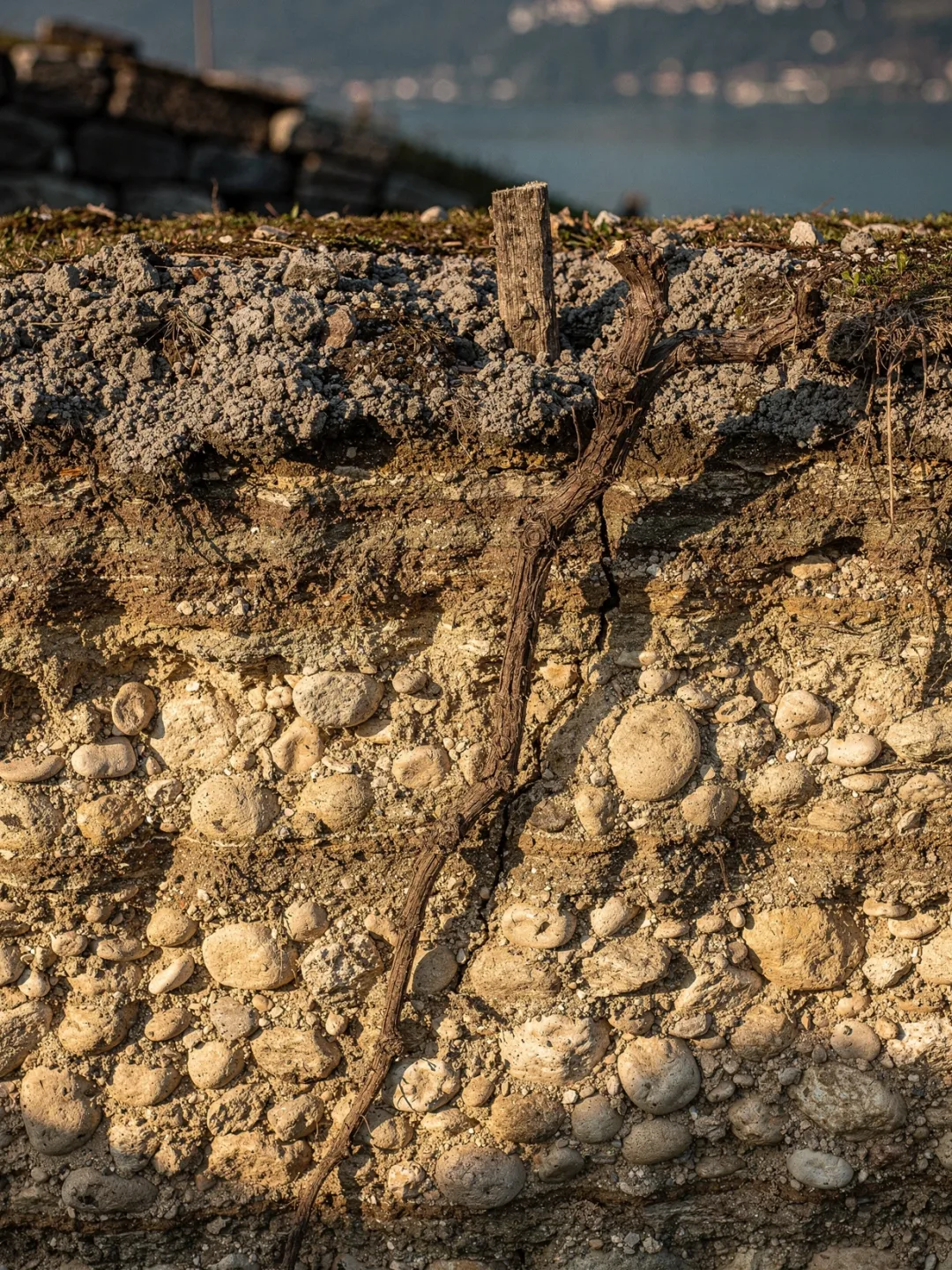
Dig a hole in a vineyard above Rivaz or Epesses, and after just one shovelful you'll hit stone. It's Nagelfluh, called poudingue in French: a conglomerate rock made of pebbles once rounded smooth by a river, then cemented together by molasse. Between them lie gray chunks of moraine, debris left behind by a glacier as it retreated many thousands of years ago.
This mix is no accident—it's half the age of the Alps written into the ground. The Nagelfluh dates from before the mountains were formed, when rivers deposited their gravel in a foreland basin. The moraine arrived millions of years later, as the ice age glaciers pushed across this basin. Water seeps between the hard layers but doesn't pool there—the vine root has to chase it, deeper and deeper. That's exactly what produces small, concentrated berries.
In Chablais, a good hour's drive east, the soil tells a different story—one that begins with a disaster. On March 4, 1584, a landslide of roughly ten million cubic meters broke loose from the Grammont. It buried the village of Yvorne under rubble. People rebuilt further down, on the fresh debris fan still known today as Ovaille. Out of catastrophe came fertile, deep soil—calcareous rubble instead of hard rock, and wines that come across rounder than the leaner Lavaux wines grown on Nagelfluh.
La Côte knows no such dramas. The soil there is more uniform. Nothing collapses here. A broad blanket of moraine and weathered molasse sandstone covers the gentler slopes, and neither the extreme gradients of Lavaux nor the force of a rockslide come into play. This allows for larger parcels and easier machine work, but also fewer dramatic differences between neighboring plots.
How strongly such differences can play out was measured in a 2004 scientific study of all of Vaud's terroirs. Dézaley and Calamin stood out so distinctly that the study later helped justify their special legal status. Two rows of vines on the same estate, just meters apart, can since then officially carry different appellations on paper. This isn't arbitrary—it's because two genuinely different soils actually meet beneath the surface.
A thin, dark layer of leaves and decomposed roots, tended by hand on the steep terraces of Lavaux.
The root: Fine roots draw what the rain brings here, and are the first to dry out in the heat.