Opoka in Layers
Soils
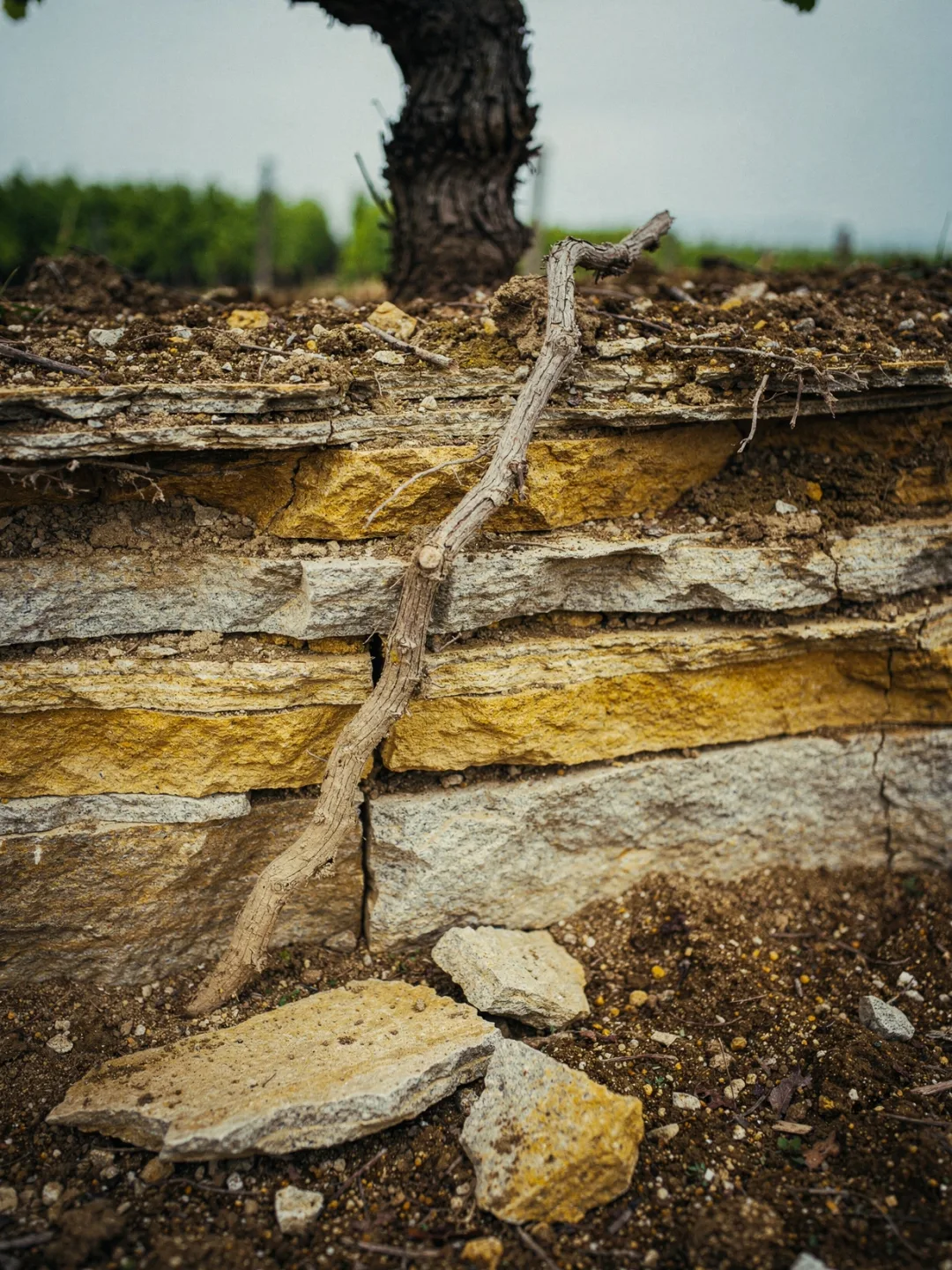
Dig a hole in a vineyard near Šmartno. After barely fifteen centimeters, the spade hits slabs of gray marl and yellow sandstone, finely layered like the pages of an open book. The locals in Brda call this stone Opoka. On the other side of the border, less than ten kilometers away, the exact same rock is called Ponca.
Both names refer to the same ancient seabed. Around forty million years ago, sediment flows slid down an underwater slope here and settled in thin bands, sometimes fine clay, sometimes coarser sand. The Alpine uplift later lifted the whole formation out of the water, and weathering has been breaking the layers apart again ever since. What today forms a chain of hills over Brda was once mud on the floor of a warm sea.
For the vine, this is a blessing with conditions attached. Water and air move easily between the loose slabs. The root follows them down into the depths, because it finds almost no nutrients near the surface. Along the way, it picks up potassium and phosphorus, which are abundant in the weathered Opoka. This is exactly why Rebula grown on this soil tastes so mineral and saline, and never feels heavy, no matter how much alcohol ends up in the glass.
Deeper down, the stone grows more solid. What crumbles into thin slabs near the surface still lies, seventy centimeters further down, as a compact bank, barely weathered and noticeably moister than the dry August surface above. Only old vines with deep-reaching roots ever tap into this reserve, and their grapes withstand drought far better than those from young plantings.
One misconception persists stubbornly: that a wine tastes of stone because the root sucks minerals directly out of the rock and passes them along. That's simply not how it works. What actually reaches the vine from the soil are dissolved salts in quantities far too small for anyone to taste. Opoka works indirectly instead — through the water it holds or releases, and through the depth to which it forces the root.
A thin, dark layer of leaves and grasses. On the steep terraces of Brda it barely holds, and every heavy rain washes some of it further down the slope.
The root: The fine roots sit here and drink first — and after just a few dry days, they're already exhausted.