Rebula & Jakot
Grape Varieties
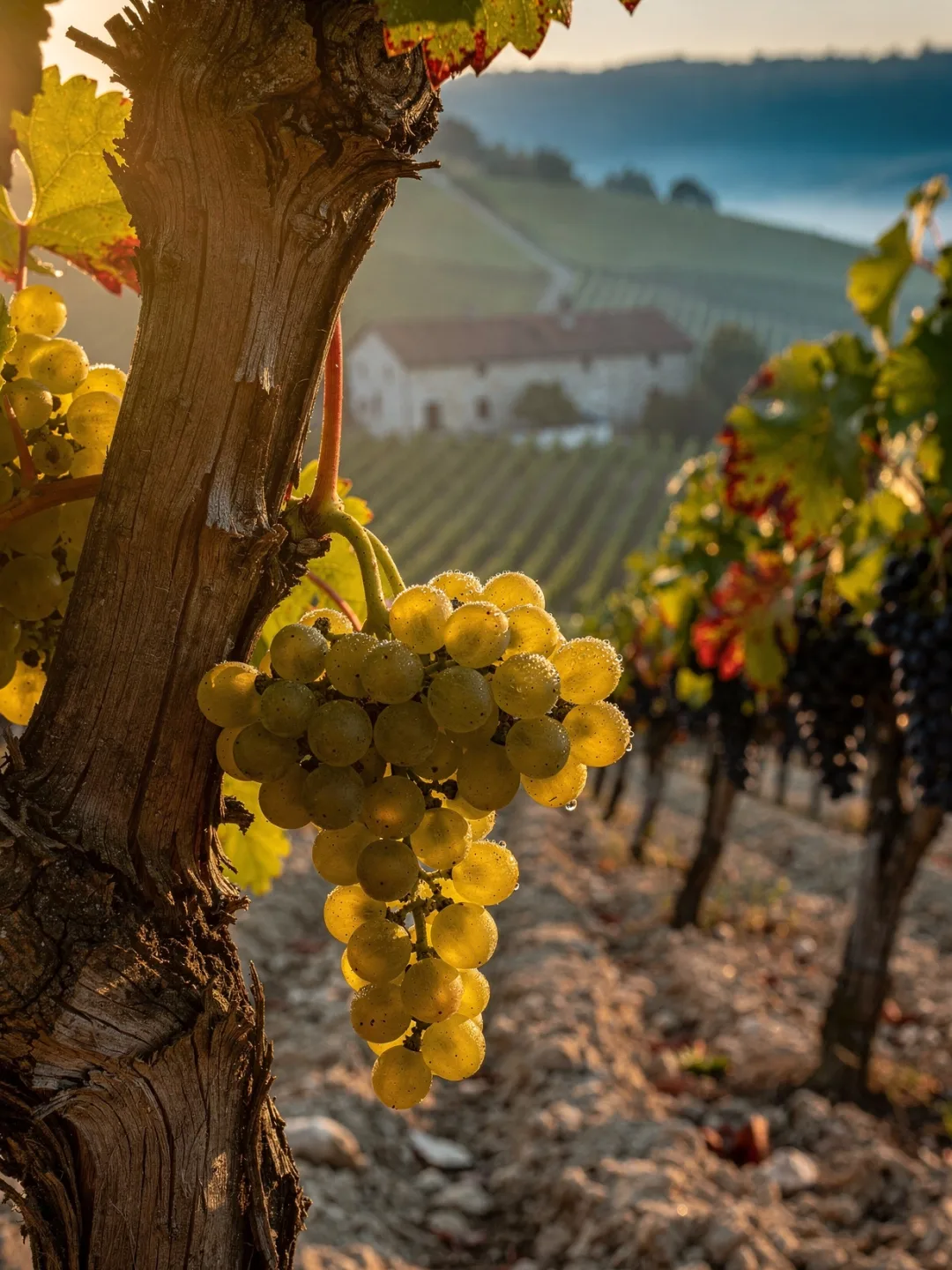
A single white grape defines the character of Brda. Rebula has been documented since 1336 and, at roughly a quarter of the planted area, is by far the region's most important variety. It's thin-skinned and brings plenty of acidity, but ripens late in the autumn. Until just a few decades ago, some sites barely got warm enough for it to fully ripen. Just across the border, less than ten kilometers to the west, this exact same grape is called Ribolla Gialla. Two names, one grape, one divided hill.
In the glass, Rebula smells of green apple, citrus peel and meadow flowers. A faint bitter-almond note lingers on the finish, the variety's telltale signature. Leave the skins in the must for weeks instead of pressing right away, though, and you get a completely different wine: amber-colored, with tannin and aromas of quince, honey and dried apricot. Both wines come from the same grape. The difference is made entirely in the cellar.
The second leading variety carries a name born out of a dispute. For decades it was known here, as in Friuli, as the Tokaj-type grape, until the EU reserved the name Tokaj exclusively for Hungary. Italy then renamed its version Friulano. Slovenia took a quirkier route in 2013, christening the variety Jakot — simply the word Tokaj spelled backwards. The wine itself stayed the same: dry, full-bodied, with a faintly grassy note.
Alongside these stand the newcomers, and together they now cover more ground than all the native varieties combined. Merlot accounts for roughly a fifth of the planted area, Chardonnay for about a sixth, along with Cabernet Sauvignon, Sauvignon Blanc and Pinot Noir. They arrived mainly after the Second World War, when the cooperative replanted with an eye toward international taste. A little Pikolit still survives here and there in Brda too, a grape with an odd quirk: a large share of its flowers never get pollinated and simply wither, so a hectare of it yields barely any grapes at all — but what little it does produce becomes one of the sweetest and most expensive wines in the region.