Pizarra & Cascajo
Soils
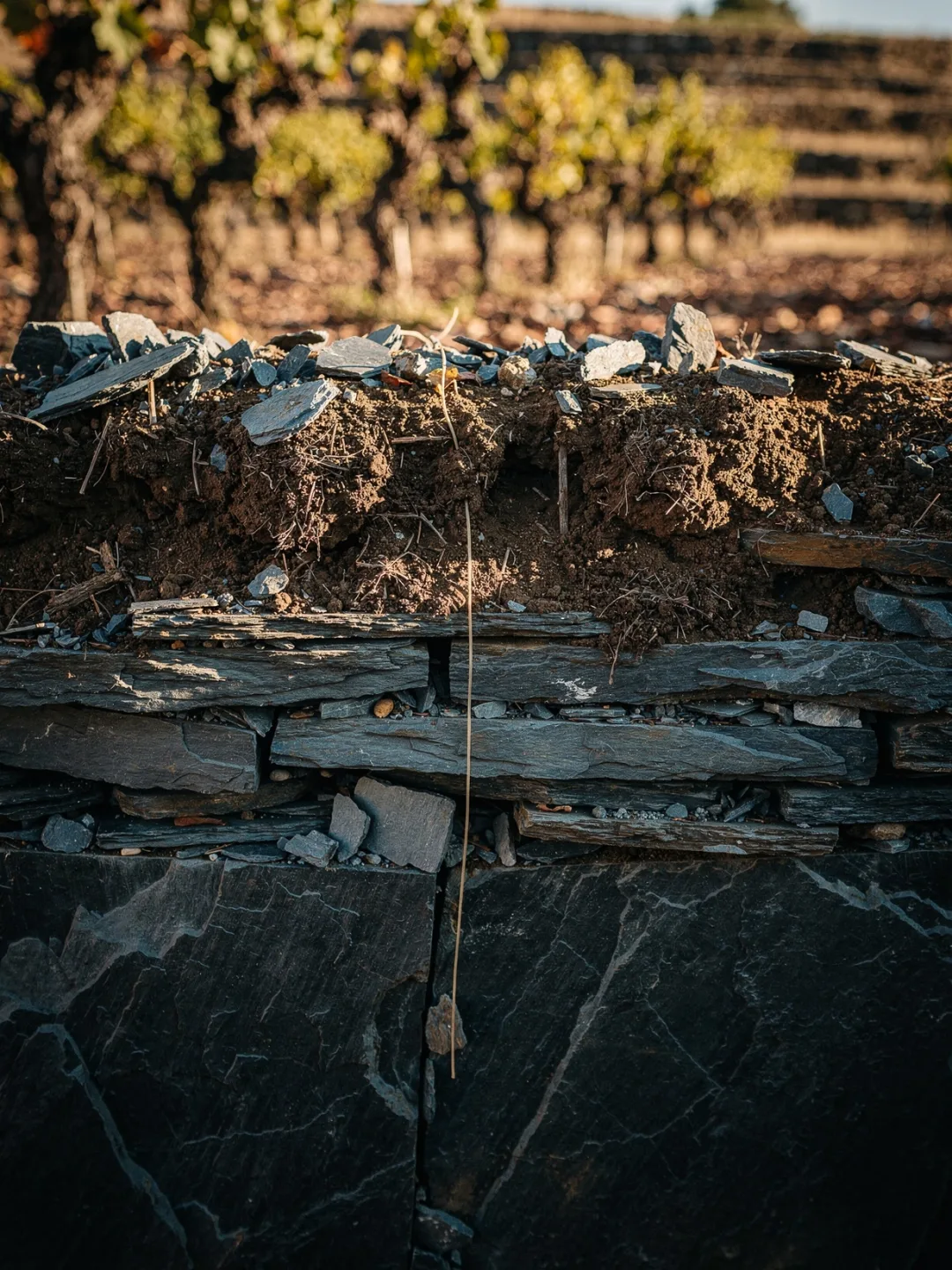
The terraces around Corullón climb a rugged slope in narrow bands, gray and jagged like a weathered wall. Pick up a handful of this soil and you're barely holding earth at all — instead, thin, sharp-edged plates, blue-gray and brittle like shattered roofing material. This is pizarra, slate. Here it doesn't lie in a single layer but stacked loosely, with barely any fine soil in between.
These stones are ancient. The whole of Bierzo sits in a depression geologists call the Hoya Berciana. Its rim consists of pre-Carboniferous rock, chiefly Luarca slate and Armorican quartzite, both more than four hundred million years old. The interior of the basin, by contrast, filled with much younger, softer Tertiary and Quaternary deposits. Dig in Bierzo, and you dig through two completely different geological eras.
Dig instead down in the flat Bierzo Bajo, and you find something else: rounded quartzite pebbles, smoothed by rivers over millennia and deposited in terraces. This soil is called cascajo. It holds more water than the slate up on the slopes, warms up faster, and for a long time mainly carried Palomino and Garnacha Tintorera for simple everyday wine.
On the slate, though, the root has a hard time — and that's exactly what pays off. It squeezes between the plates, finds almost no nutrients, and instead drives deep, resulting in small, thick-skinned berries packed with color and tannin. The slopes around Corullón are also so steep that in places no tractor can climb them. Harvesting is done by hand, and in some spots goods are still transported by mule, just as they were a hundred years ago.
This exact same harsh, unforgiving soil is what makes the region's reputation today. The single-vineyard wines of Corullón, pressed from pure slate and ancient vines, rank among the most expensive Mencías in Spain. A rock that would never have given a farmer a decent wheat field has become the most valuable soil in Bierzo.
A thin, dark layer of sand and decomposed leaf litter, mixed with small chunks of slate. Poor in nutrients, like nearly all soils in Bierzo.
The root: This is where the fine roots sit, though after a few dry summer weeks they find almost nothing left.