Atlantic Meets Meseta
Climate
Mountains stand all around, and that's exactly what makes Bierzo special. To the west and north, the Sierra de los Ancares blocks the moist Atlantic winds. To the south, the Montes Aquilianos do the same against the harsh Castilian Meseta. In between lies a depression, almost a basin. Within it, a mild climate persists that neither wet Galicia nor the dry plateau nearby ever experiences.
The numbers confirm this. Average annual temperatures hover around twelve degrees Celsius. Rainfall ranges between seven hundred and just under eight hundred millimeters a year — considerably more than in Castile and considerably less than on the Galician coast. Meteorologists classify Bierzo as having a Mediterranean climate with mild summers, neither Atlantic nor continental.
Exactly where this boundary runs shows up best in the mountain valleys west of Corullón. There, in the valleys of Ancares, Burbia, and Cúa, the dividing line between the Eurosiberian and Mediterranean climate zones sits at around a thousand meters of altitude. Both weather systems collide there. That's why birches and ancient oaks grow alongside holm oaks and strawberry trees, plants otherwise found only in the warm south.
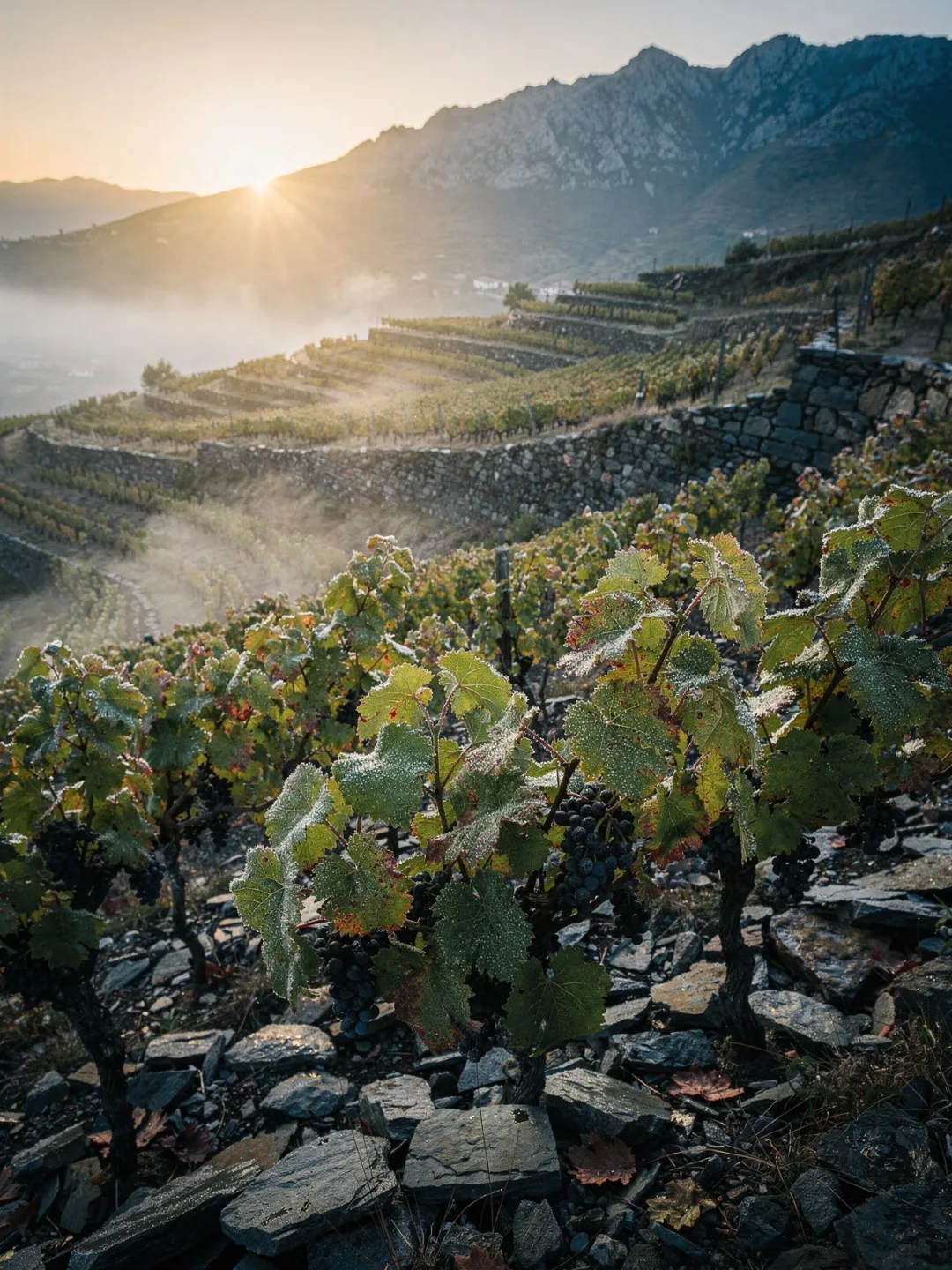
For the vine, this means above all one thing: enough warmth to fully ripen Mencía, but never as much heat as on the Meseta, where acidity vanishes as early as August. The vineyards sit between four hundred fifty and nine hundred meters above sea level. With every meter of elevation, the vine retains more of that freshness which sets a Bierzo Mencía apart from a heavier wine from further inland.
Within the region, this creates yet another distinction. Up at Corullón, in the so-called Bierzo Alto, altitude and steep slopes cool the nights noticeably. Down in the flat Bierzo Bajo around Camponaraya, by contrast, the air stays warm longer, and the soil retains more heat. Two landscapes, one Denominación — and quite different wines, depending on which side the grapes grew.