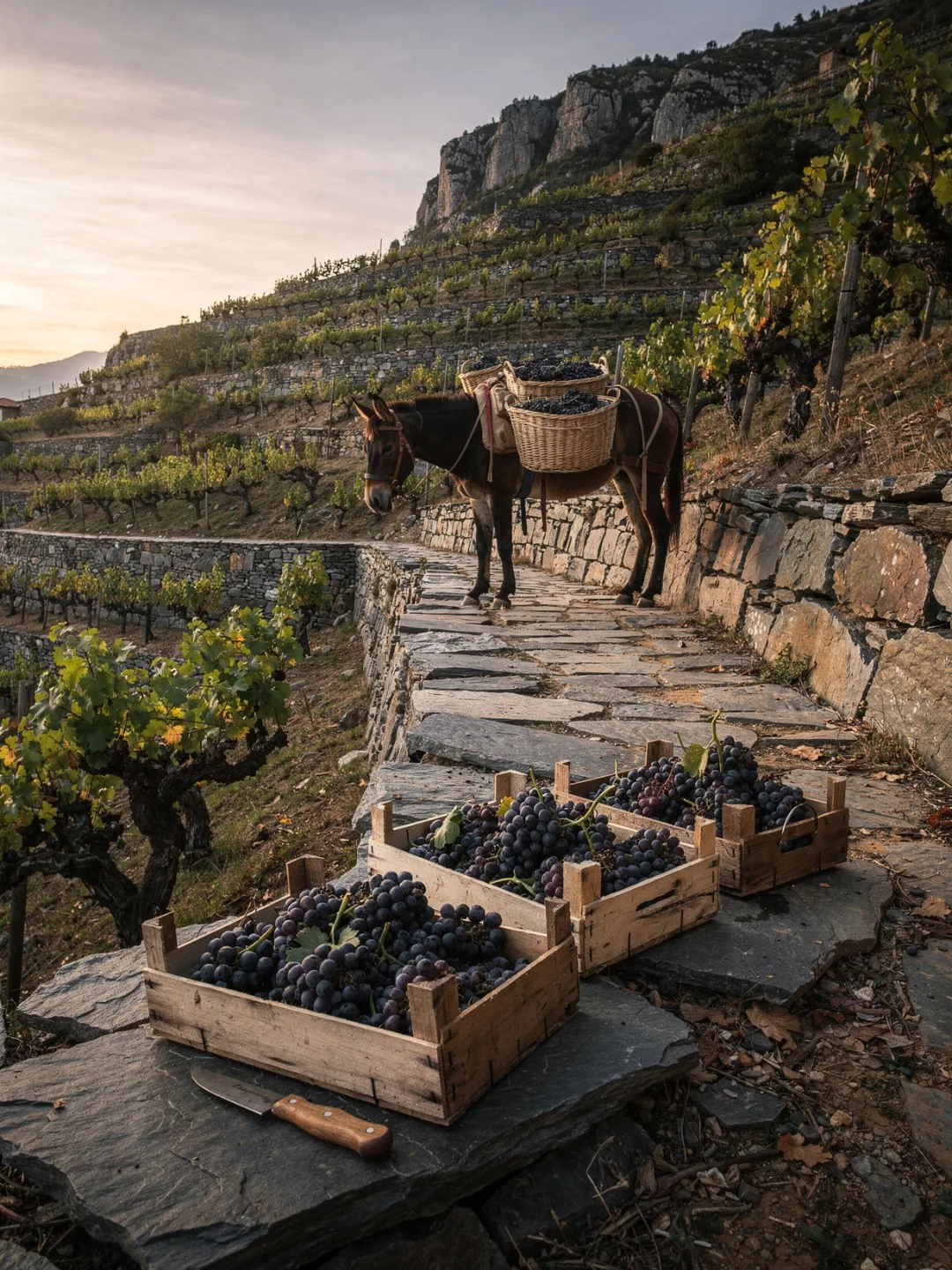
Hand & Mule
Winemaking
Bierzo has two completely different ways of vinifying Mencía, and both continue to coexist. The old school ferments whole, uncrushed bunches under carbon dioxide, the same technique used in Beaujolais, producing a light, fruity wine meant for quick sale. The new school aims for the opposite: concentration, structure, and ageability.
Even the harvest itself is done entirely by hand. No tractor can climb the steep slate terraces around Corullón anymore; the steepest vineyards in Bierzo reach a gradient of around forty-five percent. Grapes are cut by hand and carried down in small crates. In some spots, mules still carry them down into the valley today, since no other vehicle fits between the narrow walls of the old terraces.
In the cellar, most quality-focused producers now fully destem the grapes and ferment them with spontaneous yeasts from their own vineyards. The goal is gentle extraction that pulls out color and fine tannin without overwhelming Mencía's delicate violet aromas. Some winemakers deliberately let a portion of whole bunches ferment along with the rest. This adds extra spice to the wine without introducing bitter edges.
When it comes to oak aging, the region holds back noticeably. Instead of new, heavily toasted barriques, many bodegas turn to used French oak or large old casks, since new wood quickly masks Mencía's delicate fruit aromas. Where new oak is used, the best producers dose it sparingly, and only for part of the harvest.
The aging categories themselves are strictly regulated. A Crianza requires at least twenty-four months total, six of them in oak; a Reserva needs thirty-six months with at least twelve in barrel. The Gran Reserva ages longest of all: sixty months total, at least eighteen of them in wood, the rest in bottle. A simple Joven, by contrast, often goes on sale as early as the spring following harvest.