Limestone, Sand, Tosca
Soils
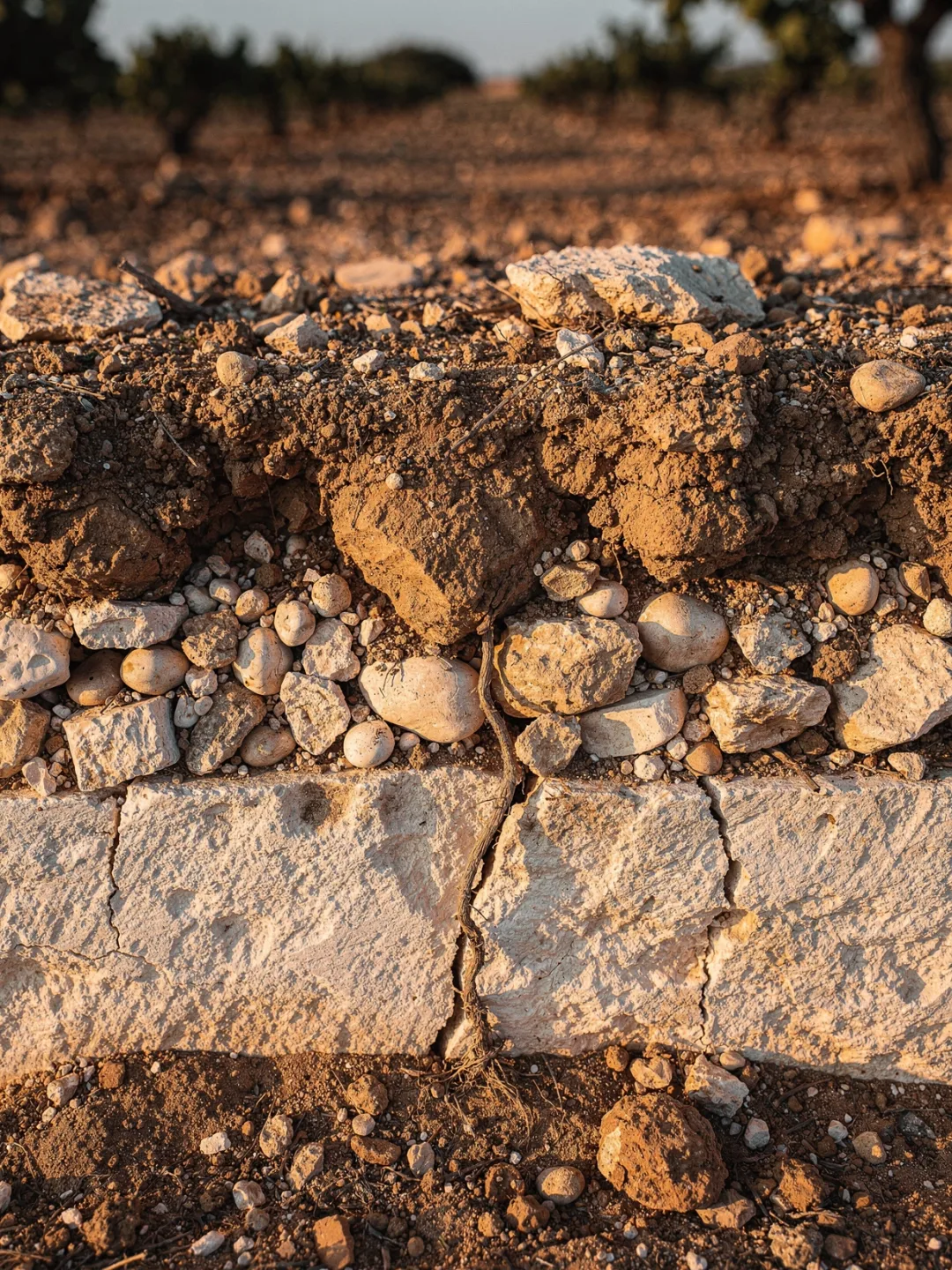
Dig a hole in a vineyard near Jumilla. After just a few spadefuls, the soil turns pale, brown to reddish-brown, loose, and full of stones. Limestone governs almost everything here. The structure is sandy-clay rather than clayey, and that's exactly what sets this soil apart from the rest of Spain.
This soil didn't form where it lies today. It was carried in: rubble and scree from the surrounding hills, worn down over millions of years from the end of the Tertiary well into the Quaternary period. Only then did the calcareous mass finally settle in the basins of the Altiplano. Depth therefore varies greatly from plot to plot, even though the source material was the same everywhere. Most often, the loose subsoil reaches surprisingly deep, and a vine allowed to grow old here drives its roots ever further down over the years.
Keep digging, and eventually you'll hit a hard, pale layer. Locally, this fossilized, cemented sandstone is called tosca — the same limestone crust once used to build houses in the area. On some plots it lies so close to the surface that growers must break it up with machinery before planting, or no young root can penetrate through. Beneath it waits moisture, stored since the last autumn rain and often the only reserve a vine has left by August.
This very loose structure has given the region an unlikely advantage. A pest that needs to burrow through wet, compact clay to move from root to root finds hardly any purchase in loose sand. Minerals themselves, despite the persistent belief, aren't something you can actually taste — what limestone truly provides is water in the right measure, an alkaline environment, and stored daytime warmth that it releases again at night. A roundabout path. But the entire reason this soil matters at all.
Pale, brown to reddish-brown soil made of sand and clay, loose and full of stones, low in humus.
The root: This is where the fine roots sit. They find hardly any nutrients here, and after a few dry weeks, no water either.