Limestone, Marl, Sea
Soils
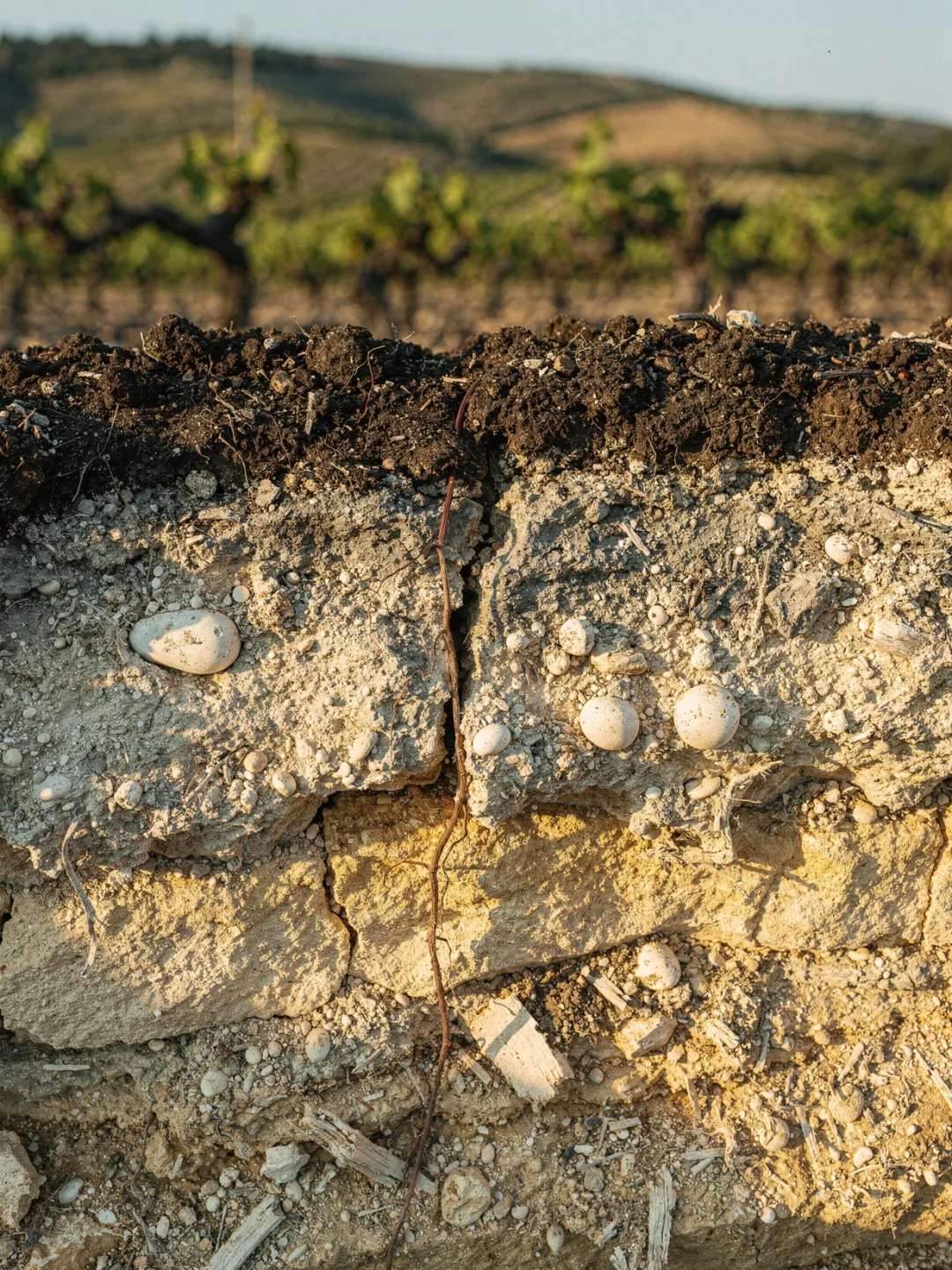
Dig a hole in a vineyard near Sant Sadurní d'Anoia. You'll quickly land in a story older than any vine: seabed. What's a vineyard today lay underwater sixteen million years ago. The layer beneath is still full of fossils today — snail shells, mussels, oysters, embedded in sandstone and limestone marl.
Right beneath the thin layer of humus lies marl almost everywhere: a firm mix of clay and limestone, yellowish-gray, with carbonate embedded in small nodules. A vine root struggles here. The clay holds water tightly and is hard to penetrate. That's why almost no root grows straight down — it seeks out cracks, and that takes years.
Whoever manages to go deep enough is rewarded. Beneath the marl lies the actual marine layer, a loose mixture of sandstone, calcarenite, and fine silt, still containing shell fragments today. It stores water like a sponge and releases it only during the driest weeks of summer, when everything above is already dusty.
This structure explains why the soils of Penedès are generally considered poor, and why that's exactly an advantage. Little organic material, plenty of limestone, hardly any fertility — a vine has to work hard here just to get water and nutrients at all. Small, concentrated berries are the result. Richer soils further down in the valley yield more volume, but rarely more depth in the glass.
One misconception persists here too: people often read that you can taste limestone directly in wine, as minerality. That's not quite true — what the root draws from the rock are dissolved minerals in such tiny amounts that no tongue could ever identify them individually. What actually matters is the detour: the warmth that pale limestone stores, and the water that marl and the marine layer hold or release. This detour shapes Xarel·lo and Parellada far more than any single number from a soil lab.
A thin, dark layer of decomposed vine wood and herbs between the rows.
The root: This is where the fine roots sit, the first to drink after every rain — and the first to grow thirsty.