From the Phoenicians to Corpinnat
Region & History
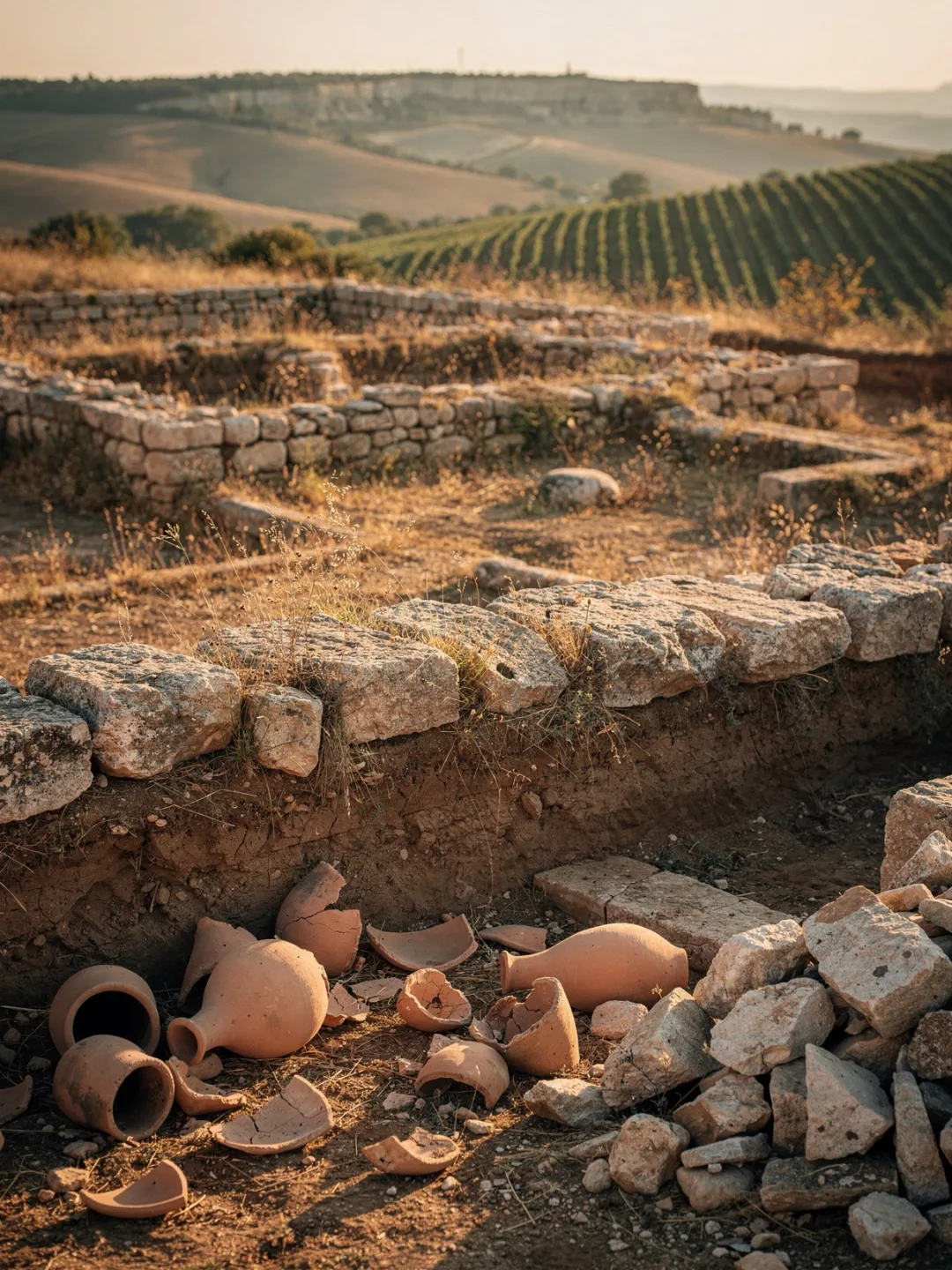
At the foot of a hill near Avinyonet del Penedès lies Font de la Canya, an Iberian trading post that existed from the seventh to the first century BC. Archaeologists found native drinking vessels alongside shards of Phoenician amphorae there. Trade was already close-knit back then. Wine arrived by sea long before Rome even existed, and the region immediately absorbed it into its own culture.
Many centuries later, a winegrower from Sant Sadurní d'Anoia traveled to a trade fair in Reims. Josep Raventós returned in 1872 with an idea he had only seen used by the Champagne houses. A second fermentation directly in the bottle turns still wine into sparkling wine. He tried it with local grape varieties in his own cellar at Codorníu, entirely without any official mandate. That single experiment grew into an entire industry.
Fifteen years later came phylloxera. Starting in 1887, it chewed its way through nearly every vineyard in the area. Almost everywhere, growers replanting chose the same three white varieties. In 1888, Manuel Raventós Domènech, Josep's son, formalized the blend that still holds today: Macabeu, Xarel·lo, and Parellada. The origin wasn't officially recognized until 1960, with the founding of the Consejo Regulador of the DO Penedès.
A century after Raventós, another winemaker from the Penedès dared something completely different, in an area that hardly anyone internationally knew. Not sparkling wine — still red wine, made from a foreign grape variety. Miguel A. Torres planted Cabernet Sauvignon at the Mas La Plana estate in 1966. In 1979, his first vintage, harvested in 1970, beat the great names of Bordeaux in a blind tasting held by the trade magazine Gault-Millau in Paris. Overnight, the wine world learned that this region grew more than just the three white grapes used for Cava.
The most recent turning point didn't come from the cellar, but from the field. In 2020, Penedès set itself the goal of working entirely organically starting with the 2025 harvest — and became the first wine region in the world to achieve it. The Albet i Noya winery had already led the way in 1978 with Spain's first organic wine. At the same time, another movement had been growing since 2015: six wineries around Gramona and Recaredo met to discuss the future of Cava. On January 31, 2019, nine of them officially left the DO Cava to write their own, stricter rules as Corpinnat.