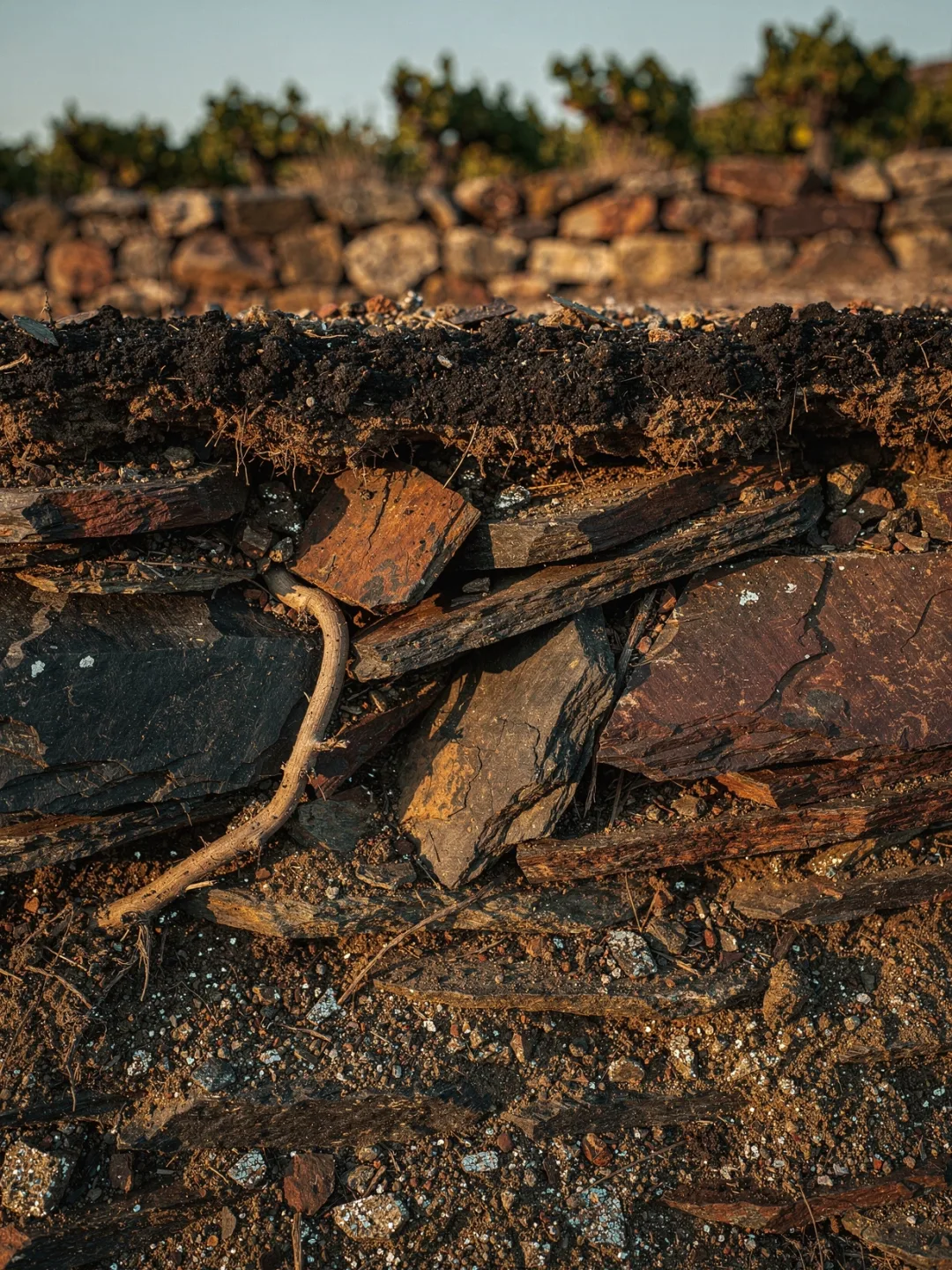
Llicorella, Black Slate
Soils
Dig a small hole in a Priorat vineyard, and you won't get far. After ten, at most fifteen centimeters, the spade hits stone. Thin, brittle slabs lie there in a dark copper hue, tightly layered like a deck of cards someone let fall at an angle. This slate is called Llicorella here.
Its age is striking. The slabs date from the Devonian and Carboniferous periods, rock between 318 and 416 million years old. It's one of the oldest exposed at the surface anywhere in Catalonia. Once this seabed was soft; then pressure over millions of years compressed it into these sharp-edged layers, thin enough to break by hand.
For a vine root, this is no comfortable place. It has to squeeze between the individual slabs, searching for moisture that's still trapped deeper down, long after everything above has dried out. This effort costs energy that would otherwise go into growth. The result is strikingly small yields: on average, a single vine here bears only about one kilogram of grapes a year, far less than is typical elsewhere in Spain.
The dark color is no accident for the wine. Tiny mica flecks in the Llicorella reflect sunlight back onto the grape, and the black slabs store heat during the day, releasing it slowly again at night. Combined with the region's cool nights, this creates a heat balance that extends ripening without burning off the acidity.
Because so little soil covers these slopes, generations of farmers built dry-stone walls from this very slate, just to keep the few centimeters of soil in place at all. Without the walls, any heavy rain would wash the thin layer of humus down the valley. Around Porrera and Torroja del Priorat, these hand-stacked terraces still shape the landscape today. Some are over a hundred years old, stone upon stone, without any mortar.
A thin, dark layer of decomposed leaves. In the Priorat, rarely more than a hand's width, often less.
The root: Here lie the fine roots, right where the scarce rain arrives first — and dries out again first as well.