Dryness and Cool Nights
Climate
Little of the Mediterranean actually reaches here, even though the Priorat lies just twenty-five kilometers from the coast. The mountains in between block almost every moist, mild wind, leaving behind a harsh continental climate in the middle of a coastal province.
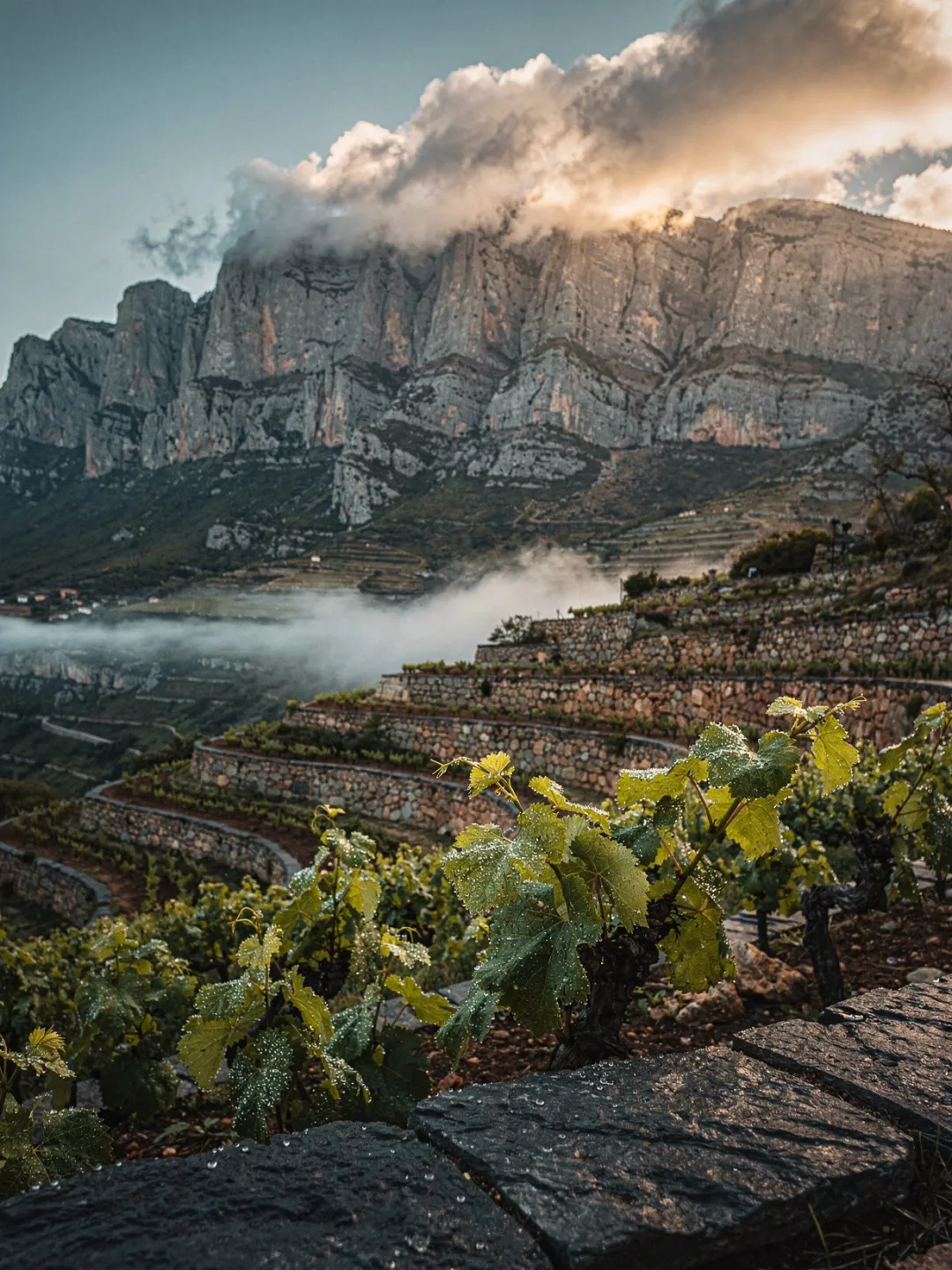
In the north, the Serra de Montsant mountain range rises like a wall before the valley. It holds back the cold north winds that would otherwise sweep across the plain. What does get through are mainly winds from the northwest. They dry the leaves quickly after rain and give fungal diseases little chance, which lets growers get by with minimal spraying.
The average annual temperature lies between fourteen and fifteen degrees Celsius, a rather mild figure for an area that reaches summer peaks well above thirty degrees. The reason for this contradiction lies in the night: as soon as the sun sets, the steep slopes cool rapidly, and the difference between daytime heat and nighttime cool can reach ten degrees or more. The vine makes use of both sides. During the day, the berry ripens; at night, the acidity is preserved.
Rain falls rarely and irregularly, averaging between four hundred and five hundred liters per square meter a year. That's little, barely more than in the dry parts of Andalusia. On some slopes, it's even less. Irrigation is therefore strictly regulated and only permitted when the plant itself would otherwise be at risk. Most vines are dry-farmed, with no artificial water supply at all.
Within this small area, the vineyards sit between one hundred and seven hundred meters above sea level, and the difference can be tasted in the glass. Wine from the lower sites around Falset tends to be lusher and ripens earlier. Grapes from the cooler slopes around Escaladei, by contrast, are harvested later and stay firmer. A single small valley thus produces very different wines, without the grape variety ever changing.