Garnacha and Samsó
Grape Varieties
Two grapes carry the Priorat, and the appellation's rulebook names them explicitly as recommended: Garnacha Tinta and Samsó. Samsó is the Catalan name for Cariñena, known elsewhere as Mazuelo or Carignan. Anyone who only knows one of these names suddenly finds the same wine here under an unfamiliar word.
Garnacha buds early and ripens late, with thin skin and lots of sugar. That gives it high alcohol levels and soft, red fruit character: cherry, strawberry, Mediterranean herbs. On the warm lower slopes, it often turns powerful, with notes of raisin and spice as soon as it's picked too late. But it often lacks the structure to age for decades, and that's exactly where the second grape comes in.
Samsó balances that out. It brings dark color, firm acidity, and plenty of tannin, along with a scent of black olive and licorice. Where Garnacha softens, Samsó holds things together. Blended, the two grapes produce the dense, almost black wine for which the Priorat became known worldwide.
How much of each must at minimum be in the glass is precisely dictated by the appellation. A Vi de Vila, a village wine from one of the twelve recognized municipalities, needs at least sixty percent Garnacha and Samsó combined. The same limit applies to a Vi de Paratge, a single-vineyard wine from one recognized parcel. The highest tier, Gran Vinya Classificada, requires ninety percent.
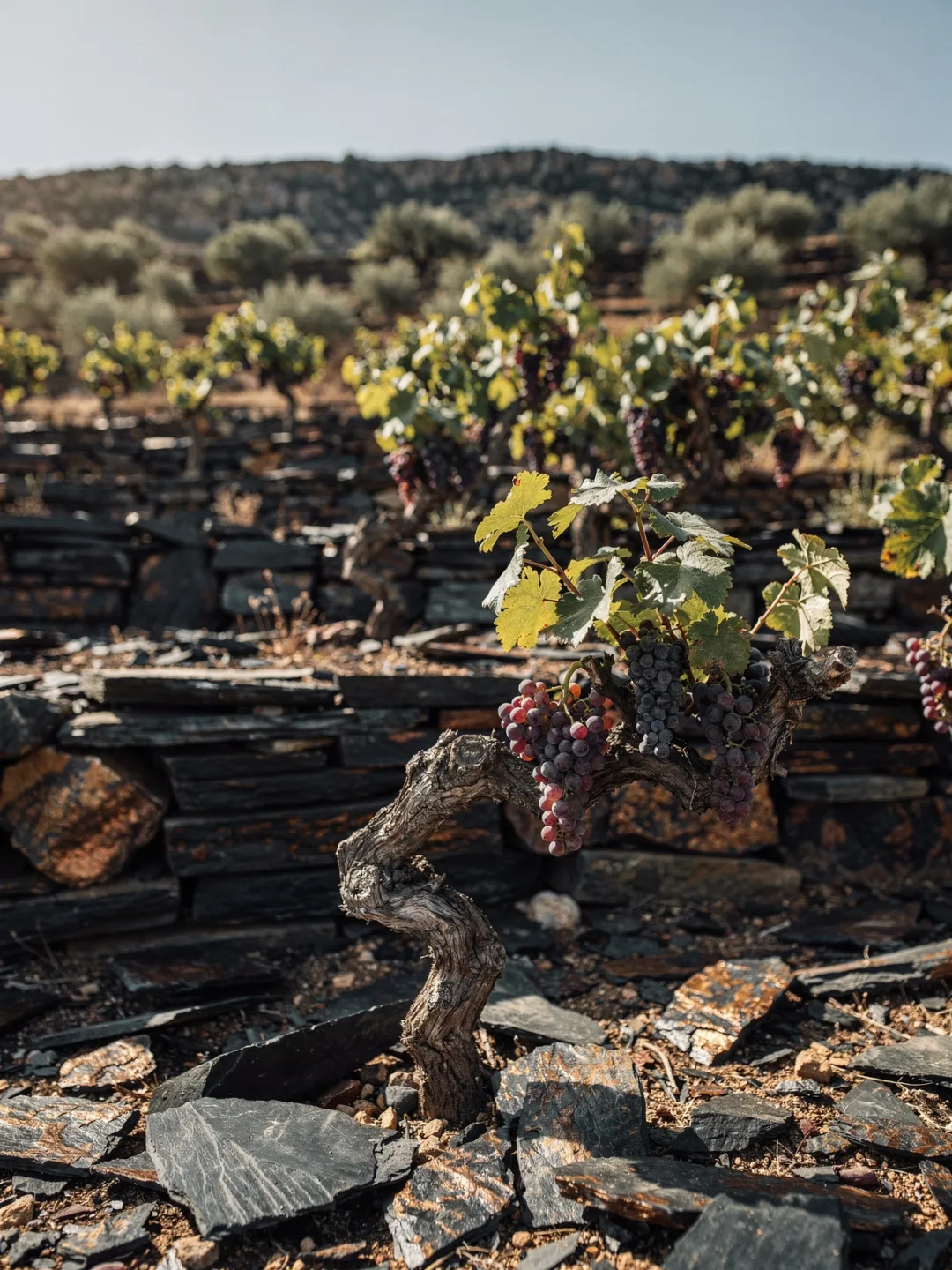
Some of these vines are ancient. After the phylloxera disaster, farmers replanted in the early decades of the twentieth century, as small free-standing bushes without wire or stake, and some of these vines still stand today, over eighty, sometimes a hundred years old. Winemakers call them vinyes velles, old vines. Because the slate soil yields so few nutrients, they produce on average just a single kilogram of grapes per vine per year.
When René Barbier and his friends replanted in Gratallops in the 1980s, they also brought in foreign grapes. Cabernet Sauvignon, Merlot, and Syrah are permitted under the rulebook, though not recommended. They lend some blends more color and smoother tannin. White wine, by contrast, remains the exception; it makes up only about seven percent of the planted area, mostly Garnacha Blanca, and grows chiefly on the cooler, higher-elevation parcels.