Slender Rather Than Bowl-Shaped
Glassware
How a glass is shaped decides where the aroma travels and how much air reaches it along the way. With Albariño, this makes a striking difference. Its aromas are volatile, its acidity pronounced.
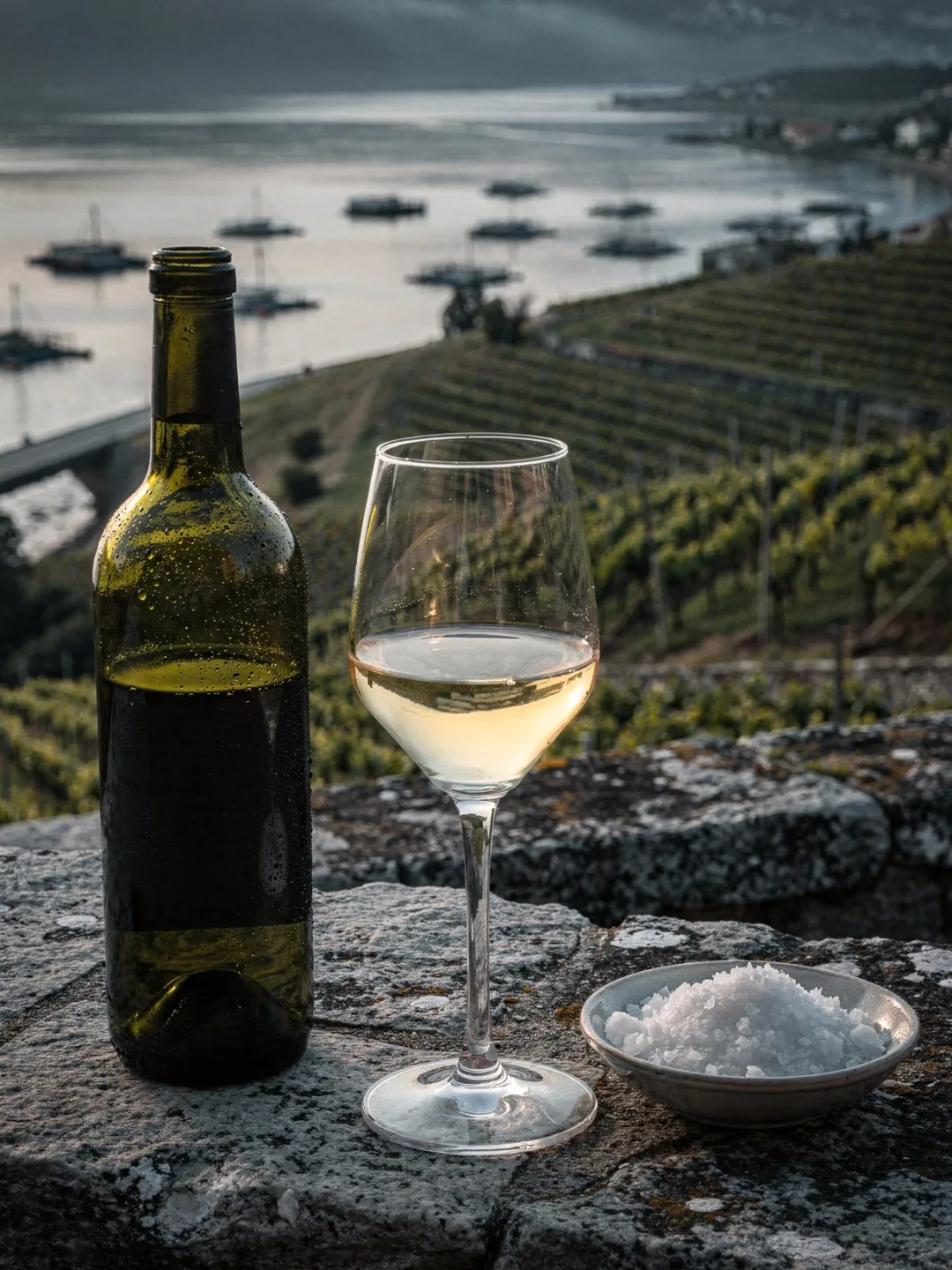
A wide, bowl-shaped glass spreads the wine broadly across the tongue. It lets the acidity jump out sharply along the sides, where it's already plenty strong. A slender tulip shape with a narrower rim works better. It steers the wine more toward the center of the tongue and carries the volatile aromas concentrated up to the nose, instead of letting them dissipate immediately in an open glass.
Temperature is where most people go wrong, usually serving it too warm rather than too cold. Forty-six to fifty-four degrees Fahrenheit suits a young Albariño without oak aging. That's colder than most red wines but warmer than industrially chilled sparkling wine. Fifteen to twenty minutes in an ice bucket gets you there. Served too cold, exactly the floral scent you opened the bottle for in the first place disappears.
A Rías Baixas Barrica or a wine aged sobre lías has already had contact with the lees after fermentation, and it can therefore handle one or two degrees warmer than a simple vintage wine, because time in barrel or on the lees has already softened some of its edge. A decanter, on the other hand, has no place with Albariño. It's simply too young and too direct for that, no matter how many months it spent on the lees beforehand.
Albariño should only fill the glass up to the widest curve of the bowl, no higher. In a standard white wine glass, that comes to roughly one hundred to one hundred twenty milliliters. What stays empty at the top collects the aroma, which only unfolds once the wine is swirled in the glass. Fill it to the brim, and that very space is missing, leaving the wine to seem duller than it should.