Fresh Rather Than Oaked
Production
With Albariño, production begins at the harvest, long before the first drop ever sees the cellar. Only hand-harvesting is permitted, grape by grape. The Emparrado, one and a half to two meters high, leaves no room for a harvesting machine to pass beneath it. Every autumn, the region mobilizes around thirty thousand harvest workers for this task. They spread across roughly twenty-two thousand parcels, most of them smaller than a quarter hectare — a patchwork of tiny holdings in which hardly any grower owns an entire hilltop.
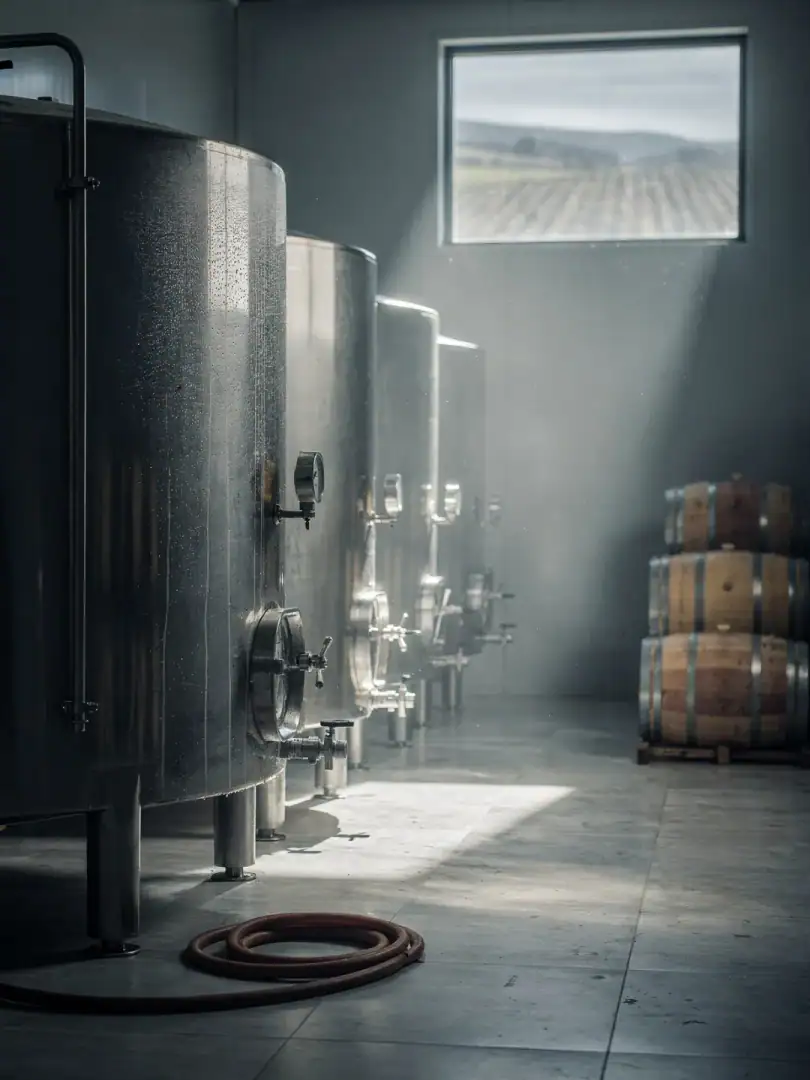
After harvest, things move fast. The grapes are usually pressed gently within a few hours, without any extended time resting on the skins. Albariño is meant to keep its pale color and delicate floral aromas, not pick up tannin or bitterness from the grape skin. Fermentation then proceeds cool in stainless steel tanks, often at barely more than sixteen degrees Celsius. This way, the volatile aroma compounds don't escape along with the carbon dioxide.
Some of the wines are then left resting longer on the lees rather than being racked off immediately — this is called sobre lías. The dead yeast cells from fermentation lend the wine more texture over the following weeks and a faintly creamy undertone, without masking its freshness. The label states this explicitly, since it's a deliberate cellar decision, not an accident.
Only a small share ages in wood, labeled as Rías Baixas Barrica, in barrels of no more than six hundred liters. How many months the wine spent there must appear on the label, and it's usually just a few — enough to add some roundness, but too little to bury the citrus note under vanilla. Most producers skip oak altogether, since Albariño prefers to bring its own tension to the table.
Hardly any other Spanish white wine region brings its wines to market so early. Most bottles leave the cellar in the spring following harvest, without years of barrel aging. This is deliberate. That very youthful freshness is the whole reason people reach for Albariño in the first place.