Limestone Marl & Duero Terraces
Soils
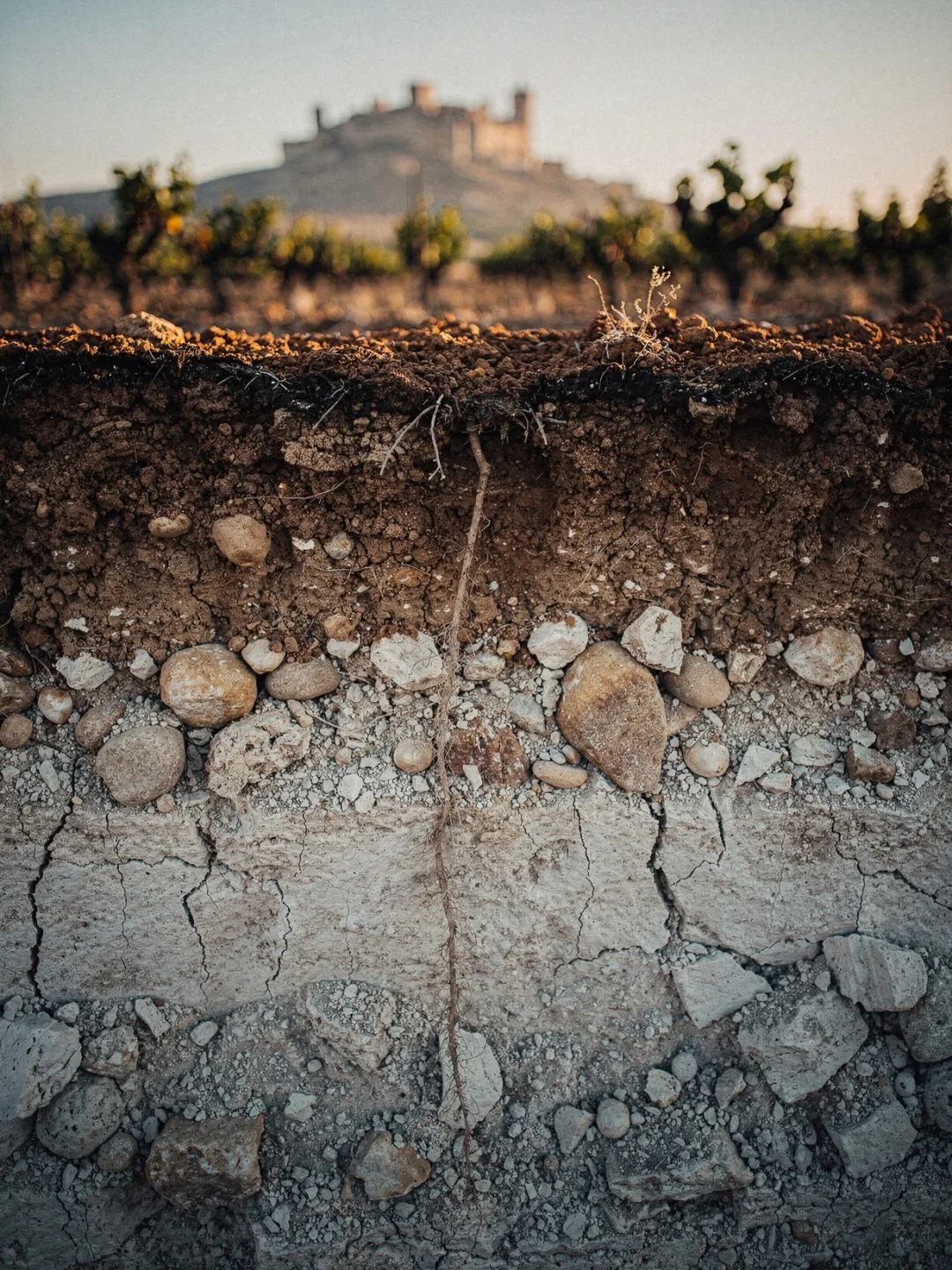
Above Peñafiel stands a castle that looks like a ship. It sits on a narrow ridge of limestone and clay, two hundred ten meters long and barely twenty wide, following exactly the shape of the hill beneath it. Erosion carved this hill out of the Castilian limestone plateau over millions of years. What served as a building site up here is, down in the vineyard, the soil itself.
Geologically, the whole region is a filled-in basin. At the end of the Mesozoic era, a large depression formed, which filled during the Tertiary with sands, clays, and limestone layers. Layer upon layer accumulated, depending on whether a dry or a wet period prevailed at the time. What remained is an alternation of sandy-clay layers and hard limestone bands, still visible on many slopes today.
Closer to the river, the soil tells a more recent story. Over the last few million years, the Duero laid down terraces of gravel and sand, sometimes higher, sometimes lower, depending on how much water was flowing at the time. These terraces are warmer and more permeable than the limestone soil of the hills, which lets the vine there bud earlier and ripen faster.
None of these soils is fertile in the agricultural sense. The pH runs alkaline, organic matter is scarce, and water passes through the sandy topsoil almost unchecked, forcing the roots downward, toward the limestone layers that still hold some moisture even in August. The result is small, concentrated berries, and with them the deep color and firm tannin that Tinto Fino from here is known for.
How workable this ground once was can be seen in Roa. Beneath the old town lie roughly a hundred fifty-five old pressing houses and two hundred thirty-eight cellars, all dug by hand into the same limestone and sand that guides the roots up in the vineyards. The same stone that ripens the wine, in other words, has also shaped the place where it's stored.
A thin, ochre-colored layer of sandy clay, barely a spade's depth and poor in organic matter.
The root: This is where the fine roots sit. After a few dry summer weeks, they find almost nothing left.