Cascajo & Raña
Soils
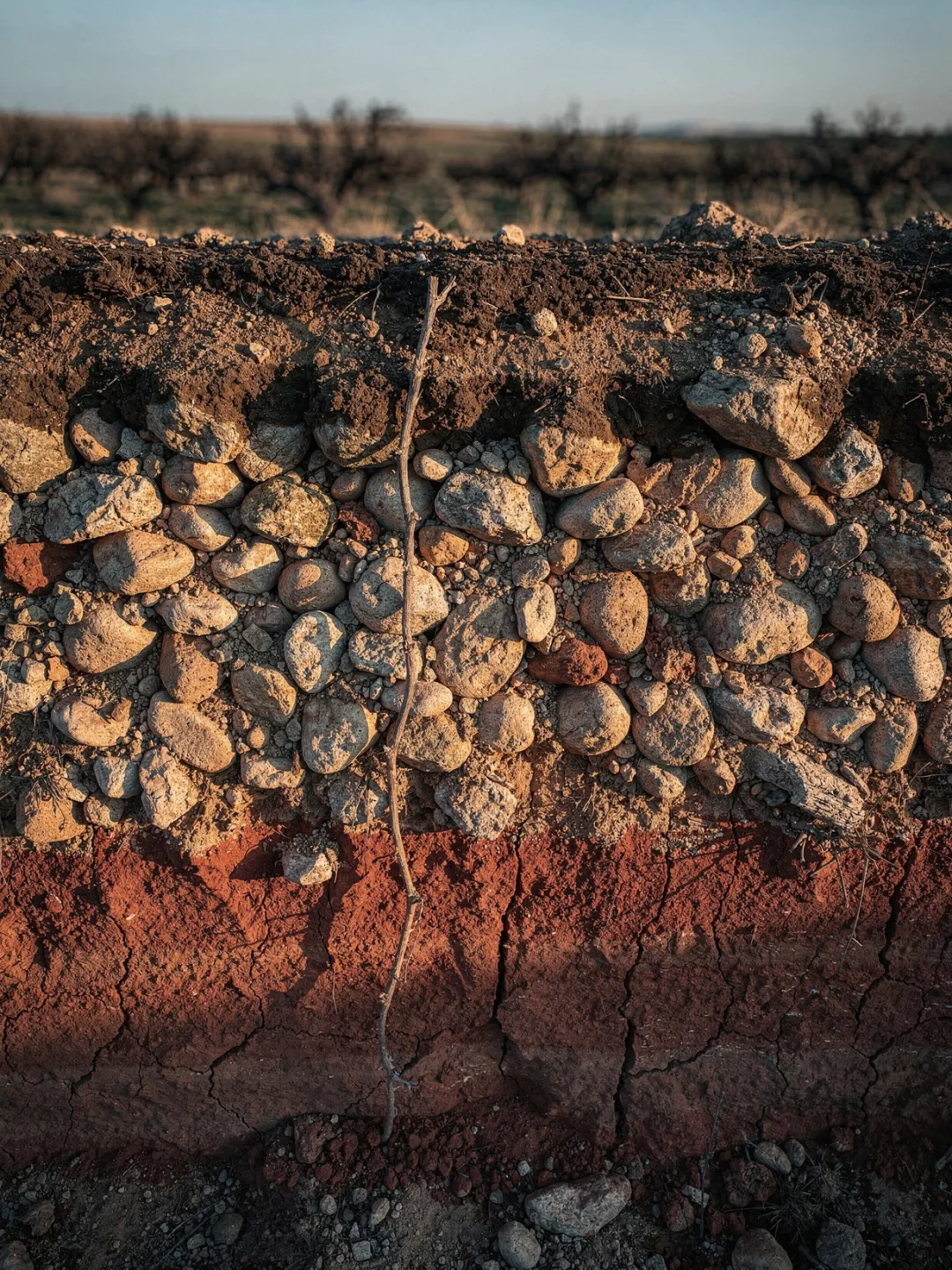
Dig a hole in a vineyard near La Seca. After just two hands' width you'll hit round, fist-sized pebbles. Cascajo, they're called here. This gravel is no whim of nature but the remnant of ancient river terraces: millions of years ago, a precursor of the Duero carried quartzite rock down from the mountains and rounded it completely smooth along the long journey.
These stones do more than simply lie in the way. They store heat during the day and radiate it back onto the low-hanging grapes in the afternoon. At the same time, they slow how quickly the soil loses moisture to the dry air. The result is small, thick-skinned berries. A small berry contains proportionally more skin than juice, and that's where most of the aromatic compounds sit, along with some of the bitter compounds typical of Verdejo.
Beneath the cascajo, things vary. In the northwest of the zone, around Medina del Campo, a layer of these pebbles up to thirty meters thick lies over reddish, calcareous loam. The pH of this soil is seven to eight, unusually high for a vineyard. In the south and southeast, by contrast, sand, clay, marl and limestone alternate in thicker, more even layers. From the same grapes, heavier, less zesty wines emerge there.
A third, rarer variant has even preserved old vine stocks for the region. In a few spots in the east, nearly pure sand lies up to eight meters deep over the bedrock. Phylloxera, which travels through soil passages, makes little headway in pure sand. As a result, some vineyards here carry Verdejo vines over one hundred fifty years old on their own, never-grafted roots, so-called pie franco, while almost everywhere else in Europe American rootstock had to be adopted after 1880.
One misconception nonetheless persists stubbornly: that the soil ends up tasting in the glass because the root absorbs minerals directly and passes them on. That's simply not true. What actually reaches the wine from the cascajo comes by way of heat, water, and a root that has to work its way laboriously through stone rather than soft earth. It is precisely that detour that makes the difference in the end.
A thin brown layer of sand with some clay, poor in humus. Barely a hand's width deep before the gravel begins.
The root: The vine finds almost nothing here. After the first rain, this layer is dry again within days.