Cascajo & Limestone Pudding
Soils
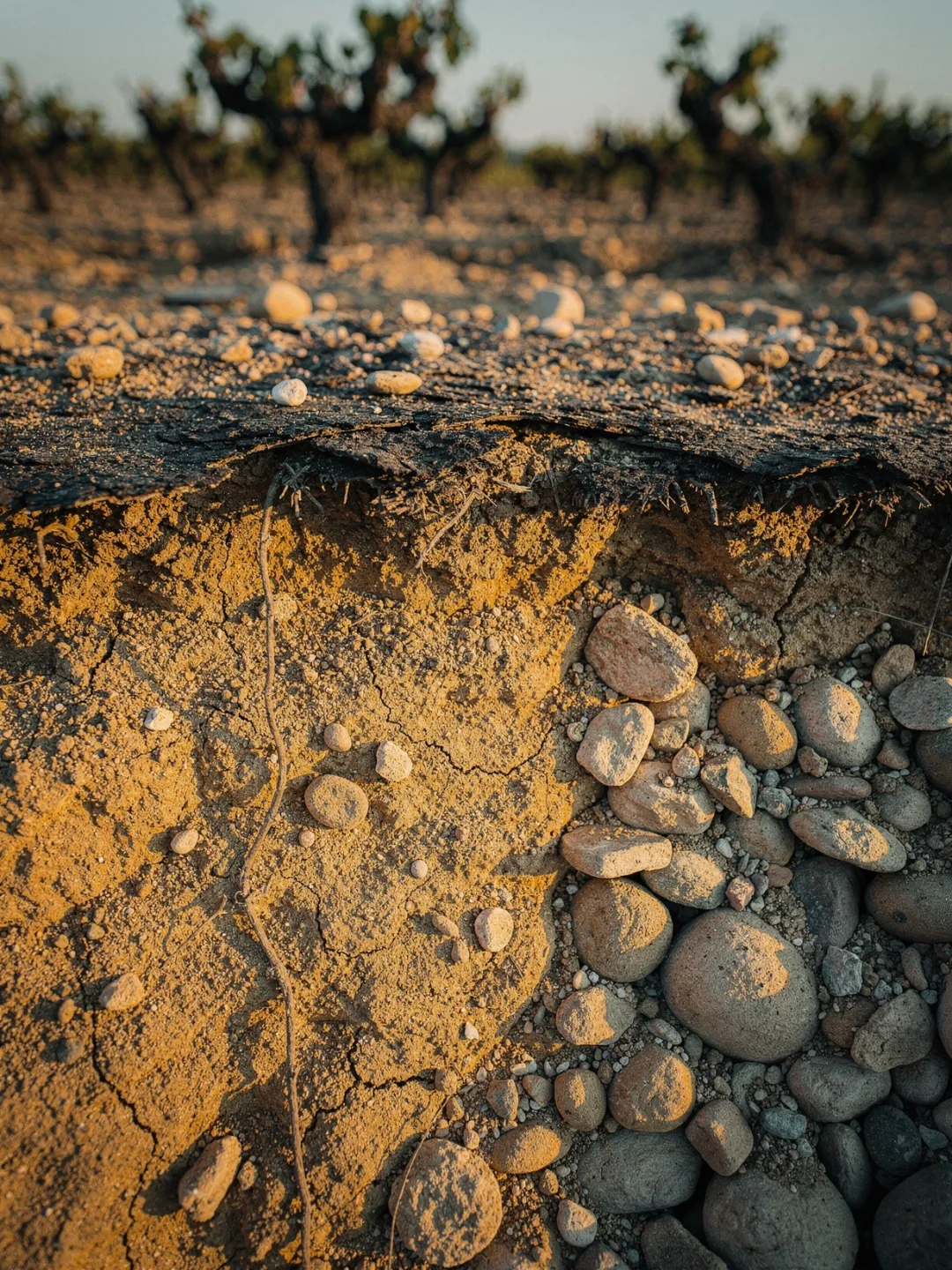
Dig a hole in a vineyard near Toro, and after just a few spade strokes you'll hit loose, gravelly rubble. Winzers here call it cascajo, coarse sand thick with stones, with barely any dark humus on top. Anyone expecting rich black earth beneath old vines will be disappointed in Toro. That's exactly the point.
This soil formed in the Tertiary period, as sandstone, clay, and lime-rich layers of gravel accumulated over millions of years in a shallow basin. Sometimes the material came from still water, sometimes from shifting river channels. The uppermost layers are brown limestone soils over loose material, poor in organic matter, with less than one percent humus content. The pH usually sits between six and seven, rising to nearly eight only in the southwest of the zone. Nutrients are scarce; only iron is abundant.
This very iron shapes the wine more than you might expect. Winemakers in Toro credit it for the deep, almost opaque color of their reds, intensified by the traditional Vaso training method, in which the vine stands free rather than on wire. Then there's the poor soil itself: where water and nutrients are scarce, the berries stay small, and small berries carry proportionally more skin than juice.
Near San Román de Hornija, the soil tells an entirely different story, written not by rock but by the river itself. There, old vineyards sit on terraces of canto rodado, rounded river stones deposited by the Duero over thousands of years. The old parcels stand on exactly this gravel. From them, Vega Sicilia later crafted its own wine with Pintia. The river itself built this soil. Its vines still root in it today.
The loose sand had another effect in the nineteenth century. It stopped phylloxera, which spreads easily through denser, clay-rich soils but cannot dig stable tunnels through loose sand. That's why Toro still has ungrafted, never-regrafted vines to this day, some over ninety years old, a legacy that has long vanished from much of Europe.
Coarse, gravelly sand with scattered limestone, barely any dark humus on top.
The root: The fine roots sit here. After a few dry weeks, they find almost nothing left.