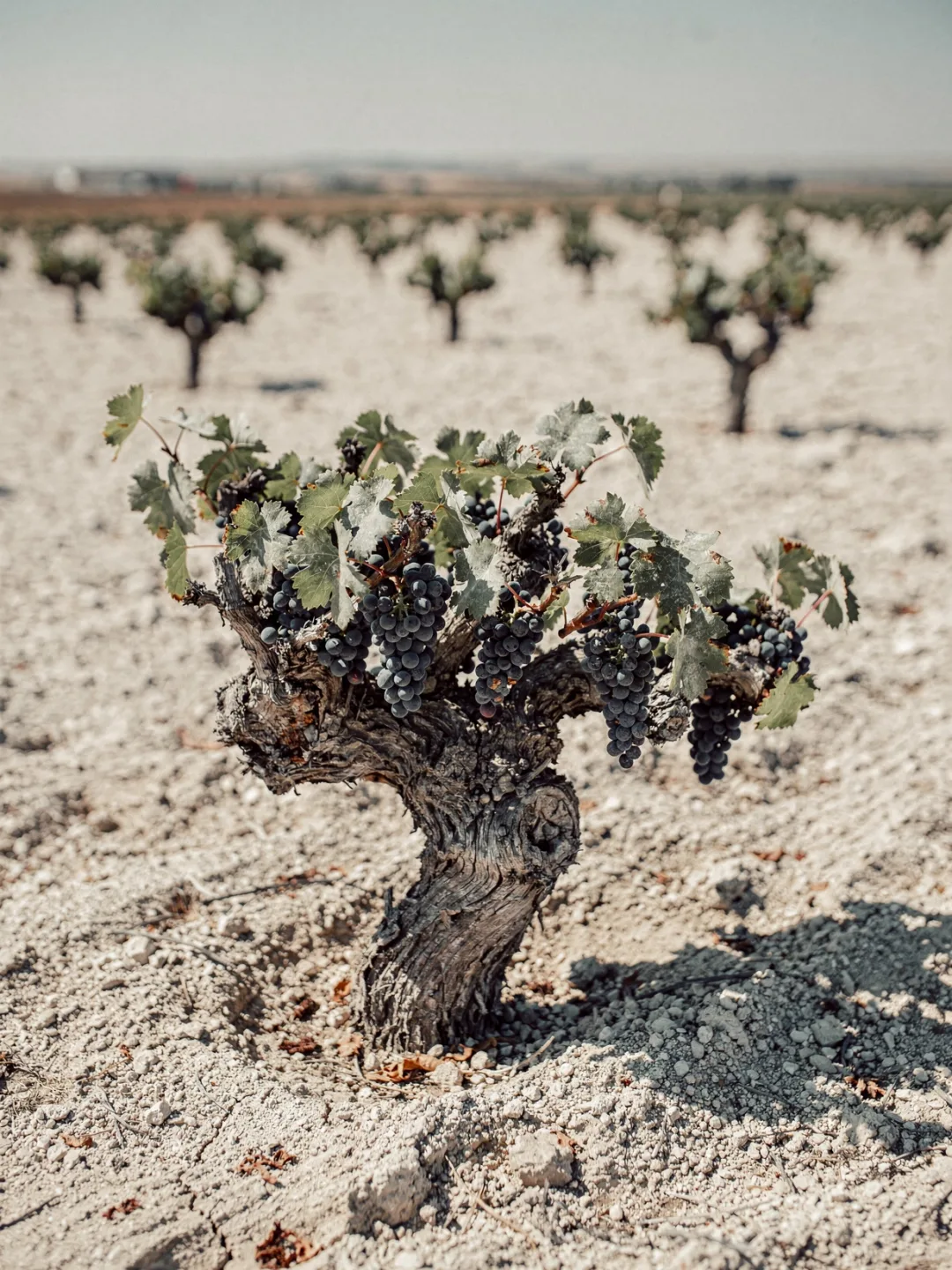
Tinta de Toro
Grape Varieties
A single grape defines the red wines of Toro: Tinta de Toro. Genetically, it is nearly identical to the Tempranillo grown in Rioja and Ribera del Duero. Yet here it carries its own name, because for generations winemakers have understood it as a distinct, place-adapted variant.
Even so, it differs noticeably from its sister in Rioja. According to the Consejo Regulador, the governing body of the denomination, Tinta de Toro yields less than Tempranillo elsewhere. In return, it brings more tannin, the furry compound from the grape skin that shows up as a dry sensation on the gums. Its juice is rich in potassium, and abundant potassium binds acidity. That's why a Toro wine tastes noticeably less acidic than a Rioja made from the same grape. When the berry ripens fully, even its flesh can take on a slight tinge of color, though in most red varieties only the skin carries pigment.
Alongside it, the regulations allow only one other red variety: Garnacha Tinta. A red wine from Toro needs at least seventy-five percent Tinta de Toro, with the rest permitted to be Garnacha, which is softer and less pigmented. Since a 2021 amendment to the Pliego de Condiciones, Garnacha Tinta may also carry a wine on its own: a varietal Garnacha then needs at least eighty-five percent, applicable across all aging categories from young wines to Gran Reserva.
Among white varieties, only two names were long permitted: Malvasía Castellana, also called Doña Blanca locally, and Verdejo. Since 2021, the regulations have also allowed Albillo Real and Moscatel de Grano Menudo, two varieties with a long tradition in the area. Neither had ever officially belonged to the denomination before. White wine nonetheless remains the exception in Toro. The region lives on its reds.
Which grape grows where follows an old rule passed down through generations of winemakers. Tinta de Toro thrives best on coarse, stony ground known locally as cascajo, with clay-rich subsoil beneath. Malvasía and Garnacha prefer the sandier sites. Verdejo manages almost everywhere. More than three-quarters of all vineyards are still grown as Vaso, free-standing bush vines without wire trellising. Over half of these are also older than forty years, an age you can taste in the glass.