Dry Meets Sweet
Glassware
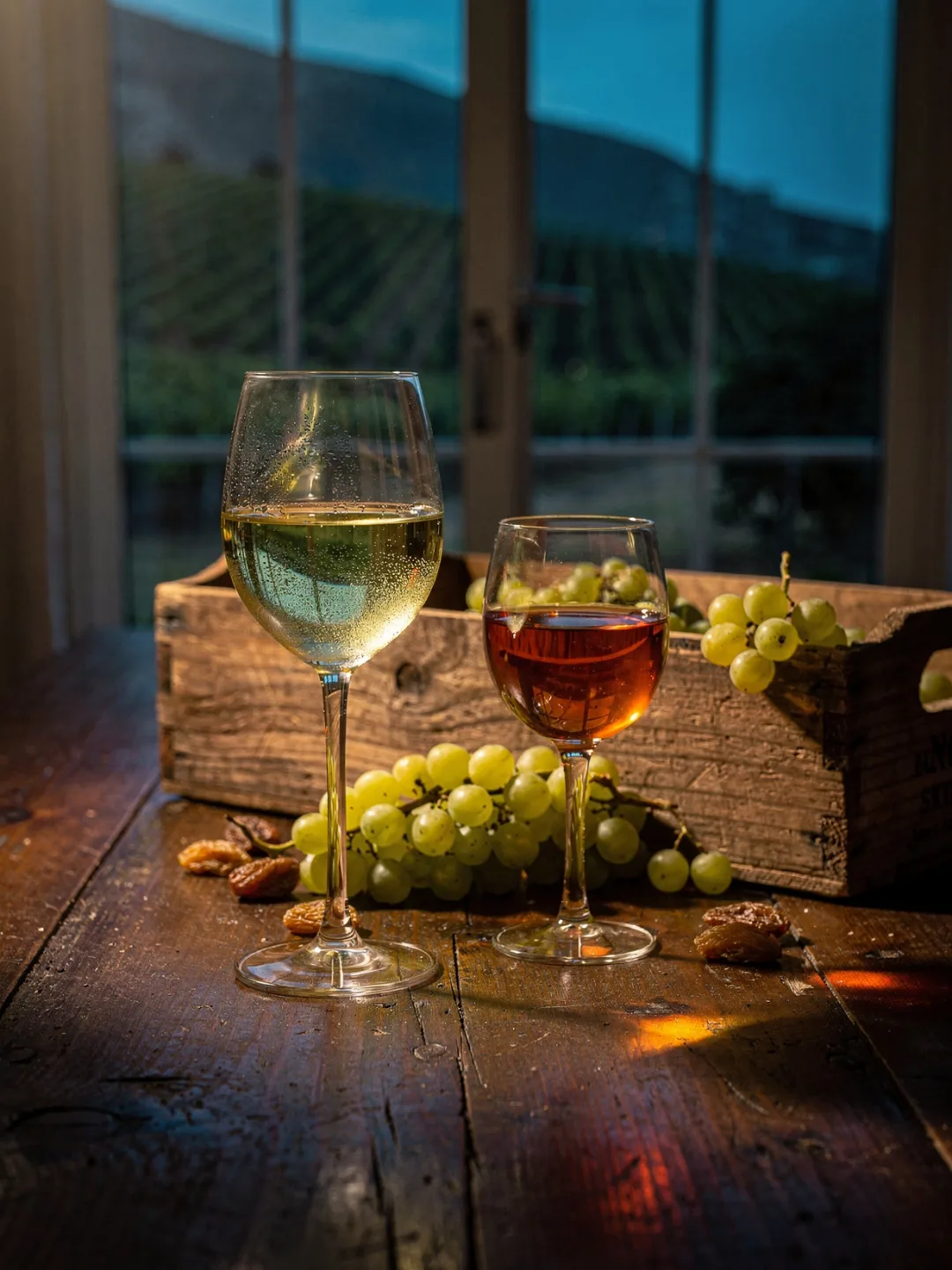
Two wines from the same valley call for two rather different glasses, and anyone drinking both from the same glass shortchanges at least one of them. A Sauvignon Blanc from Constantia thrives on freshness and green, herbaceous aromas. A Vin de Constance, by contrast, thrives on concentrated sweetness that unfolds only gradually.
For the Sauvignon Blanc, a slim, medium-height glass with a noticeably narrowing rim works best. A glass that's too wide lets the fruit dissipate quickly, exposing the alcohol instead. The narrow opening, by contrast, concentrates exactly the green notes reminiscent of blackcurrant leaves that set Constantia Sauvignon apart from warmer Cape regions. Serve it chilled, between eight and ten degrees Celsius.
Vin de Constance, on the other hand, belongs in a small glass. Not because it's worth less, but because a thimbleful is already enough to release its aromas. A Sauternes glass with a narrow bowl works well, small enough not to overwhelm the sweetness, yet with enough surface area for apricot, orange blossom, and honey to gather above it.
With temperature, people often make the same mistake with sweet wine as with Champagne: served too cold, it loses its complexity and tastes merely sweet and flat. Ten to twelve degrees Celsius is enough. Any colder, and the fine acidity that keeps the sugar in check fails to come through.
Klein Constantia therefore bottles its Vin de Constance in five-hundred-milliliter bottles, which stretch to far more glasses than one might expect. Just fifty milliliters is enough for a serious tasting. Anyone who pours it like a regular white wine, filling the glass halfway, usually ends up with more left in the glass than they can drink. By then, dessert has often already been cleared away.