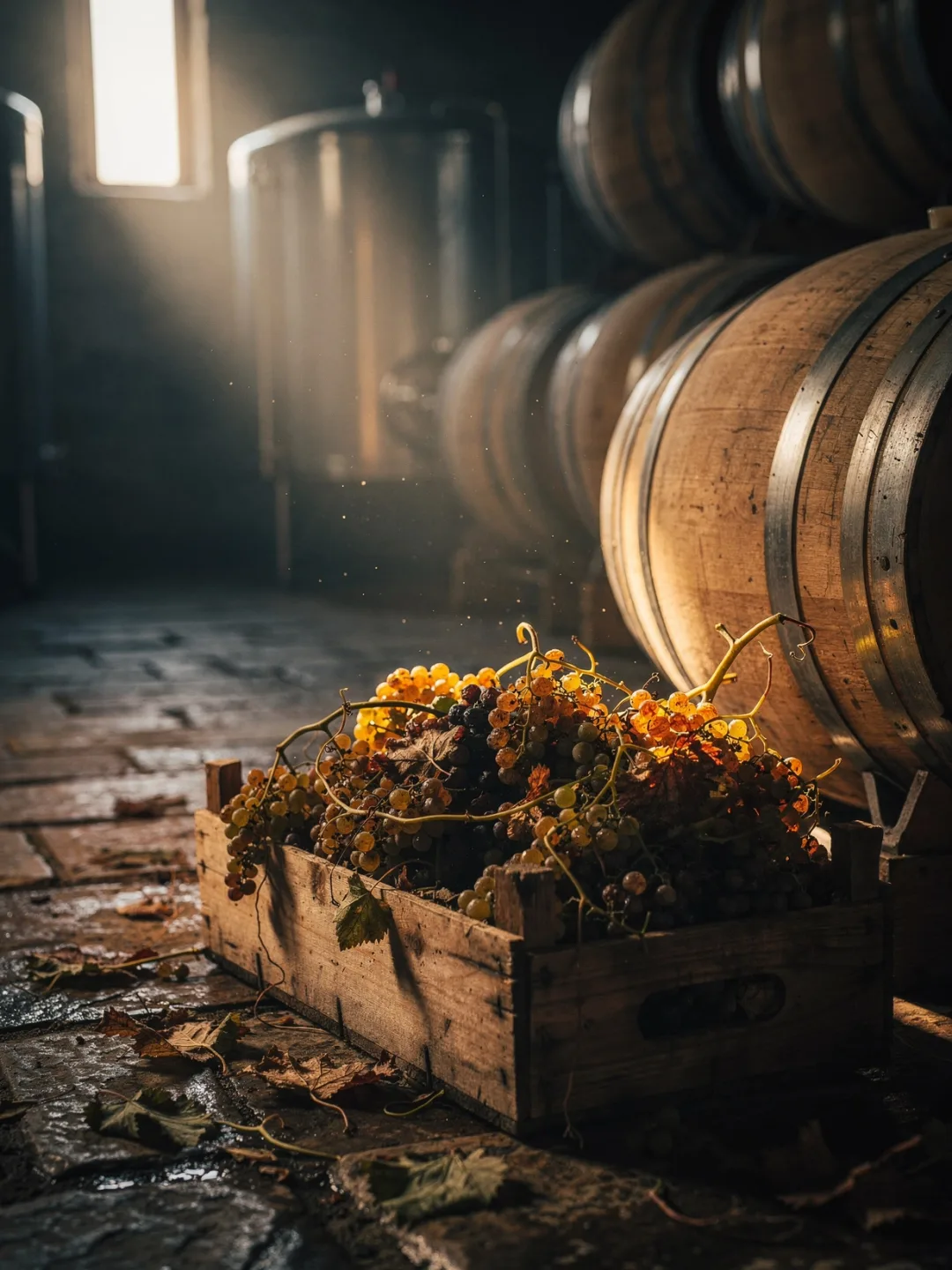
Raisins on the Vine
Winemaking
Most white wines from Constantia are made with a restrained hand in the cellar. Whole bunches go gently into the press, so the skins release as few bitter compounds as possible. The juice ferments cool in stainless steel tanks, often at just fourteen to sixteen degrees Celsius. This preserves the green, herbaceous aromas of Sauvignon Blanc, which a warmer fermentation would destroy.
A few estates take a second path. Steenberg, for instance, ferments part of its Sauvignon Blanc, along with the accompanying Semillon, in used oak barrels, giving the wine more weight and a silky texture without masking the fruit with vanilla. Two completely different white wines from the same grape, then, depending on how they're handled in the cellar.
Vin de Constance, meanwhile, follows an entirely different rhythm. The harvest stretches over several passes: first come the normally ripe, still acid-driven grapes, then, week by week, the berries that have shriveled on the vine into highly concentrated fruit. The thick skin of Muscat de Frontignan protects it from the noble rot known from Sauternes. Here, instead, the berry simply dries out in the sun, like a raisin still hanging on the branch.
Contrary to what some historical accounts suggest, today's Vin de Constance is not fortified with alcohol. All its sweetness and alcohol content come purely from what the yeasts extract from the highly concentrated grape sugar. It then matures for a good three years, half in new French oak, half in larger, more neutral acacia wood barrels. In the end, it's bottled in small, dark bottles deliberately reminiscent of the eighteenth century.
For the red Bordeaux blends from Constantia Glen or Groot Constantia, the process runs more classically: hand harvesting, careful berry-by-berry selection, and eighteen months to two years of aging in new French oak. Three completely different timelines. For three wines that all come from the same narrow valley.