Two Oceans Cooling
Climate
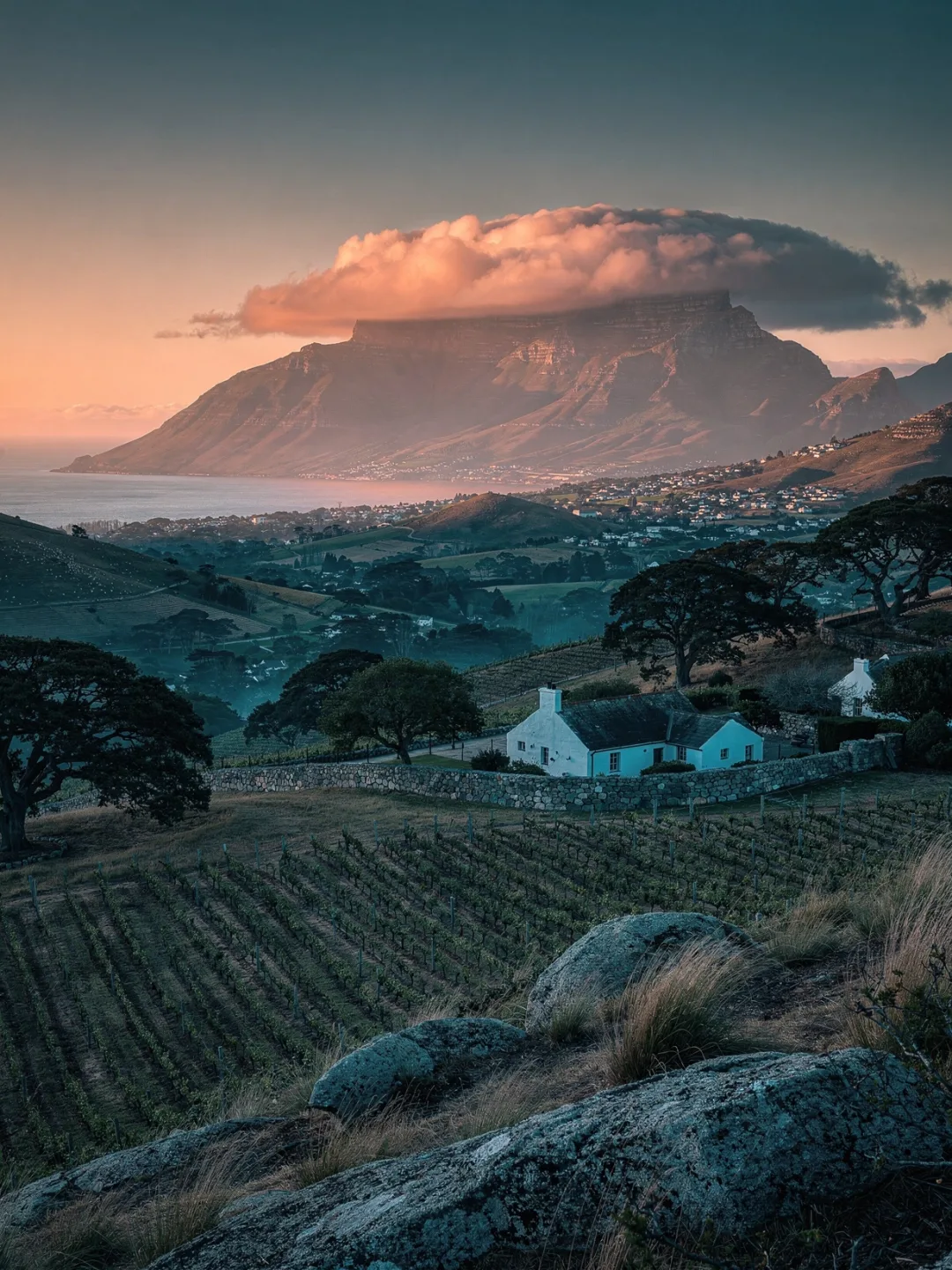
Of the mountains encircling Cape Town, the Constantiaberg is the southernmost spur of the Table Mountain massif, sitting almost like a peninsula between two oceans. Eight to twelve kilometers to the south begins False Bay, while roughly the same distance to the west lies the cold Atlantic with its Benguela Current. No other wine ward at the Cape is so tightly enclosed by water. This shapes every vintage.
This location makes Constantia South Africa's coolest wine region. In the height of summer, average daily highs typically range only between sixteen and twenty-two degrees Celsius. That's notably cooler than one might expect at this latitude, and distinctly cooler than nearby Stellenbosch or Paarl. Anyone driving through the vineyards in January often still needs a jacket.
The main reason is a wind with its own name: the Cape Doctor, a powerful southeaster that sweeps through the bay from September to March. It earned its nickname because it's said to blow smog and stagnant summer air out of the city. For the vines, it matters even more than for the lungs of Cape Town's residents. On Constantia's south-facing slopes, it lowers afternoon temperatures by four to five degrees, right when the sun is beating down hardest on the grapes. The effect is immediate.
Constantia is also an exception when it comes to rainfall. Up to a thousand millimeters fall here each year, more than in any other wine region in the country, with most of it arriving between May and August, during the South African winter. Summers stay dry, but the soils have stored enough moisture to see the vines through without irrigation, a luxury many other Cape regions, with their three hundred millimeters of annual rainfall, simply can't afford. There's no other way to manage it here.
Looking toward Table Mountain from Cape Town, one often sees the same wind piling up into a blanket of cloud that locals call the tablecloth. It hangs over the summit while the valley below stays dry. For winegrowers in Constantia, this sight is almost a weather report in itself. When the cloth lies in place, the afternoon reliably cools down, and the grapes hold onto their acidity well into March.