Form Follows Alcohol
Glassware
There's no single glass for everything in Paarl. Yet an old prejudice persists stubbornly: anyone looking for a South African glass, supposedly, just needs one big one. Paarl disproves this with every vintage. Wines here range from lean young Chenin to rich, oak-aged red and sweet Hanepoot, and each demands a different shape.
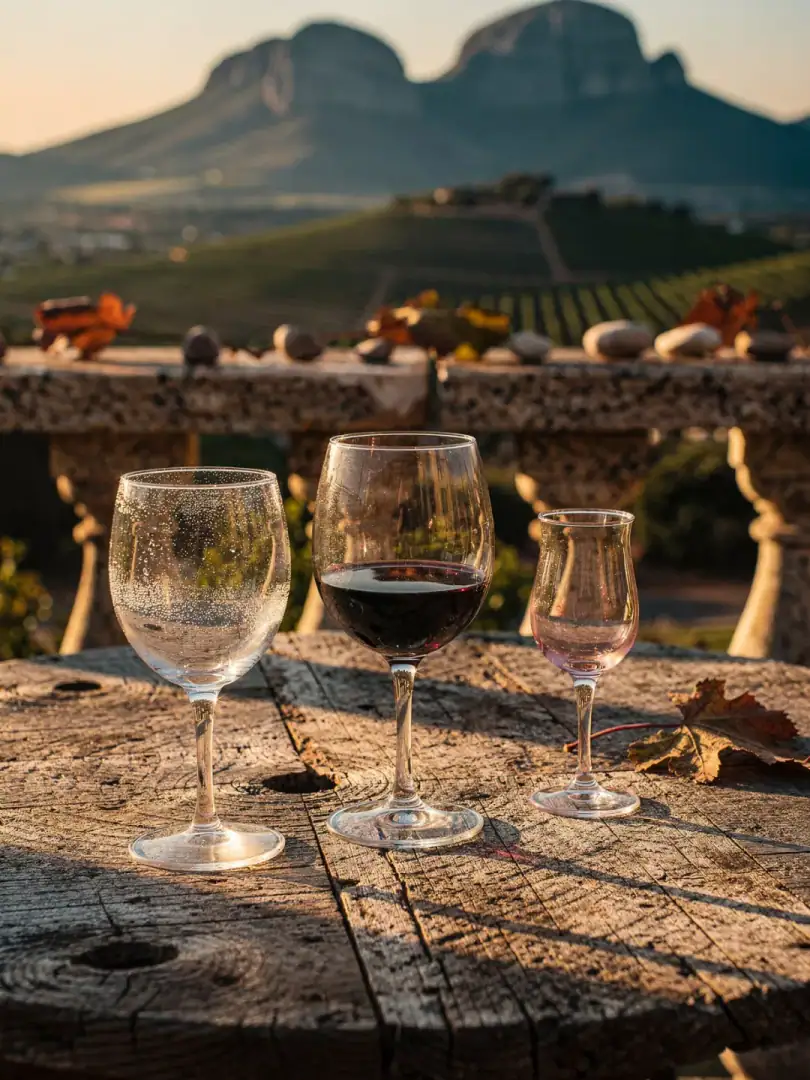
An old, barrel-aged Chenin Blanc needs room. A glass with a wide bowl and a slightly narrowed opening, similar to a white Burgundy glass, lets the aromas of quince and beeswax unfold without the alcohol rushing forward. A glass that's too narrow, by contrast, squeezes the aroma together and lets only the acidity jump out first.
Pinotage and the robust Cabernet-Shiraz blends of Simonsberg-Paarl need the opposite: a large, open bowl that lets plenty of air reach the wine. These wines often run fourteen percent alcohol or more, and without enough surface area the alcohol reads as sharp rather than warm. Serving temperature is often overdone too. Eighteen degrees Celsius is plenty; any warmer just makes the alcohol louder, not the fruit.
Sweet Hanepoot demands the smallest glass at the table. A narrow glass of no more than sixty milliliters concentrates aroma and sweetness, served well chilled at around ten degrees Celsius, or the wine comes across as cloying rather than fresh. Pour it into a regular wine glass and all you taste is sugar. Pour it into the right small glass and you taste raisin, orange peel, and a hint of caramel behind it.
Finally, there's the pour size, often gotten wrong. A glass should only be filled to its widest point, which for a standard red wine glass is around one hundred fifty milliliters, leaving the rest as room for the aroma to develop. For a powerful wine from Simonsberg-Paarl, this matters doubly, since its aromas only open up after a few minutes in the glass.