Granite & Koffieklip
Soils
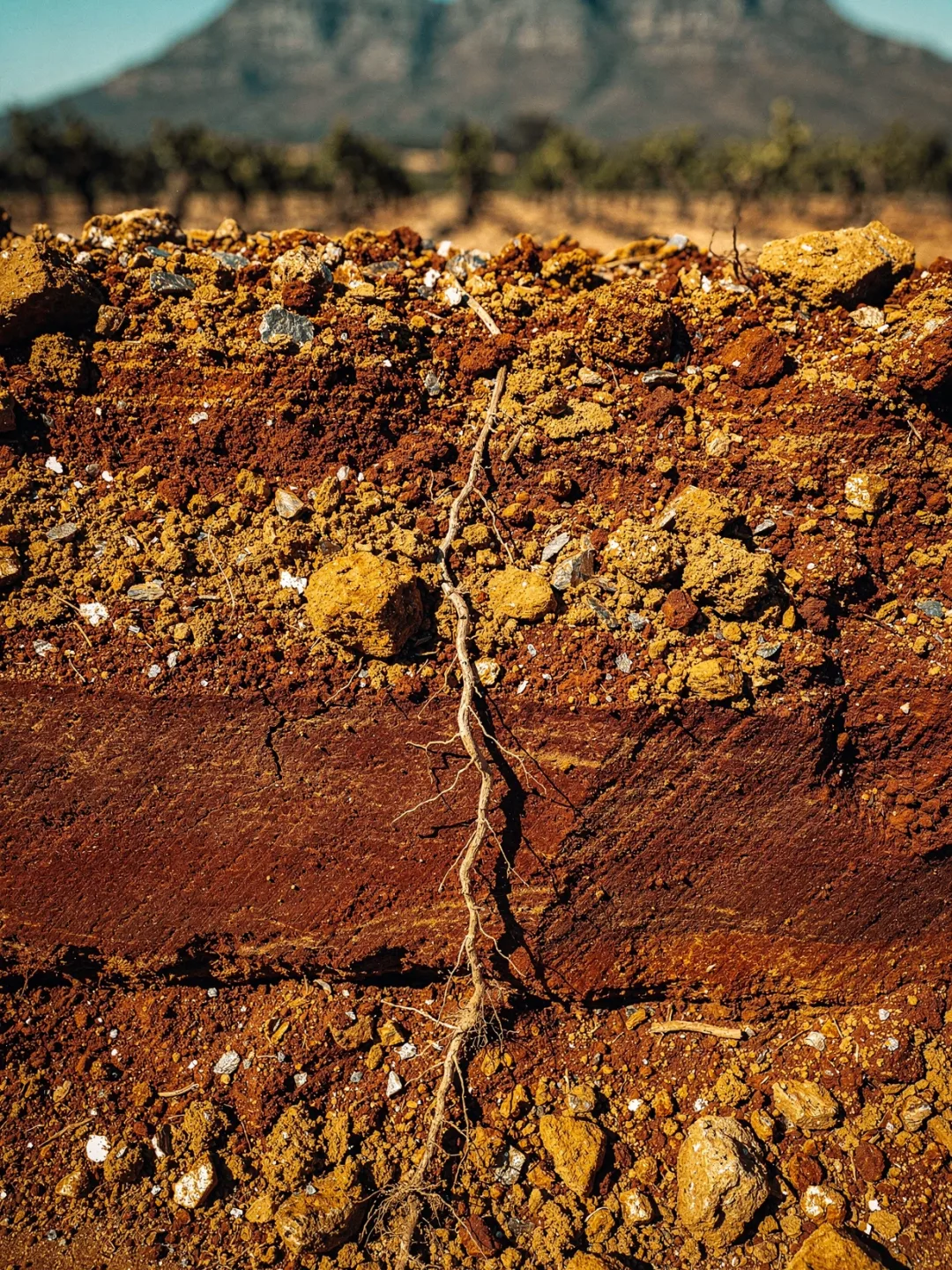
Dig a hole in a vineyard at the foot of the Simonsberg. After a hand's width, the soil turns reddish, crumbly, almost sandy between your fingers. This is weathered granite, so old here that the rock has long since broken down into its components: feldspar, mica, quartz grains, each individually visible.
The parent rock belongs to what's known as the Cape Granite Suite. It solidified deep underground more than five hundred million years ago, long before any mountain or sea existed at this spot. Over millions of years, weathering stripped away the overlying rock. What remained is the crust that today shapes the slopes of Simonsberg, Helderberg, and Jonkershoek. The soil holds water well but yields few nutrients, colored red to yellow by the iron in the rock.
In some vineyards, the spade hits something harder deeper down: a brownish-red, almost compacted layer. Here it's called Koffieklip, because it resembles ground coffee. It forms when iron-rich groundwater rises and falls over millennia, precipitating iron oxide that cements the soil like concrete. This layer is nearly impenetrable to roots. Where it lies, the vine grows sideways instead of down, which changes how much water it can still find in midsummer.
Things look quite different further north in Bottelary, the warmest and driest of Stellenbosch's eight wards. There, instead of granite, you find weathered clay rock of the Malmesbury Group: darker, denser, and considerably better at retaining water. Across more than fifty recorded soil types, Stellenbosch produces wildly different wines within a tight area, even though the same sun shines over all of them.
Roots in lean granite soil go deep, often three meters or more, since water reliably sits only at depth. The result is small, thick-skinned berries. Most of the color and tannin sits in thick skins. That's why wines from the steep granite slopes almost always taste more concentrated than those from the flat valley soils — not because the rock imparts flavor, but because it makes life harder for the vine.
A thin, dark layer of leaf litter and decomposed plant matter, barely a hand's width deep in many vineyards.
The root: This is where the fine roots sit, catching the first rains — and the first to dry out when the Cape Doctor blows for days on end.