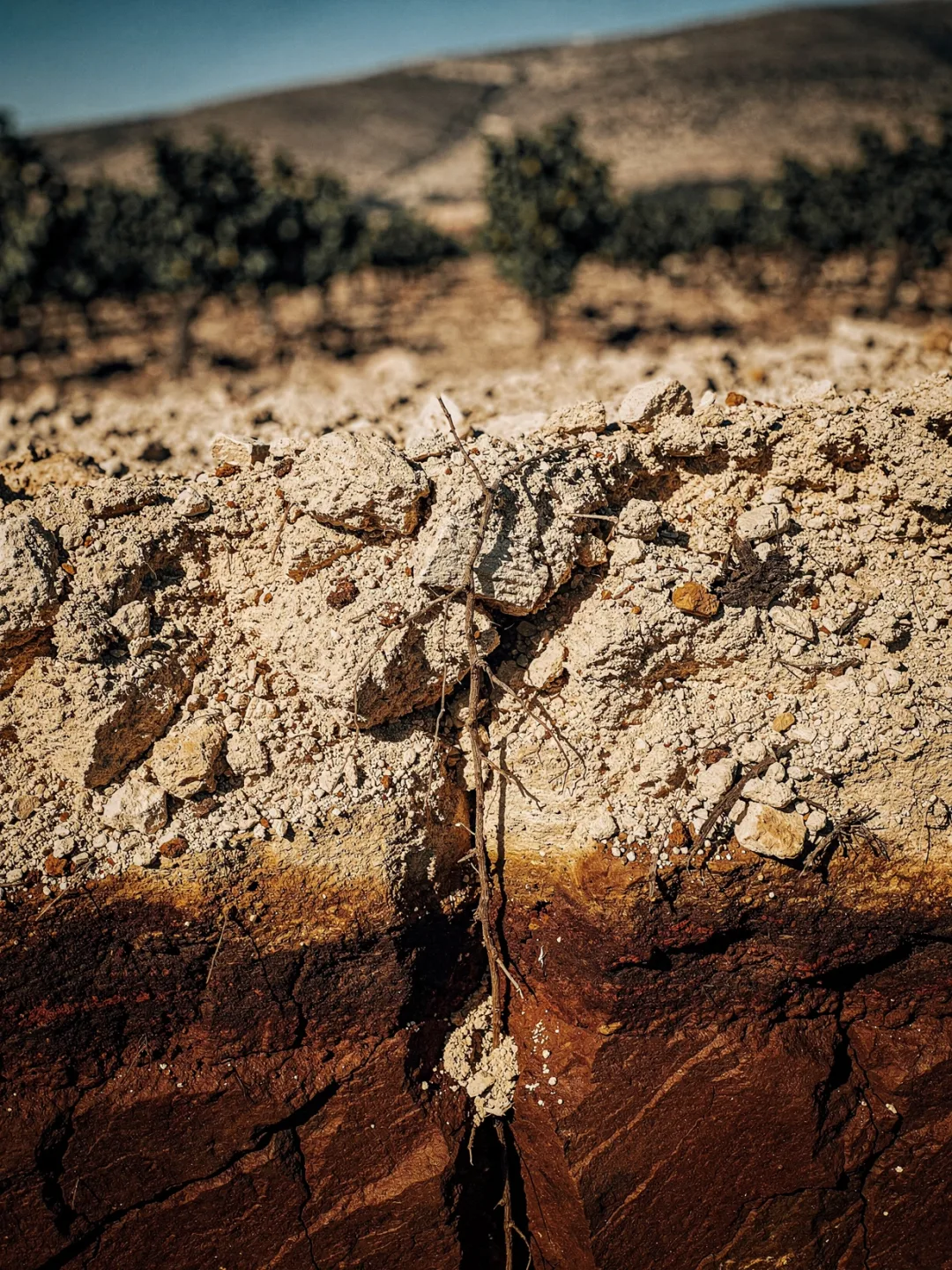
Granite, schist, koffieklip
Soils
Dig a hole into a vineyard on the Paardeberg and you land in sand, not stone. The mountain is a cooled granite pluton, over five hundred million years old. Its summit has weathered over millions of years into a deep, sandy-loamy soil. Unlike thin schist, this soil lets roots grow unhindered straight down for meters. They don't have to squeeze between hard plates.
Around Riebeek-Kasteel, Kasteelberg, and Malmesbury, a different rock lies beneath the vines: the Malmesbury Group, folded schist and phyllite. This rock dates from a time when a sea floor lay here, long before the granite of the Paardeberg. This schist breaks into narrow, hard plates, holds less water than the granite sand, and forces the root to fight its way through.
A third layer gives the Swartland what may be its most famous soil: koffieklip, literally coffee stone. This is hardened, iron-rich rock. It formed where rainwater, over thousands of years, washed iron out of the weathered granite and cemented it deeper in the profile into a hard, reddish-brown band. Roots that reach this layer still find moisture below, even when the sand above is bone dry in February.
No one demonstrates how strongly these three soils actually taste more consistently than Chris and Andrea Mullineux of Riebeek-Kasteel. They vinify the same Chenin Blanc and the same Syrah separately on granite, schist, and koffieklip, using identical yeast and identical barrel regime, so that any difference in the glass comes from the soil alone and nothing else. The granite Chenin turns out taut and saline, the schist Chenin broader and spicier.
One misconception persists stubbornly here too: that the vine draws minerals from the rock and passes them on as flavor. That's not true. What granite, schist, and koffieklip really change is water balance and warmth. This detour through water and heat is enough on its own to turn the same grape into three different wines on a single hill.
A thin, dark layer of grass and shrub remains from the Renosterveld vegetation. Rarely more than a hand's width deep on the Paardeberg.
The root: This is where the bush vine's fine roots sit. They take up whatever the winter rain brings — and are the first to dry out in summer.