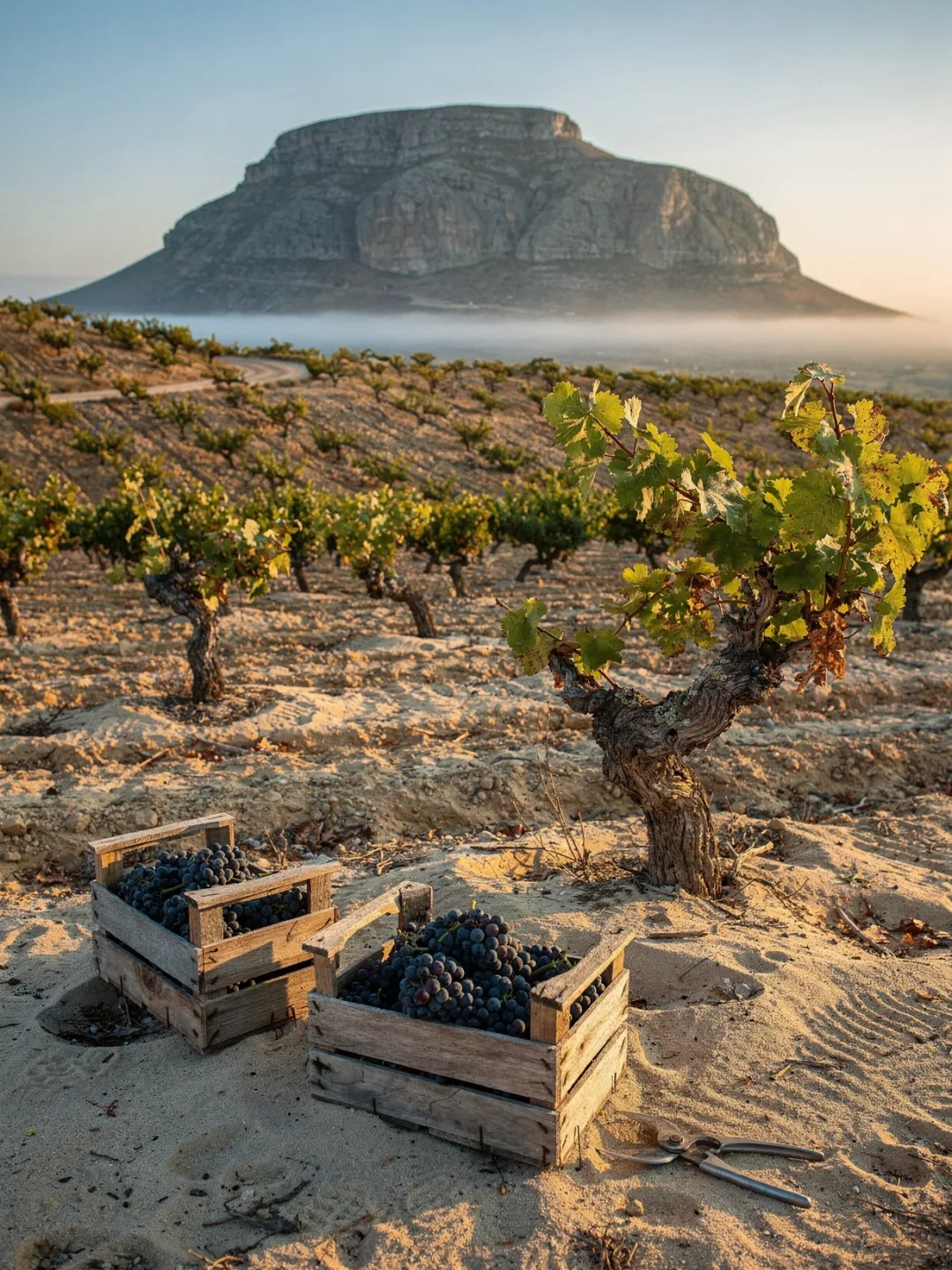
Bush vine, hand harvest, wild yeast
Winemaking
A bush vine cannot be harvested by machine. Its grapes hang low and unevenly over a compact, knee-high shrub without wire. That's why, almost everywhere in the Swartland, a hand still picks every bunch, usually in the cool early morning hours before the heat of the day sets in.
In the cellar, many estates follow the charter of the Swartland Independent Producers. It requires spontaneous fermentation using yeasts from the grape itself, no added sugar, no acid correction, no water, no reverse osmosis, and at most twenty-five percent new oak. Sulfur remains permitted, but the charter calls for moderate use, not abstinence.
Aging Sadie's Columella takes twenty-four months. It happens in large, mostly used barrels. Every six months, the wine is racked from one barrel to the next. Eight different vineyards supply the grapes for this single wine, each with its own ratio of Syrah, Mourvèdre, Grenache, and Carignan.
The Mullineuxs of Riebeek-Kasteel take the opposite approach for their single-terroir range. They deliberately keep yeast, barrel size, and aging time identical for Chenin Blanc and Syrah on granite, schist, and koffieklip. They aren't vinifying three different recipes, but one single recipe three times, purely so that what emerges shows what truly comes from the soil and what comes from the winemaker.
Palladius, the white counterpart to Columella, demands even more patience. Eleven varieties from seventeen vineyards are vinified separately and only blended into a single wine after months in barrel. No addition corrects what went wrong in the vineyard — with so little intervention, every flaw shows up immediately in the glass.