Shale & Clay
Soils
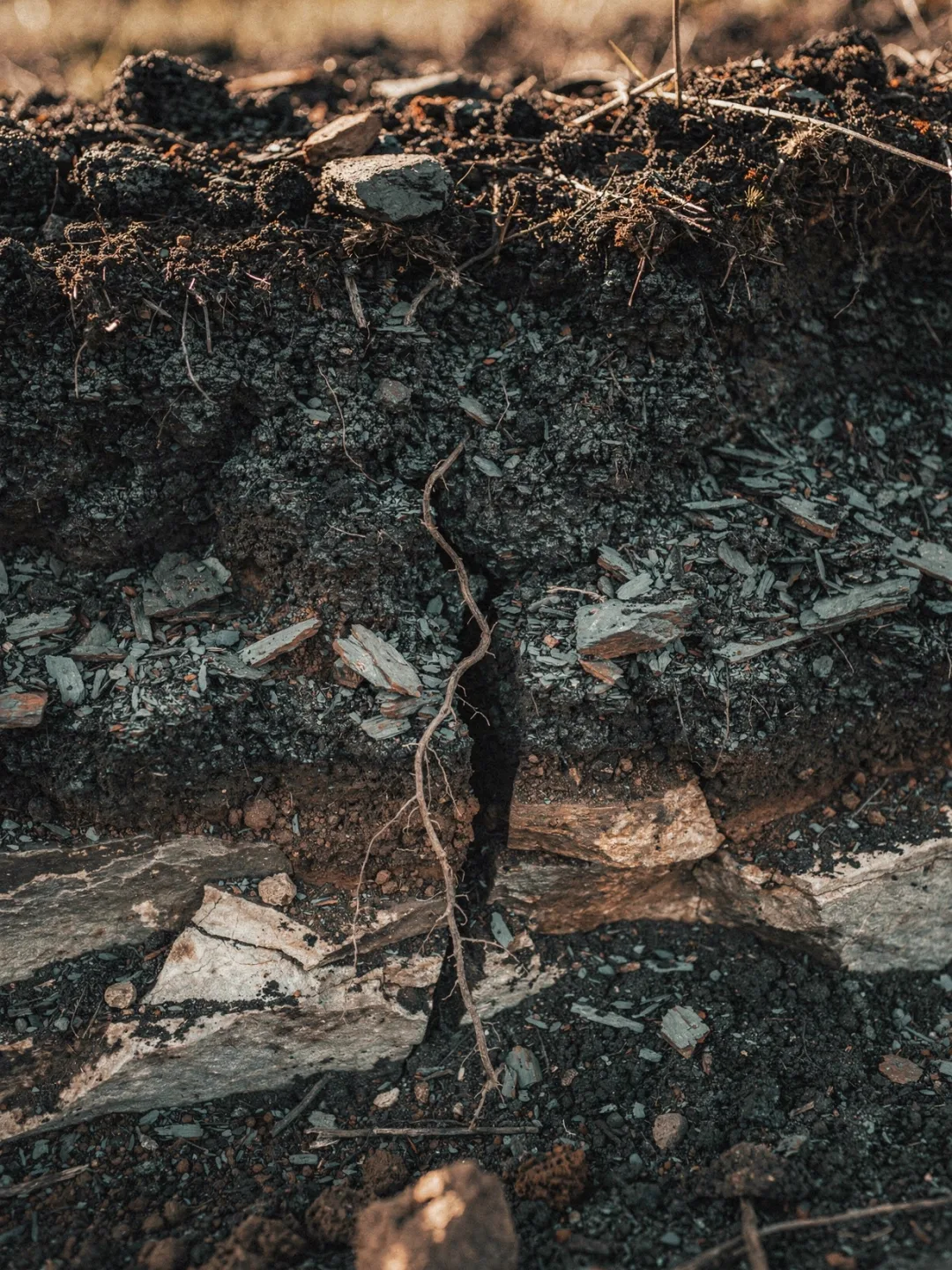
Dig a hole in the Hemel-en-Aarde Valley and you'll quickly hit dark, almost black clay. This is weathered Bokkeveld shale, a rock layer that lay as mud on the sea floor around four hundred million years ago, at a time when there was no Cape, and no continent in its present form.
Pressure compacted this mud into rock, and ever since, weathering has broken it back down into fine, clay-rich plates that store water like a sponge and release it slowly back to the vine, even when summer drags on. That's exactly what Pinot Noir and Chardonnay need. Their roots don't plunge deep but instead prefer to spread wide and shallow in the moist clay.
In the Hemel-en-Aarde Valley, right on the valley floor, this shale is especially clay-rich and dark, thanks to plenty of organic matter and iron oxide. On the Hemel-en-Aarde Ridge, higher up the slope, the same shale turns stonier and paler, laced with fragments of sandstone. Two vineyards, a twenty-minute drive apart, therefore stand, quite literally, on two different soils.
You can taste the difference. Peter-Allan Finlayson, winemaker at Gabriëlskloof estate in the Bot River ward, deliberately vinifies his Syrah from shale soil separately from his Syrah grown on sandstone, barrel by barrel, precisely to demonstrate that difference in the glass. One tastes denser, of blackcurrant and firmer tannin; the other, leaner, of white pepper.
Beneath the clay lies, finally, the bedrock itself, harder and paler, a remnant of that same ancient seabed, just less weathered. It's the hard limit. Barely any root reaches it, and the few that do find some moisture in the cracks even in the driest February.
A thin, dark layer of decomposed fynbos and root matter, rarely more than a hand's breadth deep.
The root: This is where the fine roots sit. They take up whatever rain has just fallen, and are the first layer to dry out.