Nose and Throat
How Smelling Works
A wine almost never tastes on the tongue alone. Most of what we call flavor is actually smell – picked up via two separate pathways that rarely work equally well and that can each be trained individually.
Two Routes to the Nose
Smelling runs along two entirely separate routes. In orthonasal smelling, air is actively drawn in through the nostrils, for instance when sniffing over a glass. The aroma molecules travel from the front, straight out of the surrounding air, to a coin-sized patch high up inside the nasal cavity called the olfactory epithelium. This is exactly the pathway at work when someone holds their nose over a glass before a single drop has even touched their lips. Perfumers, coffee roasters, and wine judges rely almost exclusively on this first channel, because it can be deliberately controlled: breathe in deeply, pause briefly, sniff again.
The second route is called retronasal smelling, and it only begins in the mouth. Chewing and swallowing push warm, moist air from the throat backward and upward through the nasopharynx. There it reaches the very same olfactory epithelium, just from the opposite direction. A simple trick reveals just how much this pathway contributes. Pinch your nose while drinking, and a wine suddenly tastes only sweet, sour, or bitter. The subtle fruit and the spice on the finish disappear completely. As soon as the nose is free again, the whole rest of the picture comes rushing back, often right in the middle of a sip. A head cold acts as a filter over the entire flavor experience for exactly this reason.
Four Hundred Receptors in the Head
For an aroma molecule to trigger anything at all, it has to dock onto a matching receptor on an olfactory cell, much like a key fitting into a lock. Humans have roughly four hundred functioning types of these olfactory receptors, each specialized for particular molecular shapes. American researchers Linda Buck and Richard Axel discovered in 1991 how these receptors are encoded in our genes. They also showed how this translates into a functioning olfactory cell. For this work, both received the 2004 Nobel Prize in Medicine, one of the rare honors given to a sense long considered the least important of all.
Four hundred receptor types sound like very few, measured against the many thousands of aroma compounds found in wine and food alone. The brain solves this mismatch combinatorially: a single aroma molecule almost always stimulates several receptor types at once, each to a particular degree and in a particular mix. Every scent thus creates its own activation pattern, roughly the way a handful of primary colors combine into millions of shades. From these patterns the brain assembles cherry, old leather, or wet stone, long before we're even consciously aware that we're smelling anything at all.
Warmth Turns Wine Up
Whether the nose picks up anything from a wine at all comes down to a single question: how many molecules escape from the glass into the air above it? Only volatile substances – ones that evaporate easily – make it to the nose in sufficient quantity. These are precisely what people mean when they talk about aroma compounds in wine. Warmth noticeably speeds up this evaporation. A white wine served too cold therefore smells pale and closed, almost neutral, while the very same wine just a few degrees warmer suddenly reveals fruit and floral notes that were barely perceptible before.
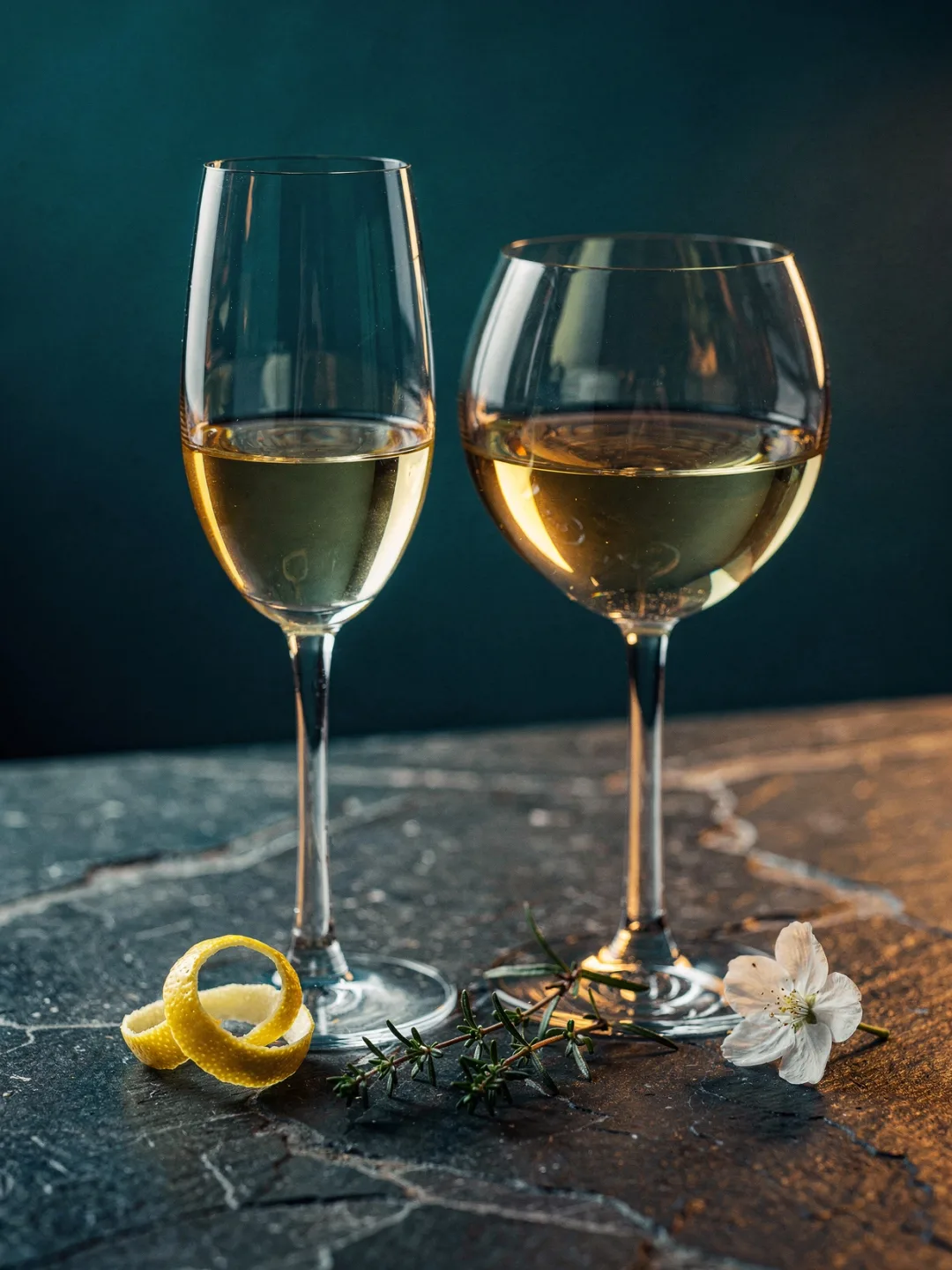
The shape of the glass amplifies exactly this effect. A glass with a narrower opening collects the rising vapors above the liquid instead of letting them scatter immediately into the room. It holds them there, concentrated and ready for the nose. Swirling pumps additional air into the wine, drawing more molecules up to the surface and accelerating evaporation a second time. Out of a straight-sided water glass, the same wine therefore smells noticeably weaker and flatter than from a proper wine glass with an inward-curving rim.
Why This Matters When Tasting
Anyone tasting a wine deliberately uses both pathways in sequence and cross-checks them against each other. First comes the orthonasal impression over the still glass, then again over the swirled glass, with markedly more vapor rising above the surface. Only after that comes a small sip, at which point the retronasal pathway takes over and often reveals quite different nuances than the nose alone picked up moments before.
This order isn't ritual for its own sake – it simply follows the science. A fault like cork taint sometimes shows up clearly only orthonasally, as damp cardboard. Subtle toasty notes from the oak barrel, on the other hand, often only emerge retronasally on the swallow. Anyone who only sniffs, or only swallows, is therefore systematically missing one half of the same picture. That's exactly why the following stops on this journey consistently build on both pathways, from the individual aroma compound all the way to the full impression in the mouth.