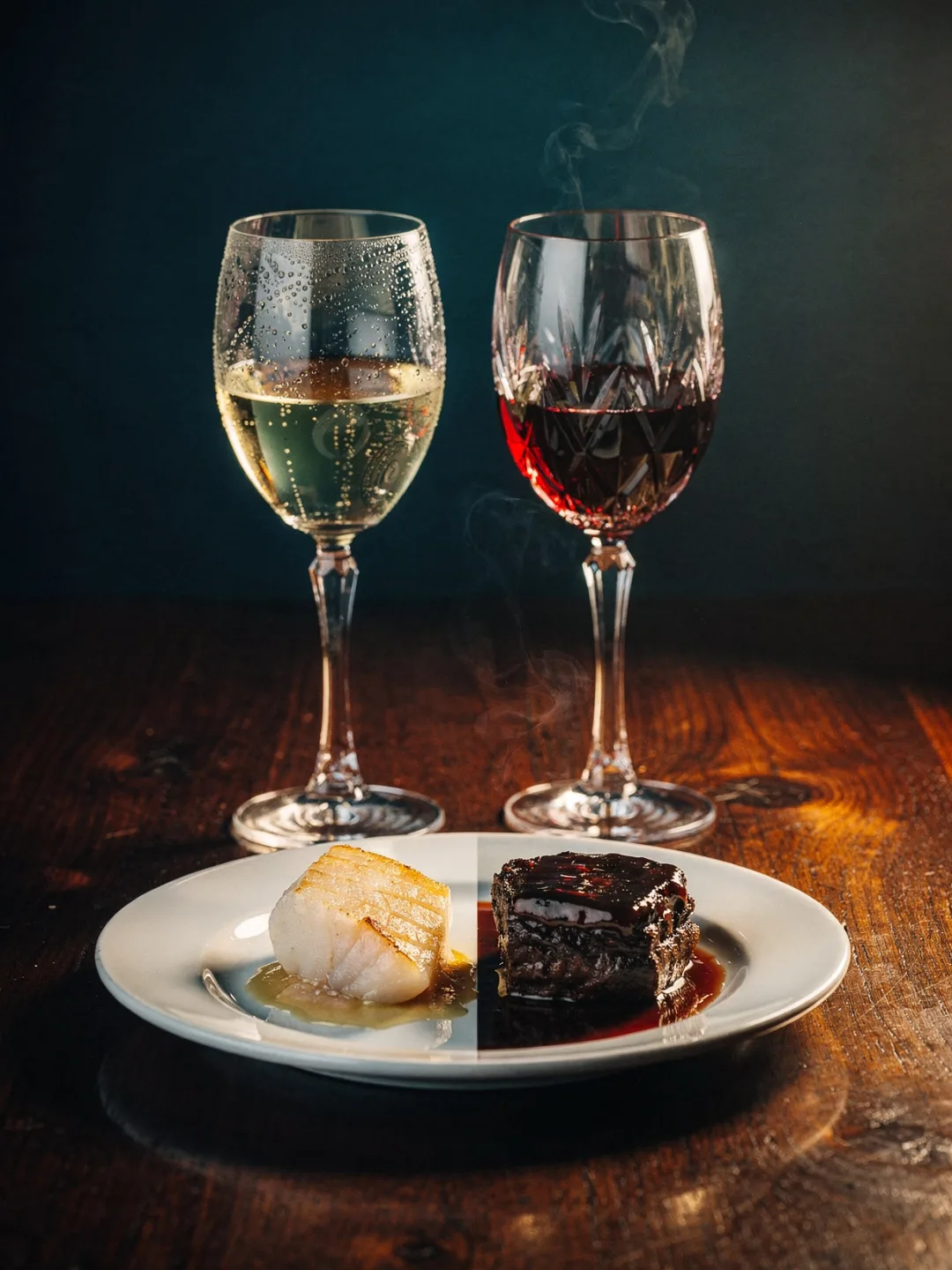
Two Strategies
Like to Like, Contrast to Contrast
Two basic approaches determine every successful wine-and-food pairing: either you reinforce a quality, or you cancel it out with its opposite. Anyone who knows both strategies can find a wine for almost any dish without having to guess.
Reinforcing: Like Seeks Like
With the first strategy, you look for a wine that mirrors and thereby reinforces a quality of the dish. A creamy risotto meets a creamy, oak-aged Chardonnay, whose soft texture continues that of the rice. An earthy mushroom dish meets an earthy Pinot Noir, whose forest-floor note picks up the mushroom aromas instead of fighting them. The combination feels familiar, almost like a continuation of the same idea along two paths.
This strategy is the safer of the two, because it can hardly go wrong. It asks only: what texture, what intensity, what fundamental character does the dish have, and which wine carries the same signature? Light, bright dishes get light, bright wines. Heavy, dark dishes get heavy, dark wines. As simple as this rule sounds, it carries a large part of the wine list in any good restaurant.
Contrasting: Opposites Balance Each Other Out
The second strategy does the opposite and uses the very difference between the two. A fiery hot curry sauce doesn't meet another powerful wine, but rather a slightly sweet, cool Riesling that calms the heat in the mouth instead of doubling it. A rich foie gras doesn't meet an equally rich red wine, but rather a nobly sweet wine with sharp acidity that cuts through the fat and wakes the palate back up.
Contrast requires more practice than reinforcement, because a poorly chosen opposite doesn't balance the dish, it outright tips it over. Too much sweetness against too little heat feels sugary. Too much acidity against a delicate dish feels aggressive. Anyone who contrasts should therefore choose only one quality to oppose, and deliberately keep everything else, such as the weight of the wine, similar.
When to Use Which Strategy
A rule of thumb helps with the choice: if a dish is already balanced in itself, reinforcement is worthwhile, because it simply continues that balance. If a dish, on the other hand, is dominated by a single strong quality, such as heat, sweetness, or a great deal of fat, contrast is worthwhile, because it offsets exactly that one dominant trait. A mild vegetable curry can therefore be given a similarly mild white wine, while a hot red Thai curry needs a noticeably sweeter counterpart.
In the end, taste always remains personal, and neither strategy is the only correct one. Some tasters prefer contrast with almost every meal because it feels more exciting, others prefer reinforcement because it tastes calmer. For beginners, it's enough to consciously try both approaches once, ideally with the same dish paired with two different wines in succession.
One Example, Two Solutions
One and the same dish can almost always be paired using either strategy, just with a completely different result. Take a spiced lamb tagine with apricots: anyone wanting to reinforce reaches for a warm, fruity red wine from a southern climate, which picks up the sweetness of the apricots and the spice of the lamb, continuing the same warm mood. Anyone wanting to contrast instead reaches for a cool, mineral-driven rosé, whose freshness creates a clear counterpoint to the warmth of the dish and refreshes the palate between bites.
Both paths lead to a harmonious result, yet they tell a different story at the table. The warm red wine makes the dish feel richer and rounder, almost like a single, unified flavor. The cool rosé, by contrast, keeps the meal lively and light, with a constant small shift between spice and freshness. Which story fits best often depends more on the season and the mood at the table than on any fixed rule.
When Both Strategies Fail
Sometimes neither reinforcement nor contrast convinces, and that's rarely due to a wrongly applied rule, but often to a dish with too many conflicting qualities at once. A sauce that is simultaneously spicy, sweet, sour, and salty demands more from a single wine than it can deliver, no matter which strategy you choose.
In such cases, it helps to deliberately pick one quality as the leading theme and set the others aside, rather than trying to serve them all at once. Anyone who decides that heat is the most important feature should choose consistently according to the rules of the sixth stop on this journey, accepting smaller compromises on sweetness or salt. Perfection is rarely the goal with very complex dishes; a coherent overall impression is usually more than enough.
Two questions are often enough. What dominates the dish? Choose your strategy based on that. When in doubt, reinforcement helps more. It fails less often than contrast.