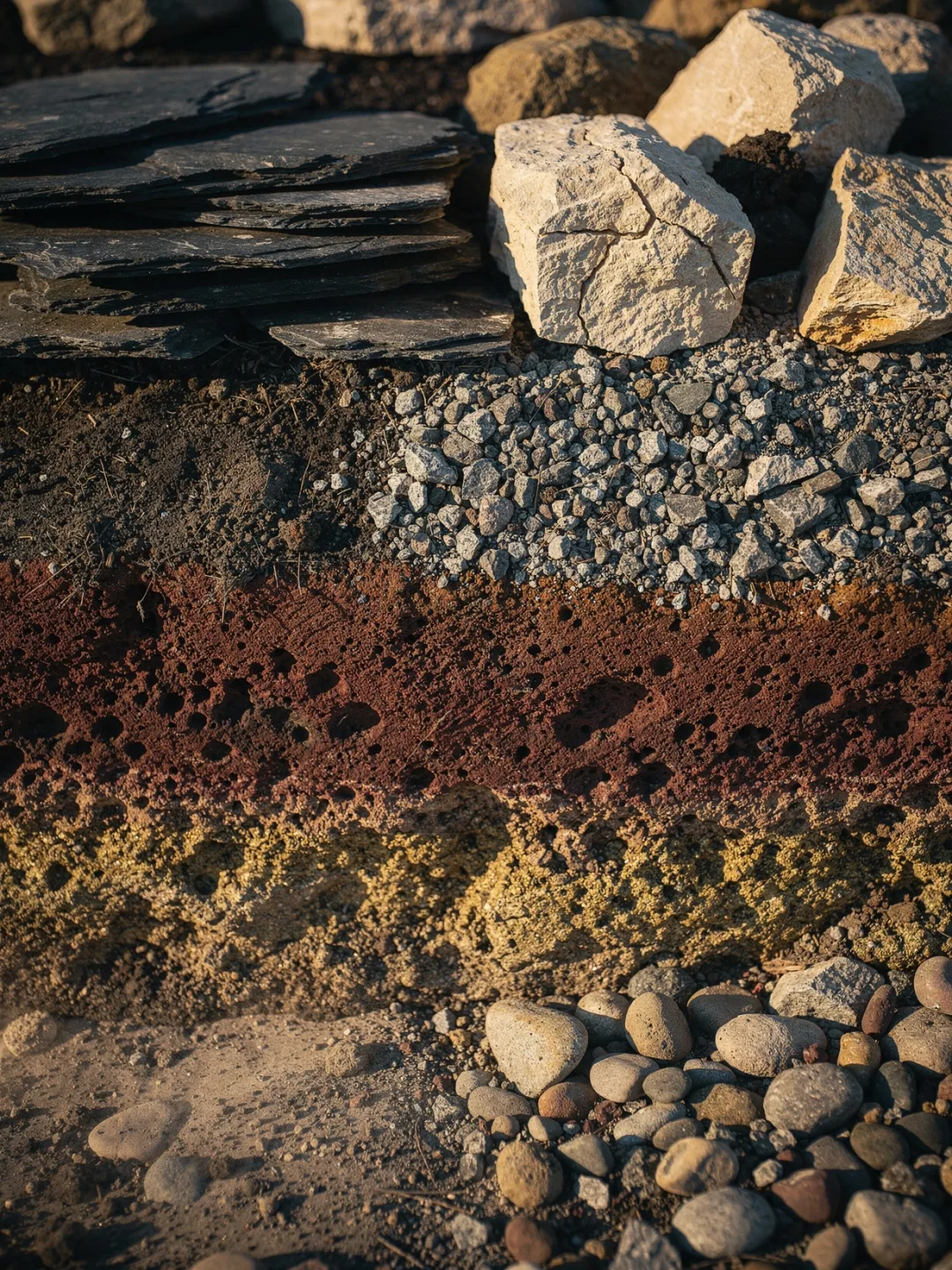
Limestone, slate, volcanic rock
Soils at a glance
Six soil types keep showing up in wine descriptions worldwide: limestone, slate, granite, volcanic rock, gravel, and loess. Each stores water and heat differently, and this is exactly what shapes how a grape ripens on it.
Limestone: freshness and fine structure
Limestone consists of the remains of ancient marine organisms, compressed over millions of years into pale, often porous rock. It stores water in fine pores and releases it to the vine evenly, even in dry summers. Wines from limestone soils are often regarded as especially fresh and finely structured, with lively acidity. Champagne and Chablis in France sit on such limestone. The same is true of the Albariza soils around the Spanish sherry town of Jerez. They shine dazzling white in the sun and reflect the Andalusian heat during the day.
The Sancerre region on the Loire and parts of Burgundy likewise rest on limestone-rich subsoil of varying ages, ranging from hard Kimmeridgian limestone to softer, more porous limestone. Winegrowers often distinguish these limestone types with great precision. Even small differences in the rock's hardness affect how deep a root can penetrate and how much water is ultimately available.
Slate: a dark reservoir for warmth
Slate is a thinly layered, often dark rock formed from compacted sea mud, splitting easily into thin plates. Its dark color absorbs plenty of solar heat during the day. At night, it releases that heat slowly, almost like a stored underfloor heating system beneath the vines. On the Mosel, this very effect is what makes growing Riesling so far north possible in the first place. Slate holds hardly any nutrients. Roots therefore must grow deep between the plates, which lowers yield and concentrates flavor.
In Spain's Priorat, too, a distinctive slate called Llicorella shapes the wines, a dark, glittering rock that makes the soils there appear almost black. Combined with steep slopes, it produces some of Spain's most concentrated red wines. Slate is therefore considered one of the most sought-after soils worldwide for cool to moderately warm wine regions.
Granite and volcanic rock: hard power from the depths
Granite is a hard, crystalline rock that solidified slowly deep within the earth and today lies at the surface in regions like Beaujolais or parts of South Africa. It weathers into coarse, sandy soil. This lets water drain quickly and forces roots to dig deep. Volcanic rock, by contrast, comes from actual eruptions and is usually richer in minerals. On Mount Etna in Sicily or on the Greek island of Santorini, vines grow in dark, porous volcanic earth. It stores water remarkably well, even though it looks dry and barren at first glance.
Both rock types share one trait: they are of volcanic or deep-earth origin and therefore often rich in minerals. These don't migrate directly into the wine, but they do noticeably influence water balance and soil temperature. Wines from such soils are often described as smoky, saline, or possessing a certain tautness. Part of this impression, though, also comes from the mostly cool, high-altitude sites where volcanic soils tend to occur.
Gravel and loess: loose and quick to warm
Gravel consists of rounded stones once carried there by a river or a glacier. Such gravel hills lie in the Médoc near Bordeaux. During the day, the stones heat up there and release that warmth to the vines at night, similar to slate, only lighter in color and looser in texture. Loess, by contrast, is finer, dust blown in by the wind over thousands of years, as found in Austria, Rheinhessen, or on the Loess Plateau in China. It holds water well and is easy to work. In spring, it warms up quickly, which encourages early budbreak.
In Châteauneuf-du-Pape in the southern Rhône Valley, fist-sized, rounded river pebbles even lie directly on the soil surface, visibly radiating heat during the day. Loess, meanwhile, is very fine-grained. In heavy rain, it erodes easily, which is why many winegrowers on loess soils plant cover crops between the vine rows to protect the precious dust from washing away.
No soil acts alone
It's important not to overestimate any single one of these six types. The same limestone produces a different wine in a cool climate than in a hot one. The same slate behaves differently on a gentle slope than on a steep one. Soils only set the framework for water balance and warmth. The climate and sunlight above ground are what ultimately determine the outcome. Understanding a soil, therefore, only reveals part of the story, not the whole of it.