Soil, Climate, People
What Terroir Is
Terroir is the French word for the fact that the same grape variety name can produce two entirely different wines. It refers to soil, climate and the winemaker's hand as one interconnected whole: the place from which a wine draws its character.
A Word Without a Real Translation
Terroir comes from the Latin word for earth, terra, and became the technical term for viticulture in France. There is no literal translation in either German or English, which is why almost every language adopts the French term unchanged. That's unusual for a technical term, since most languages find their own equivalent. The reason is that terroir describes more than just the soil beneath the vines. It refers to a bundle of factors that work together and can hardly be separated from one another.
As early as the Middle Ages, monks in Burgundy noticed that grapes from neighboring plots tasted different, even though the same grape variety grew there. They built walls around individual vineyards and gave them their own names. This practice is the root of what is now called a vineyard site, and it shows: the idea of terroir is older than the word itself. It wasn't until the 20th century that it became a legal term, one that France used to protect its wine regions.
Three Ingredients That Can't Be Separated
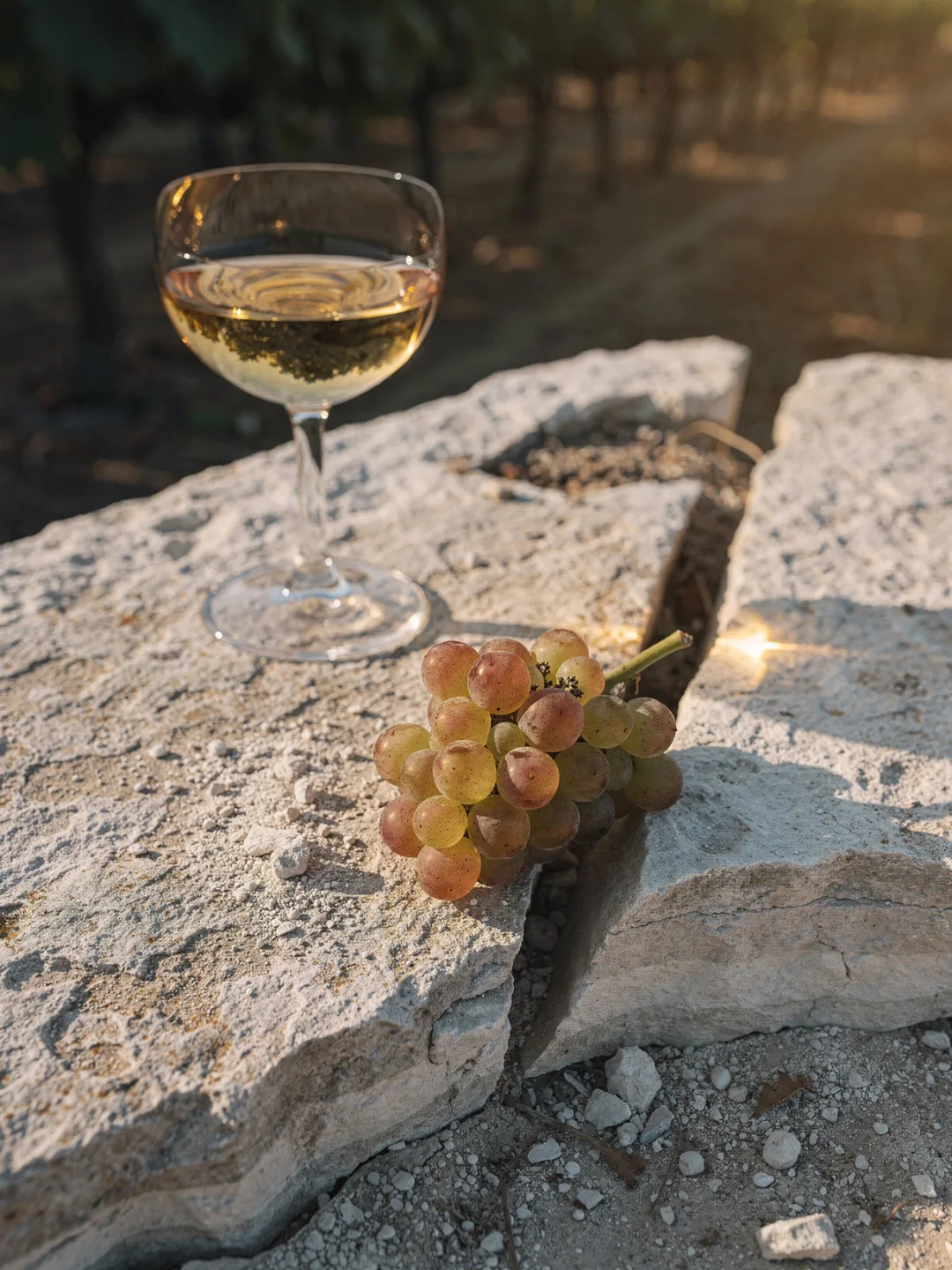
Terroir first includes the soil: its composition of rock, sand, clay or limestone, plus the depth at which a root finds water. Then comes climate, operating on three levels at once. The macroclimate of an entire region determines whether vines can ripen there at all. The mesoclimate of a single slope decides how warm it gets compared to the neighboring plot. And the microclimate right around the grape itself, within its own canopy, ultimately makes the difference between a ripe and an overripe berry.
The third part is often forgotten: the human being. Which grape variety someone plants, how densely the rows are spaced, when the harvest happens — all of this belongs to terroir too, even though it has nothing to do with soil. Two winemakers on the same hill can therefore make noticeably different wines. Terroir is thus not a purely natural phenomenon, but the result of place and decision combined.
Same Name, Two Different Wines
Chardonnay shows this difference especially clearly, because the variety grows almost everywhere in the world. In cool Chablis north of Burgundy, it produces a lean, highly acidic wine with a flavor many describe as stony or chalky, because the subsoil there consists of limestone embedded with fossilized shells. In the warm Napa Valley in California, the same variety ripens much sweeter, acidity drops, and notes of butter and toasted bread emerge from the barrel. Neither side is wrong — they're simply two answers to two completely different places.
Terroir Is Not a Magic Word
Listen closely, and you'll often hear the word terroir spoken in an almost mystical tone, as if the soil were injecting its flavor directly into the wine. Scientifically, that's only partly true. Minerals from the rock don't simply travel through the root into the glass — that would require quantities a vine could never absorb. What actually matters is an indirect effect: soil stores water and heat differently, and that alone changes how quickly and how fully a grape ripens.
For now, a simpler idea will do. Terroir doesn't answer whether a wine is good, but why it tastes the way it does, and why a copy made elsewhere rarely succeeds. This idea runs through the whole journey ahead, through climate zones, altitudes, soils, and finally through the laws that protect a place name on a label.
Terroir Reaches Beyond Wine
The idea has long since grown beyond the vineyard. Coffee from different altitudes in Ethiopia tastes different, even though the same bean variety grows there. The same principle applies to spirits: Cognac may only bear that name if the grapes come from a specific region around the French town of Cognac, and Grappa only if it's distilled from Italian grape pomace. Terroir, then, isn't a wine-specific quirk, but a basic principle behind almost every natural product with character.