Second Fermentation, Bubbles
Sparkling Wine: Traditional Method and Charmat Method
The bubbles in the glass come from a second fermentation, in which the finished base wine is treated once more with sugar and yeast. Whether this second fermentation takes place in the individual bottle or in a large pressurized tank determines both the price and the effort involved. Often, it determines the flavor as well.
The Base Wine: Still and Rather Acidic
Before any bubbles come into play, a perfectly ordinary still wine is made first, the base wine. It's deliberately harvested and produced with relatively high acidity and low alcohol content. It often comes from grapes that would be considered too early to pick for a normal wine. This freshness is intentional. It's meant to survive the later, second fermentation and give the finished sparkling wine its characteristic tension.
As described in the previous stop, this base wine is often assembled into a careful blend, drawing on many individual lots. Only once this blend is settled does the actual step that gives sparkling wine its name take place. A second alcoholic fermentation is triggered by adding sugar and yeast once again. This time, it deliberately takes place in a sealed container, so that the carbon dioxide produced can't escape. That's the whole trick, because without this sealed space, the carbon dioxide would simply escape into the air.
Traditional Method: Fermentation in Its Own Bottle
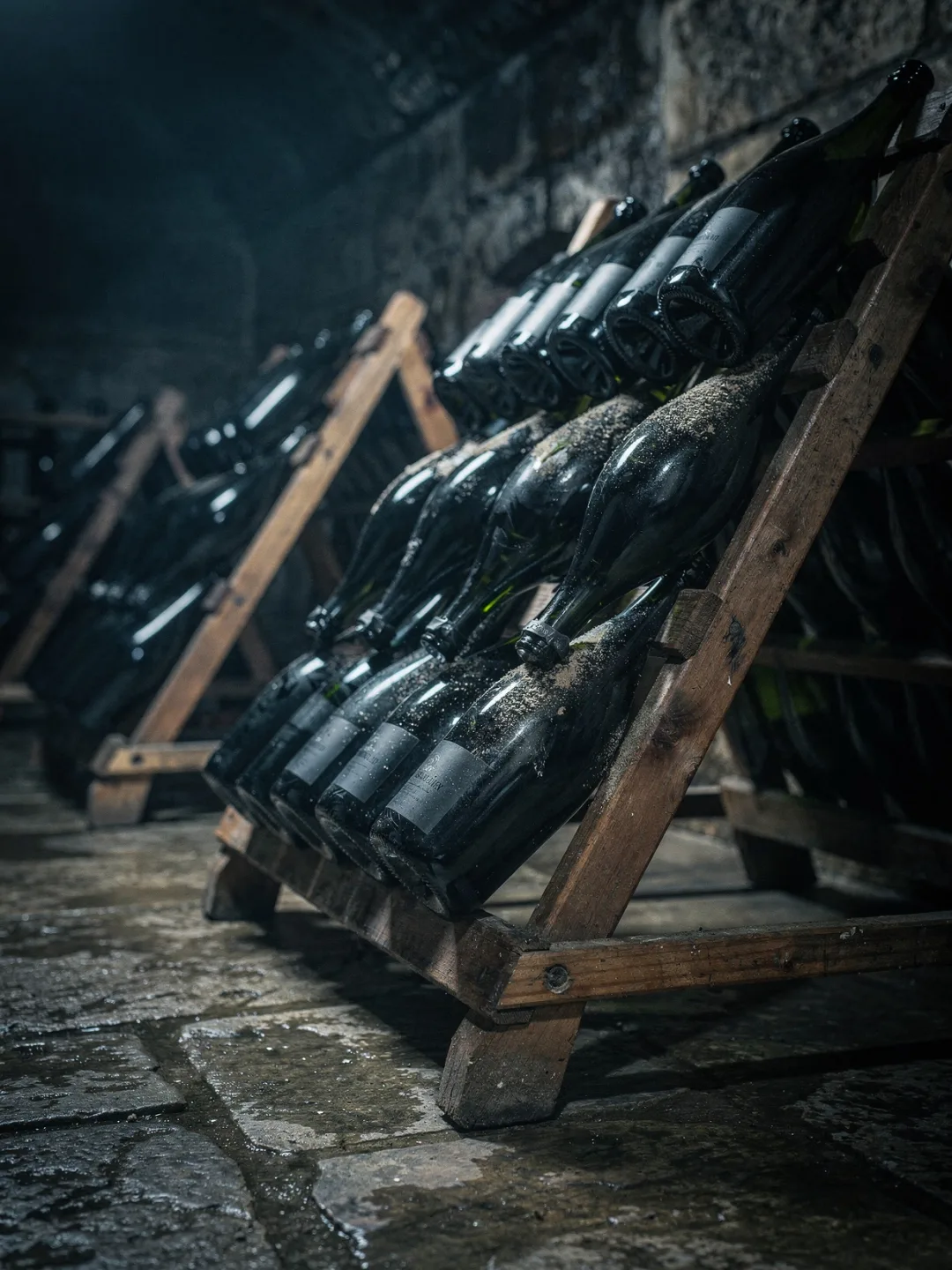
In the traditional method, as required in Champagne and also used for many Crémants and Cava, the second fermentation takes place directly in the bottle that will later be sold. The carbon dioxide produced can't escape. Instead, it dissolves into the wine under pressure. This is exactly what produces the fine, long-lasting mousse this method is known for.
After fermentation, the wine rests on its own lees in the same bottle for months to years. For non-vintage Champagne, the law requires a minimum of fifteen months total, of which at least twelve must be on the lees. For vintage Champagne, it's even three years. This long time on the lees produces the bready, nutty aromas that set typical, premium sparkling wines apart from simpler ones. Shorter aging times are usually noticeably apparent in the taste, typically as a fresher but less profound mousse.
Disgorgement: The Lees Have to Come Back Out
By the end of the aging period, the dead yeast sits in the wine as a fine sediment. It must be removed before sale, without losing the pressure and bubbles in the process. To do this, the bottles are first slowly rotated and tilted over the course of weeks until the lees collect in the neck of the bottle. This process is called riddling. In the past, it was done by hand over weeks; today, it's usually handled by mechanical riddling racks within a few days.
The neck of the bottle is then briefly frozen and the bottle opened. The frozen plug of lees shoots out under its own pressure, a step called disgorgement. The small resulting shortfall is topped up with a mixture of wine and sugar, the dosage. Its exact amount ultimately determines whether the finished sparkling wine in the glass is brut, extra dry, or noticeably sweeter.
Charmat Method: The Same Second Fermentation, in a Tank
In the Charmat method, named after its inventor and used above all for Prosecco, the same second fermentation doesn't take place in individual bottles. Instead, it happens in a large, pressure-resistant steel tank holding many thousands of liters. This saves an enormous amount of time and labor. Neither riddling nor disgorgement is needed on individual bottles. Instead, the wine is bottled directly from the tank under pressure.
Because the yeast contact time in the tank is usually much shorter than in the bottle, Charmat sparkling wine rarely develops the bready, nutty aromas of the traditional method. In exchange, the pure fruitiness of the grape is preserved more strongly. Both methods technically produce the same effect: dissolved carbon dioxide under pressure. But the path taken to get there ultimately shapes the entire character of the finished sparkling wine from the ground up.