A Year of Work
The Wine Year in the Vineyard
Long before a grape is pressed, a whole year of work has already gone into the vineyard. Pruning in winter, budbreak in spring, flowering in early summer, and a quiet ripening phase in late summer follow one after another. Together they determine how the wine will taste later on and how much of it will grow in the first place.
Pruning Sets the Direction
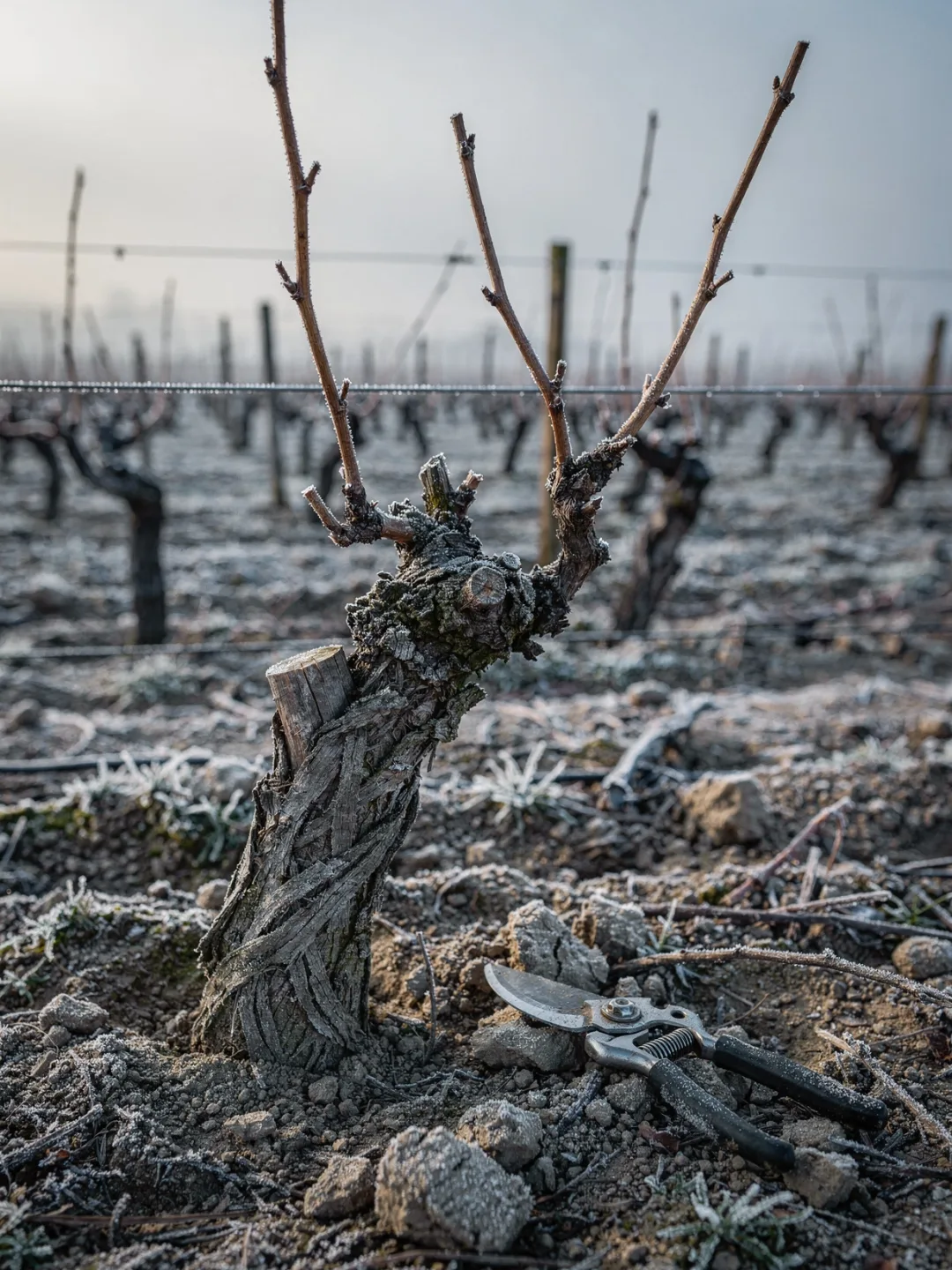
A wine year doesn't begin in spring, but in the depths of winter, when the vines have long since lost their leaves and lie dormant. Now the winegrower cuts back most of the previous year's shoots. A vine could theoretically carry a hundred buds. After pruning, often only eight to twelve remain. Each bud is a dormant eye from which a new shoot will grow in spring, first with leaves and later with grapes. Leave many buds, and you get more grapes, but smaller and less concentrated ones. Prune hard, and you sacrifice quantity for ripeness and flavor. Pruning is thus the first and most consequential decision of the entire wine year, even though the harvest itself is still nine months away.
How hard the vine is pruned also depends on the grape variety, meaning the type of grape with its own characteristics of growth, yield, and ripening time. Some varieties naturally produce few, large clusters, while others produce many small berries, and pruning helps balance out these differences between varieties. At the same time, pruning determines the shape the vine will take over decades. Old vines, often trained along a wire trellis, visibly carry the scars of such cuts on their thickened trunks, and a mistake in pruning can't be corrected within the same season—its effects often linger for years afterward. That's why pruning is considered by winegrowers to be the task demanding the most experience, more so than any single step in the cellar that follows.
Budbreak and Flowering: The First Risks
As the days grow longer in spring and the soil warms, a tender green shoot pushes out from every bud left on the vine, and this new growth is fragile. A single frost of just a few degrees below freezing can burn the young shoots. This puts an entire year's harvest at risk before it has even really begun. That's why some estates light small stoves between the vine rows on cold spring nights. Others use large fans to mix warm air downward. Still others rely on their site: slopes where cold air drains away at night are safer than valley floors, where it tends to collect.
About eight to ten weeks after budbreak, the vine flowers. The tiny, mostly self-pollinating blossoms open for only a few days. It's precisely during this short window that the number of berries a cluster will eventually carry is decided. Rain, cold, or strong wind during flowering can disrupt pollination. Unfertilized flowers simply fall off, a process winegrowers call shatter, or coulure. A rainy flowering period in early summer can noticeably reduce the autumn harvest, without the vine itself showing any sign of disease. Anyone who spots a small cluster with lots of gaps between the berries in summer is usually looking at the consequences of poor flowering weather months earlier.
Summer: Canopy Work and Veraison
After flowering, the small green berries develop, still hard, sour, and practically free of sugar. During these weeks, the winegrower focuses mainly on canopy work. Excess leaves around the fruit zone are removed so that sun and air can reach the berries. This dries dew faster and lowers the risk of fungal disease. That said, the grapes shouldn't hang completely unprotected in blazing sun either, or they'll scorch. Some estates also cut away part of the crop while it's still green, a practice known as green harvesting. Fewer grapes per vine means the remaining ones get more nutrients and develop more flavor.
The most striking moment of summer is the onset of ripening, which winegrowers call veraison. Within just a few days, red varieties change color from green to red or blue. White varieties, by contrast, shift from hard green to a softer, often slightly golden green. From this point on, the berry begins storing sugar, acidity slowly declines, and the skin grows thinner and softer. After veraison, winegrowers often start counting the days to harvest in weeks rather than months—that's how much ripening accelerates from here on.
Autumn Decides the Harvest Date
In the final weeks before harvest, the grape changes almost daily: sugar content rises while acidity continues to fall. Aromas that were barely present before now develop in the berry skin. Winegrowers therefore regularly measure what's called must weight, a value indicating the sugar content of the grape juice. They also simply taste the berries, including seeds and skin. Only when sweetness, acidity, and the flavor of the seeds all align is a grape considered ripe enough to harvest. This point doesn't fall on the same calendar date for every variety or every year.
Weather can upend this carefully watched schedule within just a few hours. A hailstorm can knock ripe berries off the vine or damage their skin, and rot quickly sets in through the wound. Sustained rain shortly before harvest causes the berries to absorb water, diluting both sugar and aroma. That's why many estates prefer to harvest a few days early. They'd rather not risk losing an entire year's work to a single turn in the weather. How exactly this harvest, known as picking, unfolds, and what determines whether it's done by hand or by machine, is the next stop on this journey.