Stable Beats Cool
Temperature and Fluctuations
When it comes to storage temperature, consistency matters more than the exact number. A wine that keeps swinging between warm and cold ages faster and more unevenly than one kept at a stable temperature.
The Guideline, and Why It's Only a Guideline
A good average storage temperature is considered to be around 50 to 54°F (10 to 12°C). At this temperature, the chemical processes of maturation run slowly enough that a wine can bring joy for years, yet fast enough that anything actually changes at all. It's a number that's easy to remember, but it's no law of nature.
Wine still matures at 61 or 64°F (16 or 18°C), just faster. That's no disaster, as long as the temperature stays stable and you factor it into the drinking window. Real damage only sets in once the temperature regularly climbs above 77°F (25°C). At that point, premature aging looms and, in the worst case, a wine that tastes literally cooked.
Why Fluctuations Do More Harm Than a Few Degrees
Liquid expands with heat and contracts with cold. With every temperature swing, a tiny bit of wine shifts through the cork, outward when warming, inward when cooling. With each cycle, a little more air enters the bottle than was ever intended.
A spot that swings ten degrees over the course of a day, say a windowsill in the sun, therefore harms a wine more than an evenly tempered room that's overall a few degrees warmer. If you only have a spot with daily swings to choose from, pick a dark interior room without windows over a cooler spot right by the glass.
How to Test Your Own Home
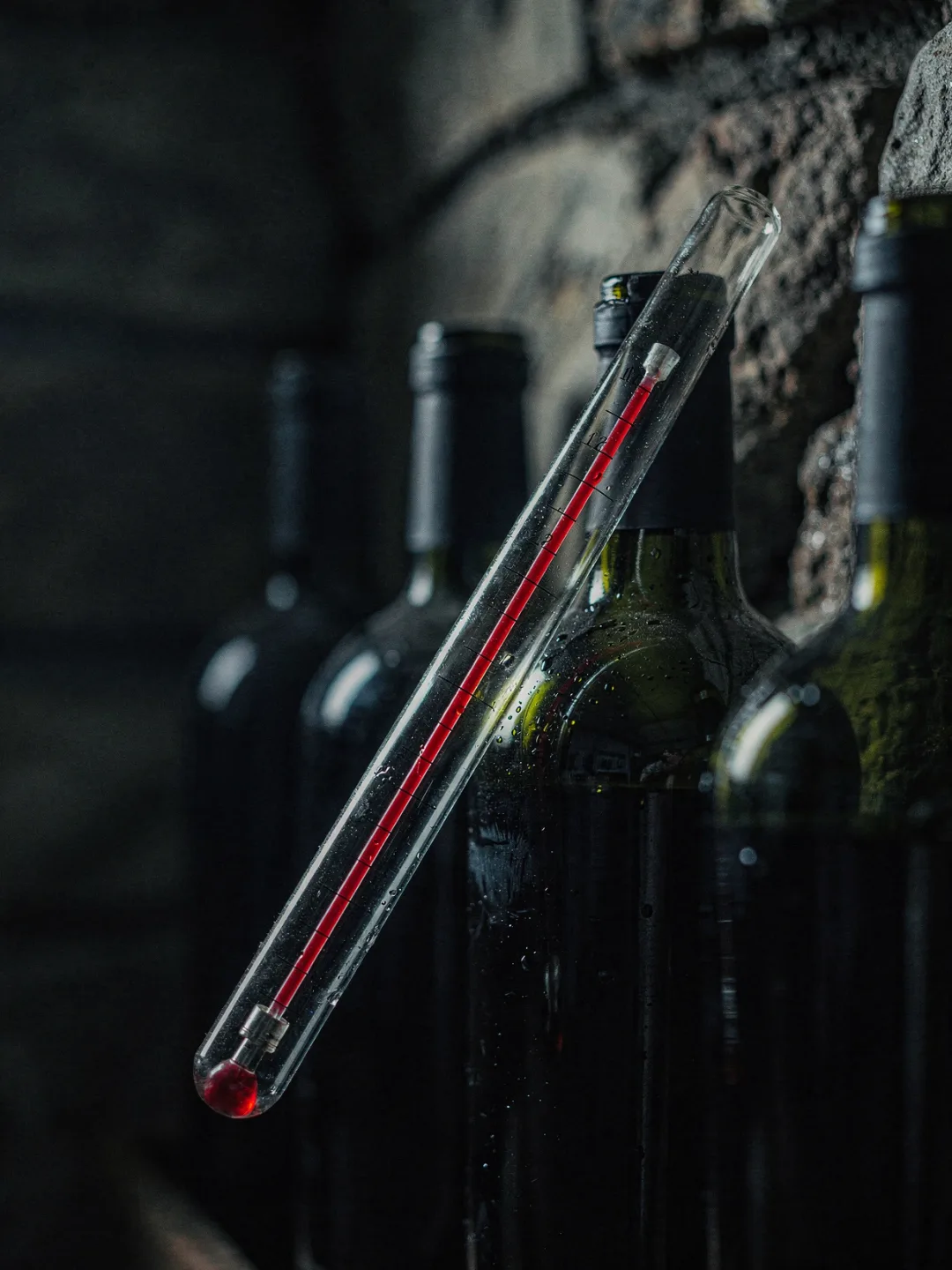
A simple thermometer with a memory function will show over the course of a week how a potential storage spot really behaves. Take readings morning and evening, ideally including one particularly warm day. Shelves inside cupboards, storage rooms, and nooks without an exterior wall almost always perform better than shelving against a wall facing a terrace or above a radiator.
Don't trust your gut feeling that a room is cool. Cellars in older buildings can be surprisingly warm if a heating pipe runs through them, and a wall closet on the top floor can be cooler than expected if it faces away from the sun. Only measurements taken over several days give you an honest answer.
Short-term transport is a different issue
A wine that sits for two hours in a hot trunk rarely suffers lasting damage, as long as it settles back down afterward. Things get critical with multi-day transport in blazing sun or repeated extremes, such as being left in the car during a summer holiday. One-off short spikes aren't the main problem.
The real problem is sustained exposure: a shelf that heats up for hours every afternoon and cools back down overnight, week after week, year after year. This constant repetition adds up to an effect that a single hot car ride could never match.
A simple test for your own living space
You don't need expensive equipment to get started. A basic thermometer costing just a few dollars will do the job. Place it at your planned storage spot for a week. Check it briefly morning and evening.
Note down the readings, ideally on your phone or on a notepad right next to it. After seven days you'll see two things: the average temperature and the range between the warmest and coolest moments.
When a second test is worthwhile
Feel free to repeat the test again in summer. A spot that seems stable in winter can behave quite differently in August, especially under a roof or right against a south-facing wall.
This bit of diligent effort costs a week of patience. In return, it saves you years of uncertainty about whether your bottles are really sitting in the right place. If the swing between day and night exceeds five degrees, it's worth searching for a calmer spot.