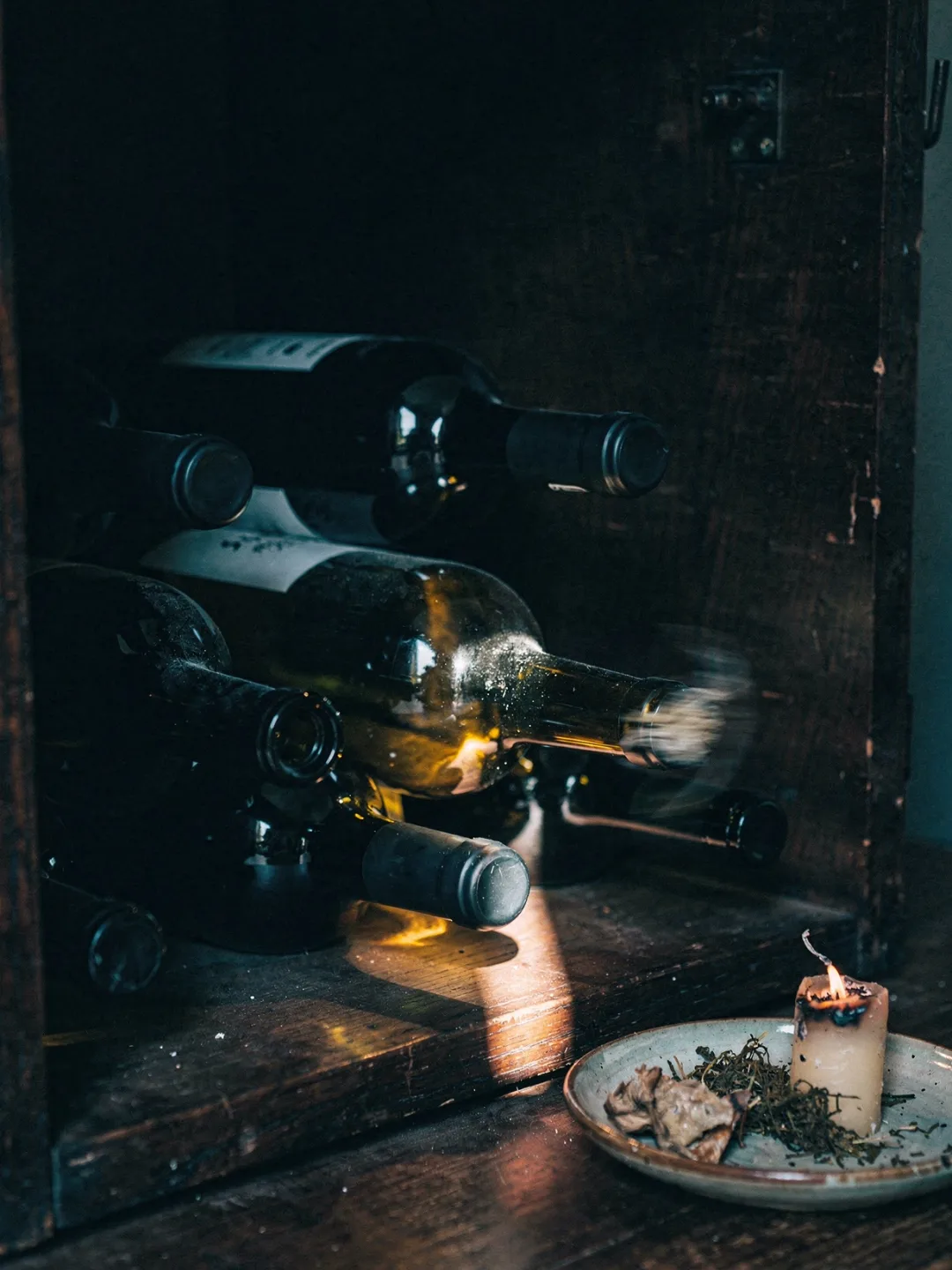
The quiet enemies
Light, vibration, odor
Besides temperature, there are three quieter dangers for storing wine: light, vibration, and foreign odors. None of them announce themselves immediately, but all three add up over months and years.
Light, especially UV light
Sunlight, and to a lesser extent bright artificial light, triggers reactions that genuinely age wine. White wines in clear bottles are the most vulnerable. They lack the protection that dark green or brown glass gives to red wine and some sparkling wines.
A telltale sign of light damage is an odor reminiscent of wet cardboard or cooked cabbage, one that can't be explained by normal aging. That's why many storage guidelines explicitly state that bottles should be kept in the dark. A simple box placed over the shelf is enough if a dark cupboard isn't available.
Vibration, the underestimated problem
Constant vibration, say from a refrigerator compressor right next door or a washing machine in the same room, keeps fine particles in the wine in constant motion. Some experts suspect this speeds up chemical reactions, since substances encounter each other faster than they would at complete rest. This isn't proven in every detail, but common practice still advises caution.
The mechanical effect is more clearly documented in old red wines with noticeable sediment: if the bottle is constantly jostled, that sediment keeps getting stirred back up. An old wine that should pour clear into the glass ends up looking cloudy instead. For longer storage, it's worth finding a calm, low-vibration spot, away from any household appliance with a motor.
Foreign odors through the cork
Natural cork is porous. Over the years it exchanges very small amounts of gas with its surroundings, which is actually desirable, since that's how controlled oxygen from the chemistry stage gets in. But that same permeability works both ways: strong odors from the surrounding environment can migrate into the bottle.
That's why cleaning products, paint, gasoline, or even strong-smelling produce like onions don't belong in the same room as a wine storage area. A cellar that doubles as a workshop or a storage space for chemicals is a poor fit for wine, even if the temperature and darkness there would otherwise be just right.
Why these three factors often go unnoticed
Temperature is easy to measure, but light, vibration, and odor act subtly and gradually. Nobody notices right away that a bottle has been sitting next to the washing machine for months, or directly under a lamp. The damage only shows up when the bottle is opened, often years later, by which point the cause is nearly impossible to pin down.
Anyone who considers these three points once, when setting up a storage spot, will barely need to worry about them afterward. A dark, quiet place free of strong odors nearby takes care of almost all three requirements at once, almost automatically.
An everyday example: the refrigerator as storage
Some people set open wine bottles or a small stash right next to or on top of the fridge. That's unfavorable in two ways at once. The compressor produces constant, fine vibration. The back of the appliance also gets noticeably warm.
For one or two bottles that will be opened in the next few days anyway, this hardly matters. But for a stash meant to sit for months or years, being near the fridge is one of the worst spots in the whole home.
How to check the three risks in practice
Stand at your planned storage spot for a minute and close your eyes. Is a motorized appliance running somewhere nearby? Does it smell like cleaning products, paint, or cooking? Does direct light fall on this spot during the day?
Three simple questions, three clear answers. If you can answer no to all three, you've found a genuinely good storage spot, whether or not it's officially labeled a "cellar."
Small fixes without moving house
Not everyone can simply switch storage locations. Often small fixes are enough: a box over open shelving to block light, a rubber mat to dampen vibration, a closed cabinet to keep kitchen odors out.
These three small tweaks cost hardly any time or money. They often turn a mediocre storage spot into a workable one, with no expensive purchase and no need to move to another room.