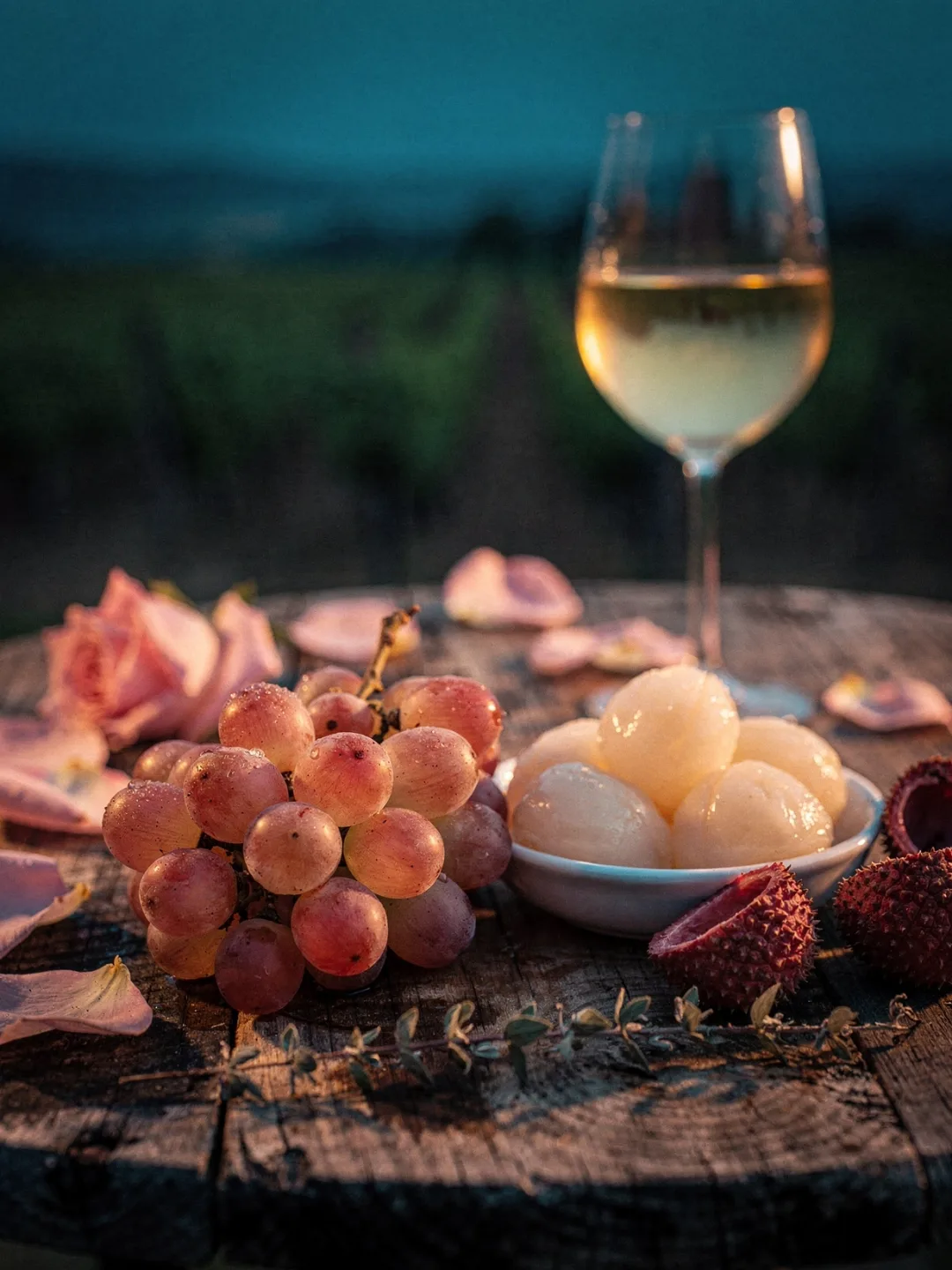
Fragrance Without an Oak Barrel
Aromatic White Grape Varieties
Some white varieties need no barrel and no special cellar technique to smell intensely aromatic—the fragrance is already built into the grape itself. Gewürztraminer, Muskateller, and Viognier belong to this family of aromatic varieties, recognizable by their scent alone, even before the glass reaches your lips.
Terpenes: Aroma Straight from the Grape Skin
Terpenes are responsible for the loud, assertive aroma of these varieties. These aromatic compounds already form in the unripe grape and increase as it ripens. With Sauvignon Blanc, aromas are only released during fermentation. It's different with grapes rich in terpenes: they smell intensely of blossoms or lychee even in the vineyard. Winemakers therefore almost always skip new oak with this family of grapes. It would only mask the delicate aroma. Even dried flowers or herbs contain very similar terpenes, which is why many wine aromas can be described astonishingly precisely using everyday scent comparisons from the kitchen or garden.
These terpenes are closely related to the aromatic compound that also gives rose oil its scent. It's no coincidence, then, that many of these wines are reminiscent of flowers. Anyone who has ever smelled a well-made Gewürztraminer immediately understands why this family of grapes triggers such contradictory reactions. Some love the opulence. Others find it too overbearing. In the perfume industry, related terpenes are extracted specifically from rose petals for exactly this reason, to create fragrances for creams and perfumes.
Gewürztraminer: Lychee, Rose, and Plenty of Power
Gewürztraminer has an unmistakable aroma of lychee, rose petals, and exotic spices. It's often accompanied by an oily, powerful body with relatively little acidity. The name traces back to the town of Tramin in South Tyrol, where an entire family of grapes called Traminer originated. Because of its intense presence, Gewürztraminer pairs beautifully with spicy or slightly sweet dishes. A more reserved variety would quickly be overwhelmed by such food. In some regions, Gewürztraminer is traditionally served with smoked fish or bold goat cheese, since hardly any other white variety can stand up to such intense flavors.
Too much of a good thing, however, quickly tips this variety over the edge. From warmer sites, Gewürztraminer can turn heavy and soapy rather than elegant. The best examples therefore usually come from cooler corners, which take some of the weight off the grape without losing its characteristic aroma. Winemakers often harvest the grapes somewhat earlier than other aromatic varieties, in order to preserve at least some of the acidity in the wine.
Muscat: Perhaps the Oldest Aromatic Family
The Muscat family is considered one of the oldest cultivated grape families of all. It tastes almost literally like what its name promises: fresh grapes themselves, plus orange blossom and a hint of nutmeg. This direct connection between grape and wine is rarely as immediate in any other variety. Historians suspect that the ancient Greeks and Romans already cultivated an early form of this grape family, long before most varieties known today even existed.
Depending on the climate, very different wines emerge from it. In the north, it turns out dry and light. In warmer regions around the Mediterranean, it becomes lush, sweet, and high in alcohol, often made into sweet or sparkling wine. The range thus spans from a light patio wine to a rich dessert wine, and both come from the same family of aromas. In Italy and Spain, some of these sweet variations have carried their own protected names for centuries, since they hold a firm place in local festive cuisine.
Viognier: From Near-Extinction to World Star
Viognier hails from France's Rhône Valley. It smells of ripe apricot, peach, and a touch of honey, while its acidity tends to stay fairly moderate. In the 1960s, the variety had nearly vanished from its homeland of Condrieu. It's temperamental in the vineyard and yields little fruit. Only a handful of hectares survived. Wine historians estimate that by the 1960s, only around twenty hectares of this variety remained worldwide, scattered across a handful of steep terraces along the banks of the Rhône.
Dedicated winemakers rescued Viognier just in time from disappearing for good. A growing international interest in its lush style helped as well. Today it grows much more widely again, from California to Australia. It's most often planted where winemakers are looking for an aromatic white wine that's not quite as loud as Gewürztraminer. Some wineries now even experiment with blending small amounts of Viognier into red Syrah to help stabilize its color and aroma—an old Rhône tradition.