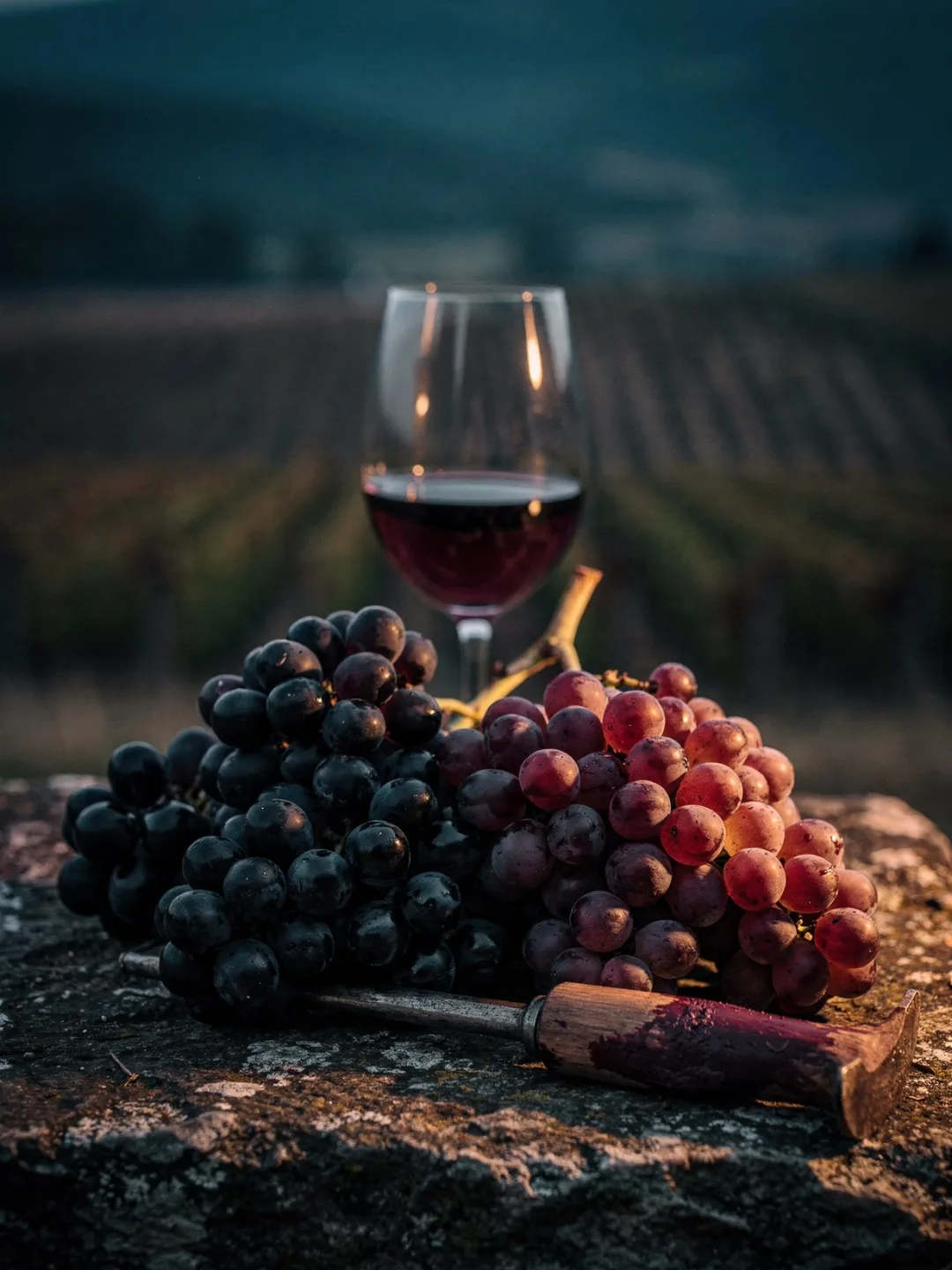
Tannin and World Fame
The Great Red Grape Varieties
Cabernet Sauvignon, Pinot Noir, and Syrah represent three completely different paths to how a red wine can turn out powerful, delicate, or spicy. This stop shows what sets these world-famous varieties apart and why the buzzword tannin plays a different role in each of them.
Cabernet Sauvignon: Thick Skin, Firm Tannin
Cabernet Sauvignon has a thick, dark berry skin. During vinification, this transfers plenty of color and tannin into the glass. Tannins are those grippy, slightly bitter compounds that leave the mouth feeling dry after a robust red wine, similar to the effect of strong black tea. Typical aromas include blackcurrant and cedar. In cooler climates, a green bell pepper note joins in. This thick skin also makes the grape more resistant to rot, which is why Cabernet Sauvignon still delivers reliable results even in unpredictable vintages.
Geneticists at the University of California, Davis made a surprising discovery in 1996. Cabernet Sauvignon itself is a natural crossing. It likely arose by chance from Cabernet Franc and Sauvignon Blanc. The variety ripens late but tolerates plenty of sun and new oak barrels well. As a result, it can be grown almost anywhere in the world that gets warm enough. This chance crossing must therefore have occurred at some point in 17th-century France, long before anyone even recognized it as a distinct variety in its own right.
Pinot Noir: Thin Skin, Little Tannin, High Demands
Pinot Noir, known in Germany as Spätburgunder, has a thin, pale berry skin. This results in lighter-colored wines with less tannin. Typical aromas include red cherry and wild strawberry, with notes of forest floor emerging as the wine ages. The variety is considered particularly temperamental. It reacts sensitively to weather, soil, and every small decision made in the vineyard. Even a single rainy day just before harvest can determine the overall quality of an entire vintage for this thin-skinned variety.
This very sensitivity makes Pinot Noir the greatest challenge of all for many winemakers. At the same time, it's also the most rewarding. When the wine succeeds, it results in a red of great finesse rather than raw power—a far cry from the image of a heavy, tannic red wine. In Burgundy, the variety has been considered the ultimate test of a winemaker's skill for centuries, far beyond the region's own borders.
Syrah and Shiraz: Two Names, One Grape
Syrah comes from the northern Rhône Valley. There, it shows dark berry fruit, black pepper, and a smoky note, all often wrapped in firm yet ripe tannins. In Australia, the exact same grape is called Shiraz. Ripened in a warmer climate, it typically delivers a lusher, sweeter-tasting fruit with less peppery bite. In the cooler northern parts of the Rhône Valley, meanwhile, that characteristic peppery note often remains far more pronounced than in the warmer southern growing areas of the same region.
The difference in name is purely historical. There's no botanical basis for it. Australian settlers simply adopted a different spelling in the 19th century. So when you taste Syrah and Shiraz side by side, you're really comparing the same grape grown under two different climates. They are not, in fact, two separate varieties. Only modern DNA analysis finally confirmed that Syrah and Shiraz are genetically the exact same variety, rather than merely two very similar relatives.
Merlot: The Soft Balance
Merlot has a thinner skin than Cabernet Sauvignon. It also ripens earlier. This results in rounder, softer tannins and aromas of plum and cherry. In Bordeaux, it traditionally serves to soften the sterner Cabernet Sauvignon in blends, without diluting the wine's structure. Because it ripens earlier, Merlot is often the safer choice in years with early autumn rain, compared to the late-ripening Cabernet Sauvignon.
Bottled as a variety in its own right, Merlot shows just how approachable a tannic red wine can still taste. This is one reason for its popularity. Beyond its role as a blending partner, it also ranks among the most widely planted red varieties in the world. In the 1990s, a veritable Merlot boom in the US triggered a surge in international demand that made the variety famous far beyond Bordeaux.