Color, Age, Church Windows
Sight
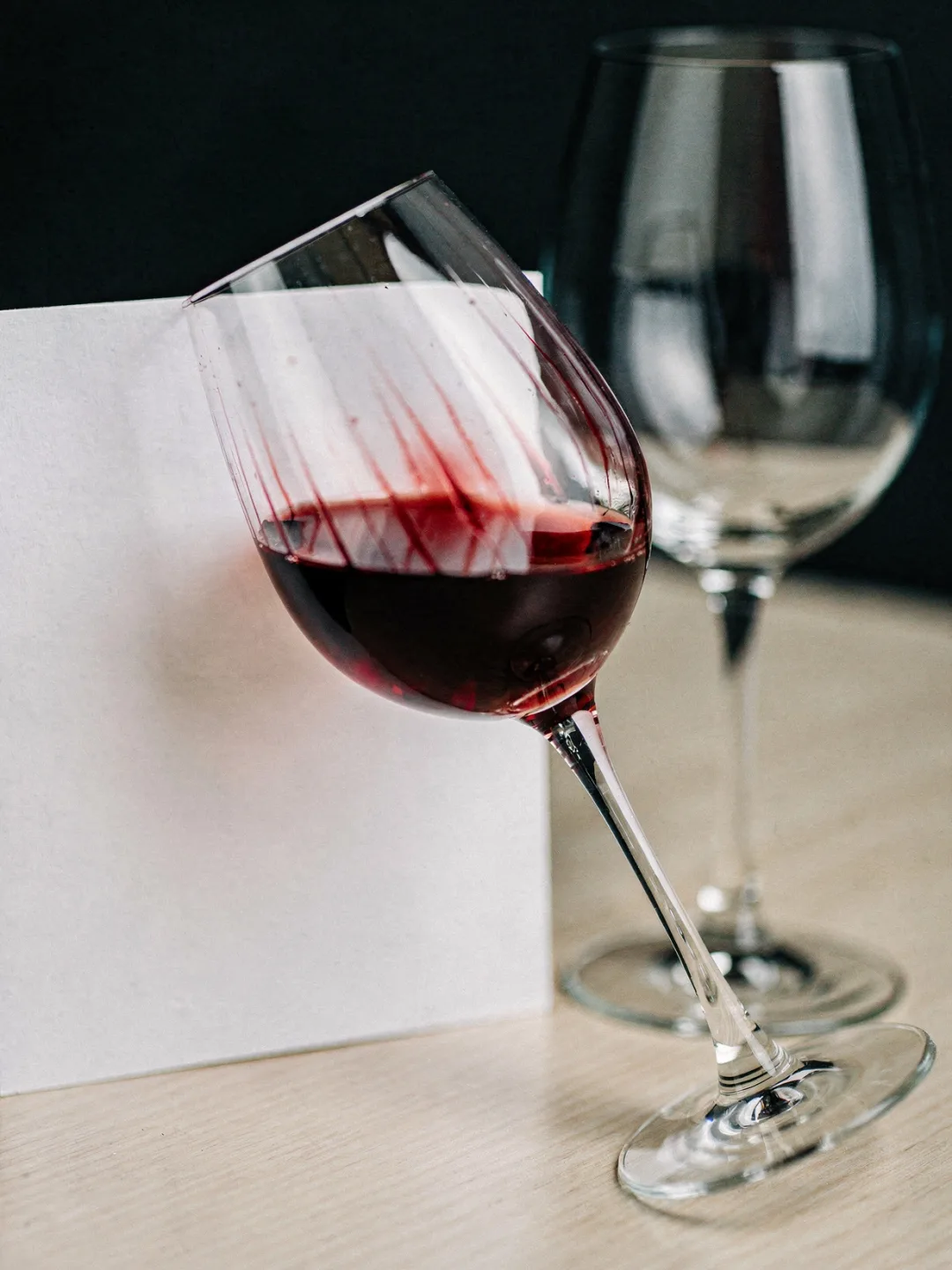
The color in the glass speaks of age, of grape variety, and sometimes of winemaking method, long before the nose or mouth have anything to say. Tilt the glass against a white background, and you can read it almost like an ID card.
Tilting and Reading the Glass
Sight involves more than just a glance from above. Tilt the glass slightly to the side, ideally over a white surface, and look down into it at an angle. This spreads the wine into a thin film, revealing two distinct zones. The center often looks dark and dense even in young wines, while the rim, known as the meniscus, thins out to almost nothing. It's right at the rim that the true age shows most clearly, since that's where the smallest amount of liquid lies.
Clarity is the first question the eye answers. A cloudy, hazy wine was almost always considered a flaw in the past; today it's often a deliberate choice in unfiltered natural wines and not a defect at all. Fizzy bubbles in a still wine that isn't supposed to be sparkling, on the other hand, point to an unwanted second fermentation in the bottle.
What Color Reveals About Age
White wine and red wine age in opposite directions, and once you know that, you can roughly estimate a wine's age without ever seeing the label. A young white wine often shows a pale green-yellow. Over the years, the color shifts toward gold and eventually a deep amber, as oxygen gradually builds color pigments. Red wine makes the opposite journey. Young, it shows deep violet to purple. Over time it fades through ruby and garnet to a brick-red, almost brownish tone at the rim.
The depth of color also reveals something about the grape variety and the winemaking. A thin-skinned Pinot Noir almost always stays paler than a thick-skinned Syrah, regardless of age. A wine that spent a long time on the skins during maceration, as many orange wines made from white grapes do, carries a more intense color than you'd normally expect from a classic white wine.
Church Windows and Tears
Swirl the wine in the glass and let it settle, and fine arcs form on the glass wall, slowly running downward. In German these patterns are called 'church windows,' in English 'legs' or 'tears.' They form because alcohol evaporates faster than water, changing the surface tension in the thin film on the glass wall. This physical effect is named after the physicist Carlo Marangoni.
Legs say nothing about a wine's quality, even though this misconception persists stubbornly. What they mainly indicate is alcohol and glycerol content: a wine with high alcohol usually forms more pronounced, slower-moving tears than a lighter one. Legs are a small window into a wine's composition, then, but not a seal of quality.
Perlage in Sparkling Wine
With Sekt, Champagne, or Cava, there's another thing to observe: the perlage, or how the bubbles rise in the glass. Fine, even bubbles that persist for a long time point to a carefully executed second fermentation and extended aging on the lees. Large bubbles that burst quickly and don't last are more often a sign of simpler production methods. Sometimes, though, it's just a glass with dish soap residue behind it, since fat reliably destroys carbonation.
The foam collar that forms right after pouring also reveals something. A sparkling wine with fine carbonation builds a tall foam that quickly collapses into a thin ring of bubbles. If, on the other hand, a thick white foam persists, that points more to a still-young, unfinished drink than to a finished sparkling wine.
The Limits of Sight
Color reveals a lot, but far from everything, and two misconceptions persist stubbornly. The first: that a darker red wine is supposedly always better. In fact, color intensity mainly reflects the grape variety and the length of skin contact during maceration, hardly the quality. A pale Pinot Noir can be more complex and more valuable than a pitch-black mass-market wine made from a thick-skinned variety.
The second misconception concerns sweetness. Neither a golden hue in a white wine nor a particularly deep color in a red wine says anything about how much residual sugar the wine contains. Whether a wine tastes dry or sweet is only decided on the palate, never in the glass. Anyone who judges by color alone will therefore regularly miss exactly the wines hiding behind an unremarkable appearance.