Bükk Against the Wind
Climate
Eger sits on the southern slope of the Bükk Mountains. That's more than a scenic backdrop: the ridge blocks the cold north winds that would otherwise sweep down unhindered from the direction of Slovakia, creating a pocket of milder air beneath it. Roughly five thousand hectares of vines are spread across nineteen villages in two districts, Eger and Debrő. Each one lies within this sheltered zone.
The climate is temperate-continental and fairly dry. Average annual temperatures sit at ten to eleven degrees Celsius. Add to that around six hundred millimeters of rainfall and nearly two thousand hours of sunshine a year — enough light to ripen the grapes, but rarely enough heat to burn off the acidity. Spring arrives late. This pushes the entire growing season back and gives the red varieties a long, mild autumn to ripen in.
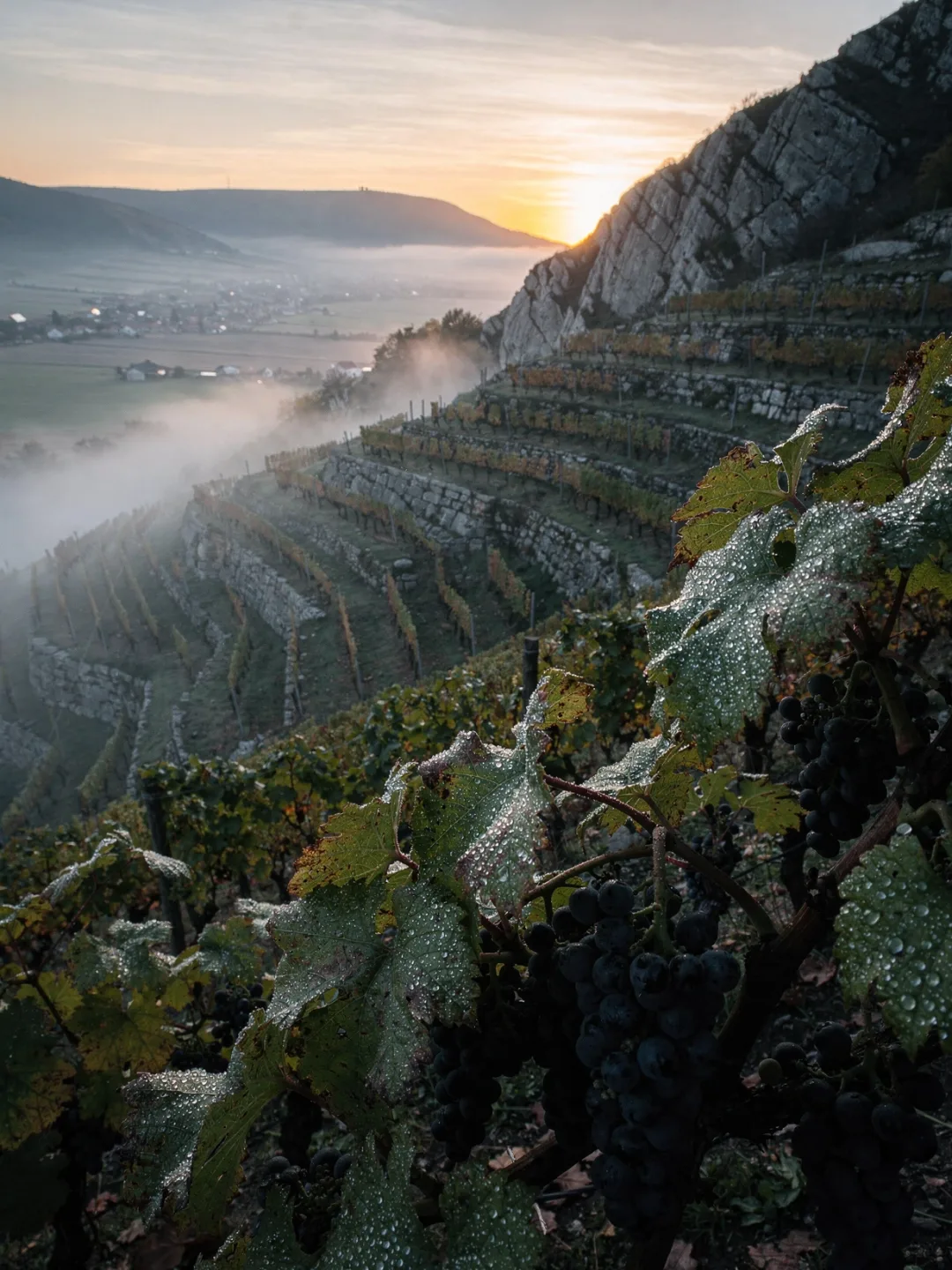
One exception is the Nagy-Eged-hegy, at over five hundred meters the highest point in the wine region. There, the warmth of the Hungarian Great Plain meets the cool air of the Bükk. On clear autumn nights, the temperature drops quickly. This swing between warm days and cool nights locks in the grape's acidity while the berries continue building sugar and aroma during the day — exactly the conditions that produce the region's densest Kékfrankos wines.
Dry doesn't mean risk-free. Hail occasionally sweeps across the slopes in summer. A too-wet September can spoil the thin-skinned Kadarka before it's harvested. Winemakers respond with late picking and, on the steepest plots of the Nagy-Eged-hegy, with terraced parcels that drain water faster than an unbroken slope would. That leaves enough time in the end for what matters most with Bikavér: a long, calm ripening period stretching well into October.