Loess & Vörösagyag
Soils
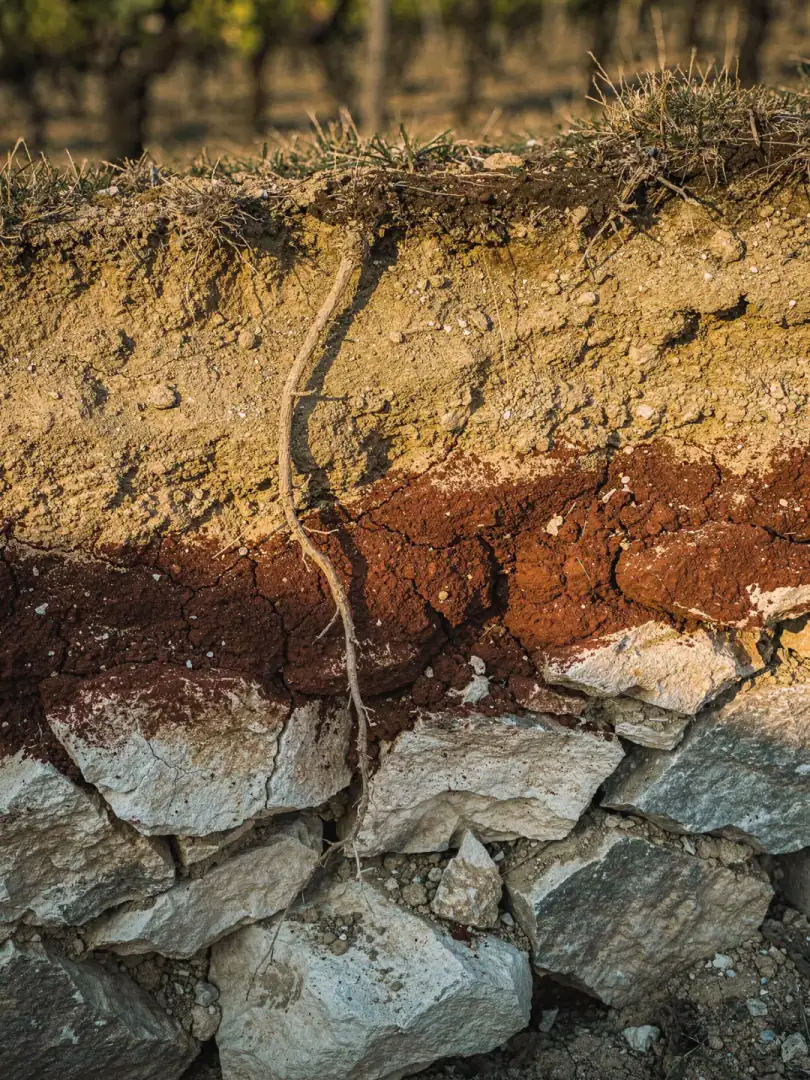
Dig into the slope below Szársomlyó, and the shovel first cuts through fine, light-brown dust. Not a stone in sight. This is loess, blown here by Ice Age winds over millennia from the dry river lowlands nearby and piled up into a layer several meters thick. Wind alone did this. Not rock, but compacted windblown dust, and yet this very dust carries the region's best vineyards.
Loess sounds fragile, but it's a clever water reservoir. Its grains are tiny and packed tightly together, so rainwater seeps in slowly and lingers in the layer instead of vanishing straight down. In a year with barely seven hundred millimeters of rain, that's exactly what decides the fate of the vines. Other soils would simply dry out.
Deeper down, things get more colorful. Beneath the loess, and in its cracks, sits Vörösagyag, a rich red clay that forms where rainwater dissolves the underlying limestone and dolomite, leaving behind tiny traces of iron oxide. This very rock forms a bizarre landscape at the summit of Szársomlyó called Ördögszántás, supposedly plowed by the devil himself: deep, parallel furrows that rain and plant roots have carved into the bare rock over thousands of years. The furrows are real.
Beneath all of this lies the true bedrock: Triassic dolomite and Jurassic limestone, both riddled with cracks and karst caves. A vine that pushes down that far finds water in the fissures that summer has long since evaporated from the surface. On the low-lying Kopár vineyard, this layer sits especially close to the surface, and that's exactly why one of the region's most concentrated Cabernet Francs grows there. You can taste it in the glass.
Fine, light-brown windblown dust from the Ice Age, piled up meters thick. The grains are packed so tightly that rainwater seeps in slowly and stays stored for a long time.
The root: Fine roots draw up the little water a dry Villány summer leaves behind here.