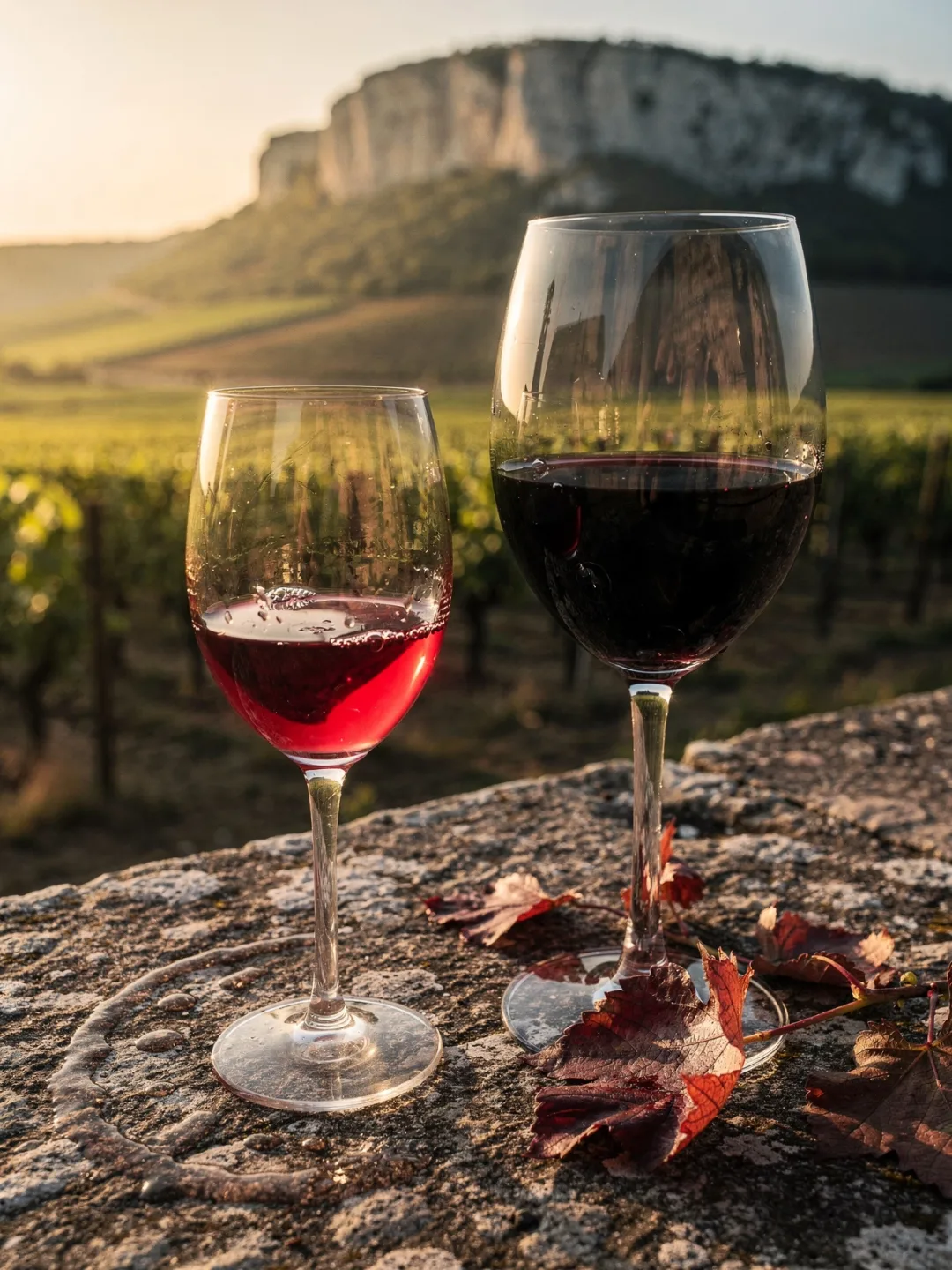
Bordeaux Glass for Franc
Glasses
In Villány you don't drink one wine, but two quite different ones, and that should decide your choice of glass. On one side stands Kékoportó, young, pale, and low in tannin. On the other stands the big, dense Cabernet Franc that gave Villány its name as a red wine region.
A smaller, slimmer glass suits Kékoportó perfectly well. Its fruit sits right on the surface. Nothing more is needed. The tannin, the fuzzy coating you feel on your gums after a sip, is barely noticeable. A wide glass would only push unnecessary alcohol vapor into the nose instead of concentrating the fruit.
With Cabernet Franc, everything changes. Completely differently. In Villány, the variety brings firm tannin, solid acidity, and often a spicy, bell-pepper-like note, plus an alcohol level that easily reaches fourteen percent in hot vintages. A rounded Bordeaux glass with a tall bowl gives this wine room to open up, while its narrowing rim funnels the aromas straight to the nose instead of simply scattering them around the room.
Temperature separates the two wines even more clearly. Kékoportó tastes best cool, around twelve to fourteen degrees, almost like a robust rosé. Cabernet Franc, on the other hand, needs sixteen to eighteen degrees. Any colder and its tannin turns hard and edgy; any warmer and it tastes of alcohol rather than fruit.
A Szuperprémium Villányi Franc ages for at least two years, one of them in wood, and cannot go on sale before the third year after harvest at the earliest. A wine like this has had time to drop sediment, and it needs a half hour of air in the decanter before it shows what it can do. Straight from the bottle, it often stays as closed as a door nobody has knocked on yet.