Clay over granite
Soils
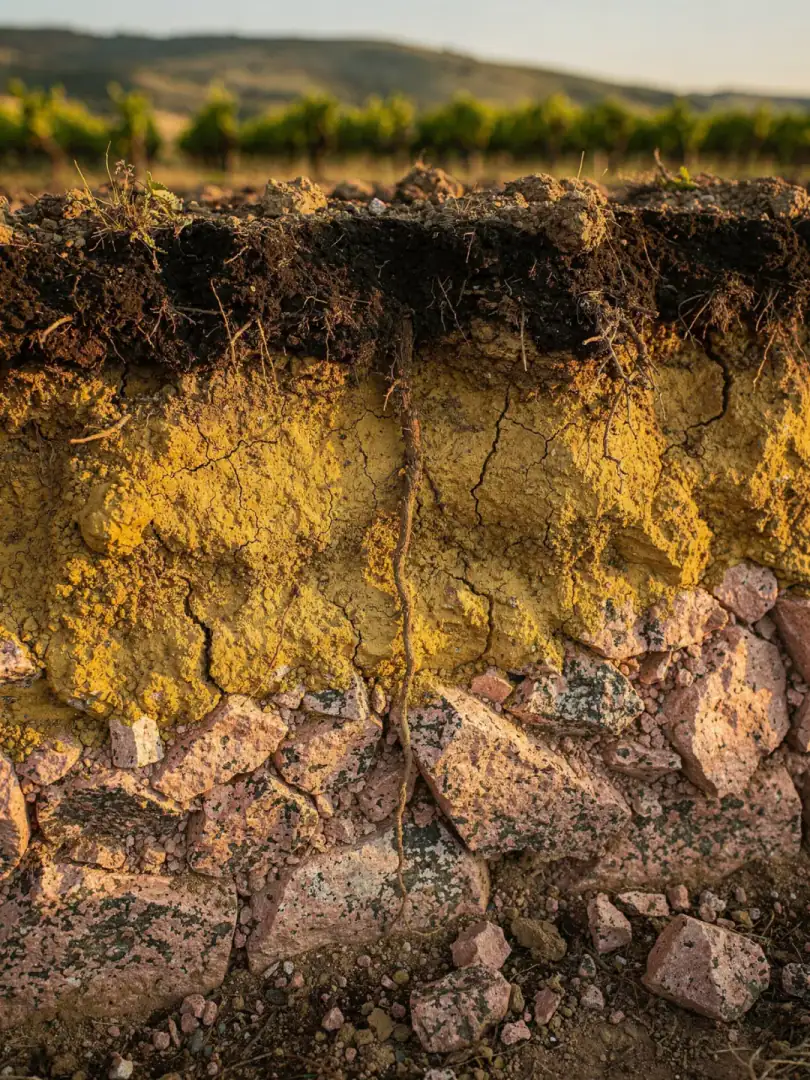
Dig a hole in a vineyard near Toledo or Canelón Chico. After about twenty centimeters, the color changes. On top lies a thin, dark layer of decomposed leaves and root remains. Beneath it begins a dense, yellowish clay.
This is the A horizon, usually around twenty-two centimeters deep. Agronomists describe its texture as silty clay, or "franco limoso" in Spanish. It holds moisture well but is easy for roots to penetrate—a comfortable first floor for the vine.
Below that, down to roughly sixty-four centimeters deep, it turns dense. This clay layer consists largely of swelling minerals, chiefly montmorillonite and illite. They soak up water when it rains and shrink again in dry weather—the soil then visibly cracks open, in fissures you can measure by hand. Studies conducted right here in these vineyards reveal something clear: the more montmorillonite present in this layer, the more vigorously the vine grows. In the end, yields turn out higher too.
Dig deeper still, and in some spots, around La Paz, the clay disappears entirely. In its place lies weathered rock: pink granite, the very same stone quarried near La Paz for paving stones and building façades. Where vine roots manage to reach that deep, they tap into a water reserve that still gives something back, even in the driest summer.
Don't be fooled by wine that tastes "mineral." What the roots draw from granite are dissolved traces, not tasteable minerals. The soil acts through water and warmth, not through direct flavor transport — and that's exactly what determines whether a Tannat from Canelones turns out dense and concentrated or thin and watery.
A thin dark layer of decomposed leaves and fine roots, barely a hand's width deep, in a typical vineyard near Toledo or Canelón Chico.
The root: Here the fine roots absorb whatever the frequent rain has just delivered — and are the first to dry out again.