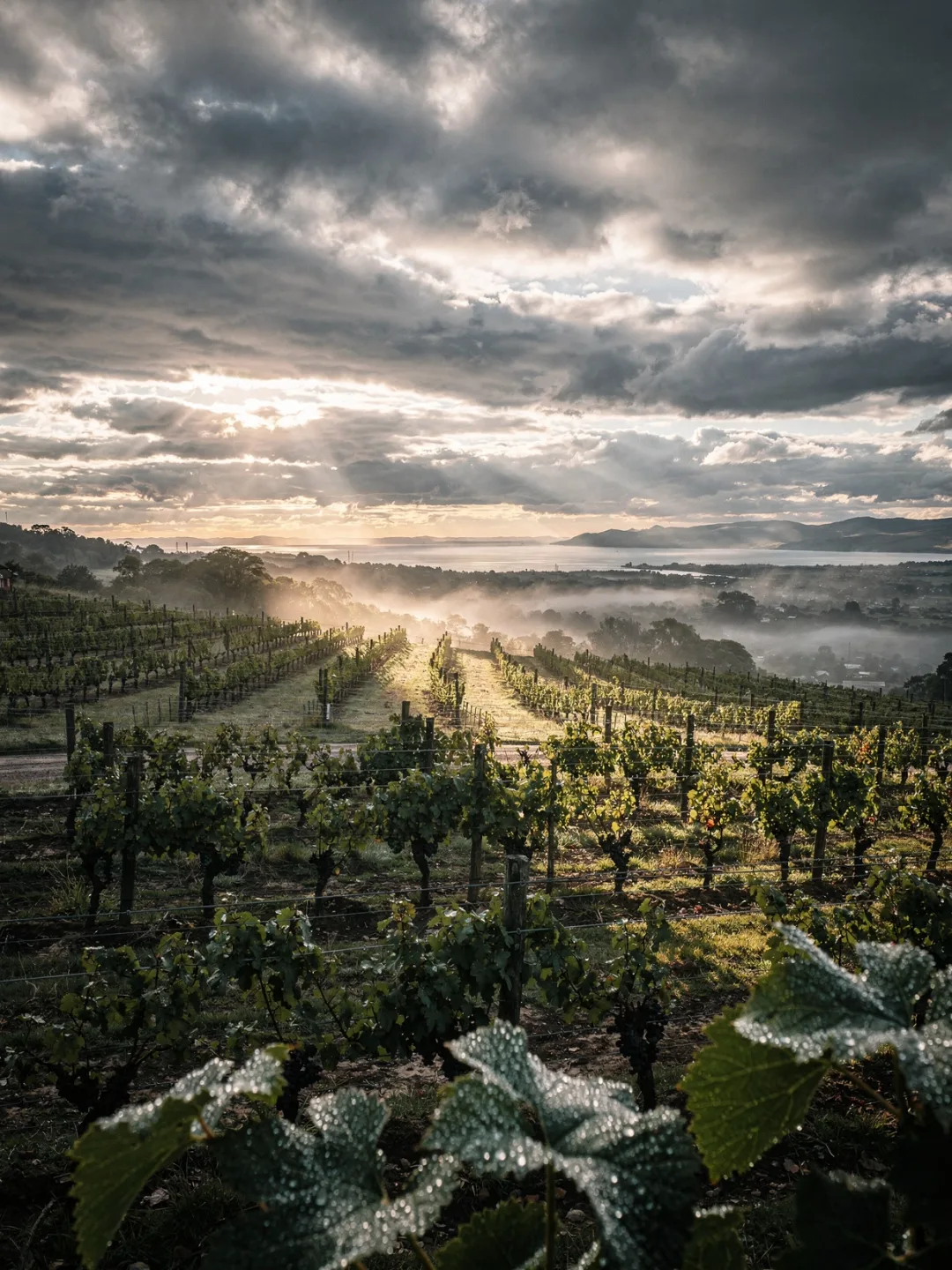
Humid instead of dry
Climate
Canelones doesn't have a classic wine climate. It rains here all year round, even in the middle of summer. Roughly a thousand millimeters of rainfall fall annually, spread across all four seasons, and of all times, harvest in February, March, and April can be just as wet as May.
Two bodies of water are responsible: the Atlantic to the east and the wide funnel of the Río de la Plata to the south. Both send humid air inland and keep temperatures in check. Summers turn warm, but rarely brutally hot—averaging around twenty-eight degrees Celsius, with cooling sea breezes on the hottest afternoons.
Over the year, the thermometer swings between five and thirty-one degrees Celsius. Only rarely does it drop below minus one or climb above thirty-six. It hardly ever gets truly cold. Late June and July bring the greatest risk of frost, but unlike in Central European viticulture, it's a footnote here, not a yearly concern.
This humidity is both a curse and a blessing. It forces winemakers toward open canopies, loose clusters, and often hand-harvesting, since fungal rot spreads quickly through dense bunches. At the same time, the cloud cover slows sugar accumulation in the berries, so Canelones wines rarely turn out overripe or heavy with alcohol—a rainfall pattern similar to Bordeaux's, just south of the equator.
These exact conditions explain why Tannat, of all varieties, became the leading grape here. Its thick skin withstands moisture better than thin-skinned varieties like Pinot Noir, and its acidity holds up under overcast skies instead of melting away in blazing sun. Where other vines struggle in Canelones, Tannat thrives precisely because of it.