Balasto & Granite
Soils
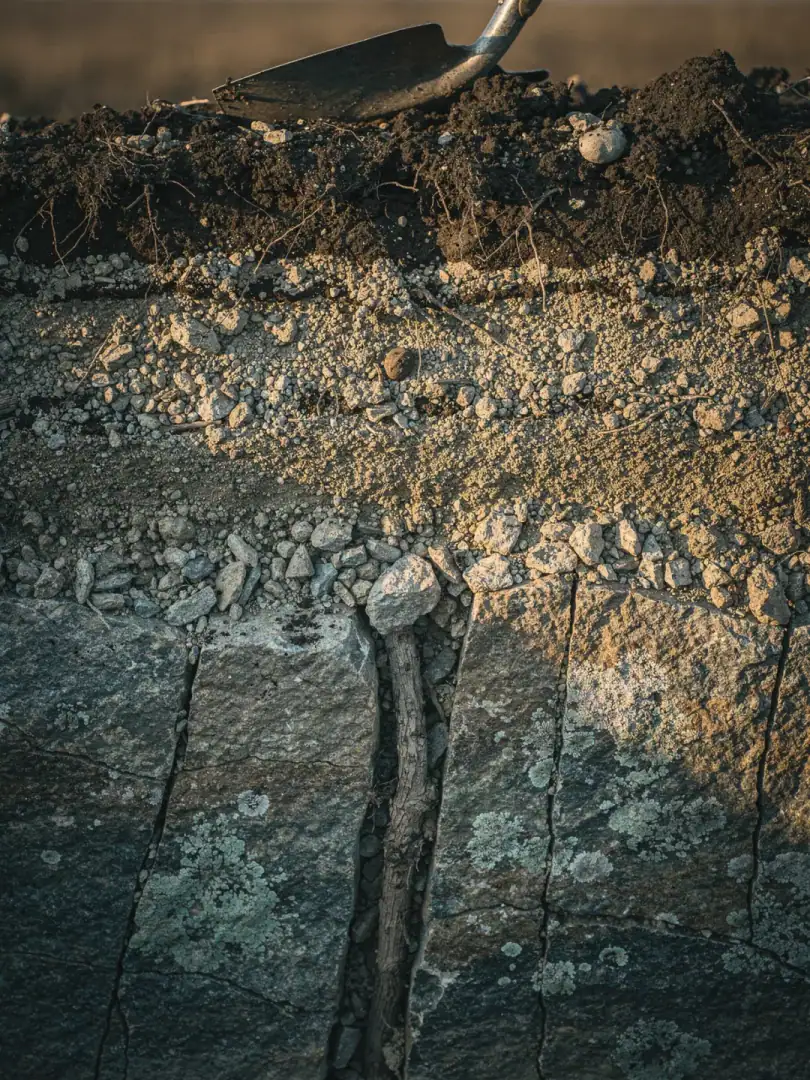
You don't need to dig deep in Maldonado to hit resistance, since the loose topsoil ends after at most thirty centimeters, and rock begins below. Soil scientists call this a lithic contact. On Uruguay's official soil map, this shallow soil type is named Litosol.
What lies between the surface and the rock is called Balasto here: weathered, coarsely broken granite from the so-called Crystalline Basement, a rock formation more than 2.5 billion years old. Hardly anywhere else in South America does rock this old sit so close beneath the vineyard.
An intermediate layer, the kind found in deeper soils elsewhere, is almost entirely absent. The thin layer of humus is followed almost directly by rock, what specialists call an A-R sequence. The roots must therefore squeeze through cracks in the granite. There they find hardly any nutrients, but excellent drainage for rainwater that would otherwise sit for days. Little nourishment, plenty of drainage, small berries: this is exactly where Tannat draws part of its already enormous tannin load.
Not every part of the department looks the same underfoot. Closer to the coast, around Piriápolis and José Ignacio, sandy-stony Brunosols dominate, shallow and full of gravel. On these, Albariño develops its salty freshness. Further inland, near Garzón and on the Sierra de la Ballena, pure granite dominates instead, and there Tannat thrives above all.
The name Balasto has even made it onto the label: Garzón's best-known cuvée shares its name with the very soil its vines grow in. That doesn't mean the wine tastes literally mineral, though, since the roots don't consume rock fragments; they only act indirectly on the water balance and warmth that the rock governs, long before any grape ever ripens.
A thin, stony layer of sandy loam full of gravel—a Brunosol Subéutrico Háplico, as Uruguay's soil map records it for the south of Maldonado.
The root: This is where the fine roots sit. Organic matter is scarce, and water evaporates quickly from the thin layer.