Limestone & Granite
Soils
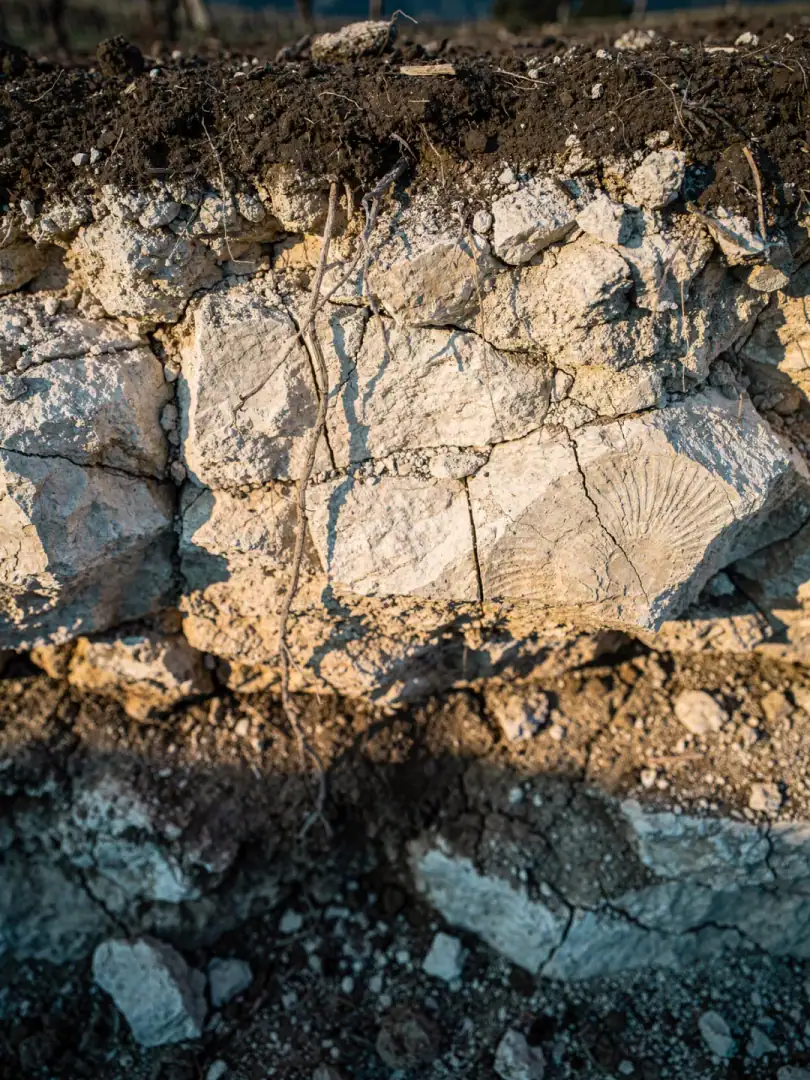
Drive past a road cut near Paso Robles, where construction crews have exposed the hillside. What you see is usually not brown earth but pale, almost white rock — brittle, chalky, laced with fine cracks. This is limestone marl, compacted limestone formed from ancient sea sediment, and it tells a story that began long before any vineyard.
Many millions of years ago, this entire area lay beneath the sea, a marginal basin on the Pacific Plate. Over endless stretches of time, the shells and skeletons of tiny marine organisms sank to the seafloor, rich in calcium, and the pressure of the layers above compressed them into rock. When the plate lifted, this ancient seabed rose to the surface and became the bedrock of Paso Robles.
The stone has a rare dual nature. It's porous like a sponge, so it holds onto the water the vine desperately needs during California's dry summer. At the same time, it fractures easily along fine cracks. Excess water drains downward instead of suffocating the roots. This combination of storage and drainage is rare, and it's one of the reasons so many different grape varieties thrive here.
Further west, in the Santa Lucia Highlands above the Salinas Valley, the soil looks completely different: no limestone here, but weathered granite, broken down into loose, sandy alluvium. It's arranged in terraces, sitting between fifteen and sixty meters above the valley floor. Water runs straight through, holding onto almost nothing — which is why many Pinot Noir vineyards there rely on irrigation, while a Zinfandel near Paso Robles gets by without any at all.
Both soils force the vine to do something similar: root deep, because there's little to find near the surface. And both disprove a popular misconception. The wine doesn't taste of stone because the roots pass minerals straight through — the amounts absorbed are vanishingly small. The soil works through the detour of water, warmth, and root depth, not through the flavor of the rock itself.
A thin, dark layer of organic material over the pale limestone of Paso Robles — in many vineyards barely a hand's width deep.
The root: This is where fine roots sit, soaking up the scarce rain immediately — and the first to dry out during the summer drought.