Fog and Desert Heat
Climate
Most of the mountain ranges along California's coast run parallel to the sea, north to south, like a wall against the Pacific. Around Santa Barbara, they suddenly turn sideways. The Santa Ynez Mountains and their neighboring ranges belong to the so-called Transverse Ranges — one of the few mountain groups in the entire country that runs east to west instead of the other way around.
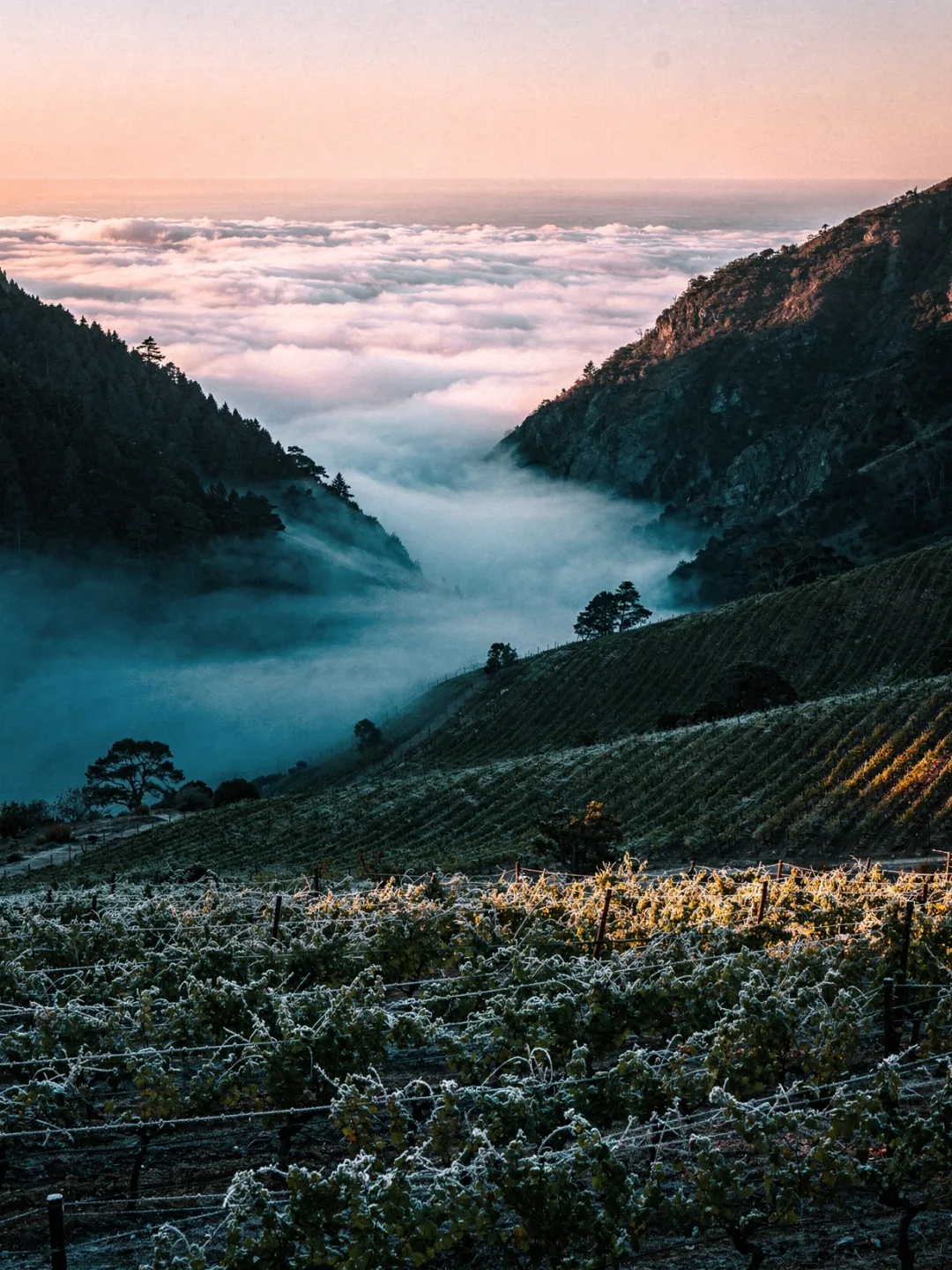
This twist opens a gateway rarely found elsewhere on the West Coast. Cold fog and moist ocean air stream inland unimpeded, instead of bouncing off a north-south chain. In the Santa Maria Valley and the Santa Ynez Valley, this coolness reaches far inland. The result is one of the longest growing seasons in all of winegrowing. Grapes ripen slowly, and sugar and acidity stay in balance for a long time.
Further north, around Paso Robles, this opening is almost entirely absent — except for one gap: the Templeton Gap. Through it, sea breeze flows in from the nearby Pacific each afternoon, cooling the western slopes, but just a few kilometers further east, beyond the gap, the climate turns nearly continental. Summer days easily climb past thirty degrees Celsius, and on clear nights the thermometer can drop sharply. Day and night temperatures there often differ by twenty degrees Celsius. That's enormous.
Near Monterey, the same trick plays out through a bay instead of a mountain range. In the afternoon, the heat of the Salinas Valley draws cool air in from Monterey Bay, a steady, often strong wind. It noticeably cools the Santa Lucia Highlands on their benches above the valley floor. Anyone standing in the vineyard there reaches for a jacket by afternoon, even if it still felt like summer at noon.
So within a few hours' drive lie one of California's coolest Pinot Noir sites and one of the state's hottest Zinfandel corners. Both belong to the same region. That's exactly what makes Central Coast so hard to sum up in a single sentence. And that's exactly why so many different varieties thrive here.