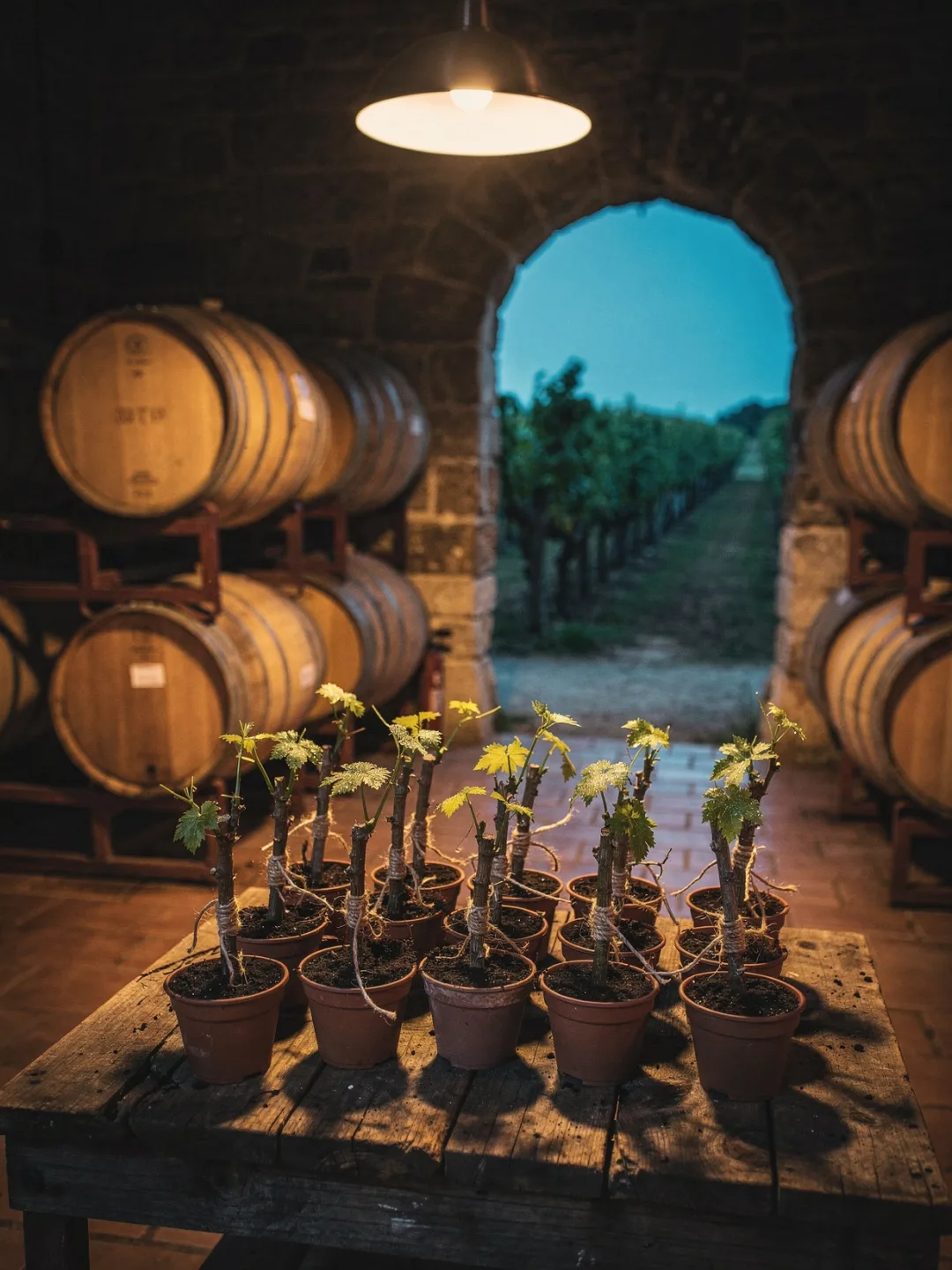
Cutting & Barrique
Production
When the Perrin family of Château de Beaucastel in southern France and importer Robert Haas co-founded Tablas Creek in 1989, they didn't bring finished vines. They brought only cuttings — trimmed shoots meant for propagation. Before US authorities allowed them to plant, the vines had to spend three years in quarantine, to make sure they were virus-free. Only in 1994 did Grenache, Mourvèdre, Syrah, and Roussanne actually go into the ground.
Their own quarantine station eventually turned into a nursery, which has since supplied nearly five million cuttings to over six hundred wineries from California to Texas. Without this one detour, today's Rhône blends across the whole of Central Coast would hardly exist in their current form.
There's no fixed formula for the actual blending. Grenache, Syrah, and Mourvèdre ripen at different times and are usually fermented separately. The sugar in the grapes is converted to alcohol tank by tank, individually. Only afterward does the winemaker taste the wines and bring them together. One vintage might be dominated by Grenache's fruity sweetness, another might need more Mourvèdre for structure.
On the Bordeaux side, things run more methodically. Justin Baldwin's Isosceles is usually led by Cabernet Sauvignon, rounded out with smaller portions of Cabernet Franc and Merlot, then aged for over a year in barriques — small oak barrels typically holding two hundred twenty-five liters — before it ever reaches the bottle.
With Pinot Noir from the Santa Lucia Highlands, many winemakers deliberately ferment whole clusters, stems and all, in the fermentation tank — they don't pluck the berries individually from the stem beforehand. The stem contributes extra tannin and a spicy, slightly green note that gives the pale wine more backbone. With Zinfandel, the opposite holds true: the berries are often picked overripe, loaded with sugar. They need to be cooled and fermented carefully, or the wine tips too hot and loses its balance.