Shale & Limestone
Soils
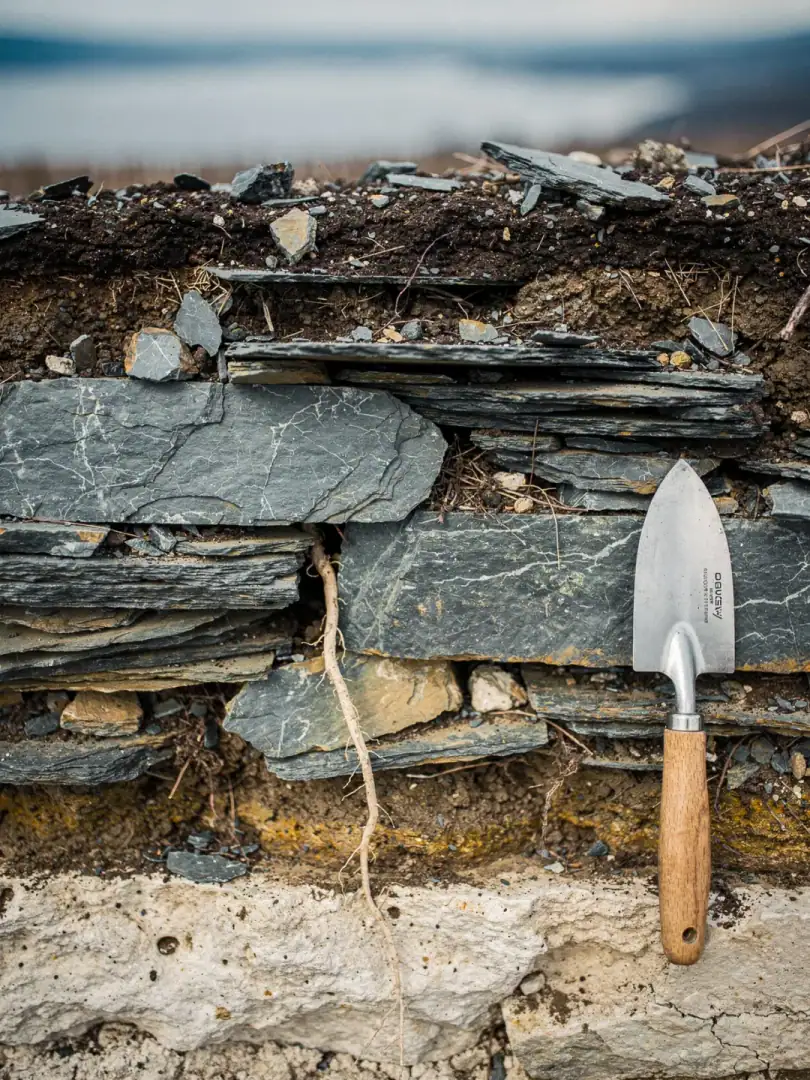
Dig a spade's depth into a slope above Seneca Lake. After just a few centimeters of soil, the spade hits pale gray slabs that splinter at the touch. That's shale, and it sits just beneath the surface almost everywhere here.
The rock itself is ancient. Between 360 and 416 million years ago, during the Devonian period, the ancestors of the Appalachians washed sand and mud into a shallow sea that once covered what is now New York State. The finest mud became shale, coarser material became limestone and sandstone, layered in alternating strata more than two kilometers thick in total. Millions of years later, glaciers carved today's lake valleys straight through this very rock.
This exact layering determines whether a vine lives or dies. It's no small matter. New York winters bring snow and heavy spring rain, and roots sitting in standing water for days will rot. Fractured shale, by contrast, lets water drain through quickly while its cracks still give roots something to hold onto. Where thick, compacted clay sits instead, vines struggle, and growers tend to avoid planting there altogether.
Around Cayuga Lake, some vineyards climb to roughly 240 meters above lake level, with thin topsoil and shale lying almost at the surface. Beneath the shale in many spots lies a solid limestone bed. It holds onto residual moisture even after the topsoil has long since dried out by August.
No two slopes are quite alike. A vineyard above Keuka Lake can show completely different shale than one just ten kilometers away on Cayuga Lake, depending on which layer the glaciers happened to strip away there. Growers rarely talk about a single Finger Lakes soil, then. They talk about their slope.
A loamy, stony remnant of the last ice age: crushed shale, limestone fragments, and clay left behind by the glacier.
The root: This is where the fine roots sit, drawing up water first in spring—and freezing solid first come winter.