Ice, Bubbles, Steel
Production
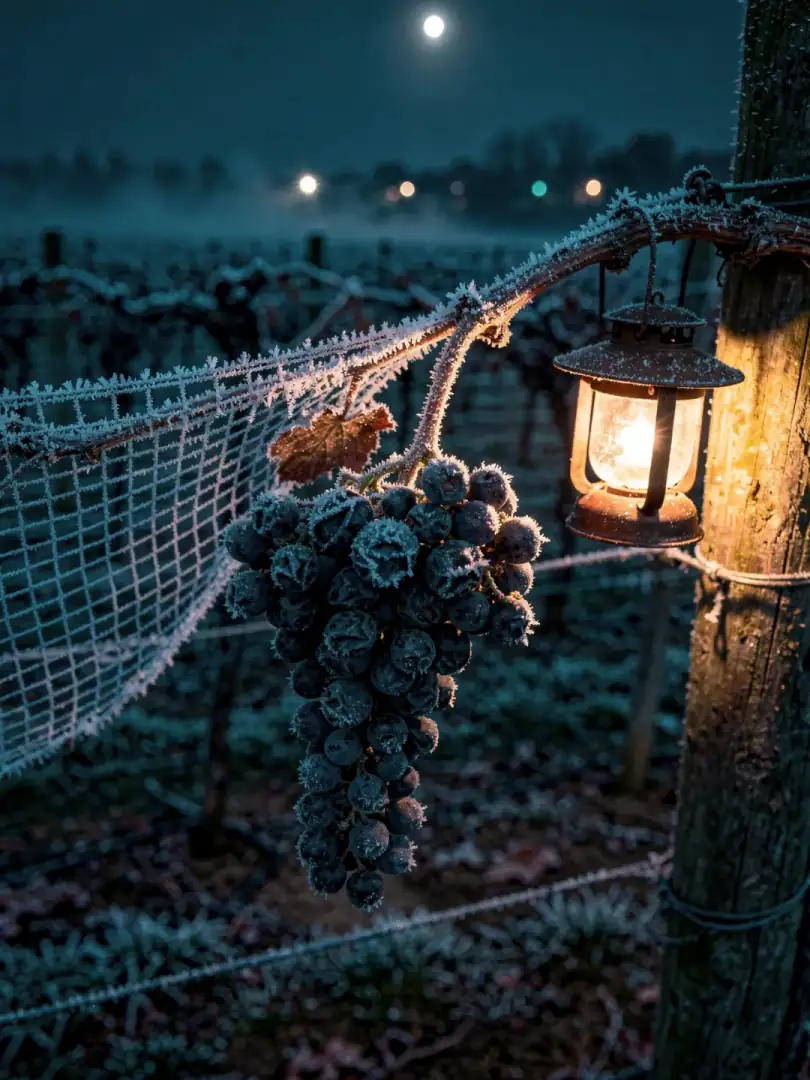
Harvest workers walk the rows in the middle of a January night with headlamps on, when the thermometer reads minus eight degrees Celsius or lower. They pick grapes that have hung on the vine for weeks and are by now frozen solid. Every hour of delay counts, because once the sun thaws the berries, that winter's harvest is over.
Pressing happens immediately, while the grapes are still frozen. Only the highly concentrated sugar syrup inside the berry flows out, while most of the water stays behind in the press as ice. Ten kilos of grapes often yield just a single glass of wine this way. Great Western Vineyards pressed the region's first ice wine from Vidal Blanc in 1981. The variety has a thick skin and plenty of acidity—both essential for a wine that has to survive weeks of frost, rain, and hungry birds. Netting strung over the rows now keeps the birds away.
With still wine, it nearly all comes down to keeping things cool. Riesling ferments almost exclusively in stainless steel tanks rather than oak barrels, at temperatures just above ten degrees Celsius. This protects the delicate apple and citrus aromas from yeast character and wood influence. Some producers deliberately stop fermentation before all the sugar has converted, leaving residual sweetness in the wine—a deliberate choice, not a fallback.
The region's oldest craft tradition isn't Riesling, but sparkling wine. Back in the 1860s, Pleasant Valley Wine Company was already bottling its Catawba using classic bottle fermentation. Secondary fermentation in a sealed bottle, years on the lees, hand-riddled, finally hand-disgorged. This hands-on process made the wine expensive, but it's what earned those medals in Paris and Vienna, and Cornell's experiment station in Geneva continues researching new, hardier varieties today that make such labor-intensive work worthwhile at all in the lakes' harsh climate.