Volcano Meets Ocean
Soils
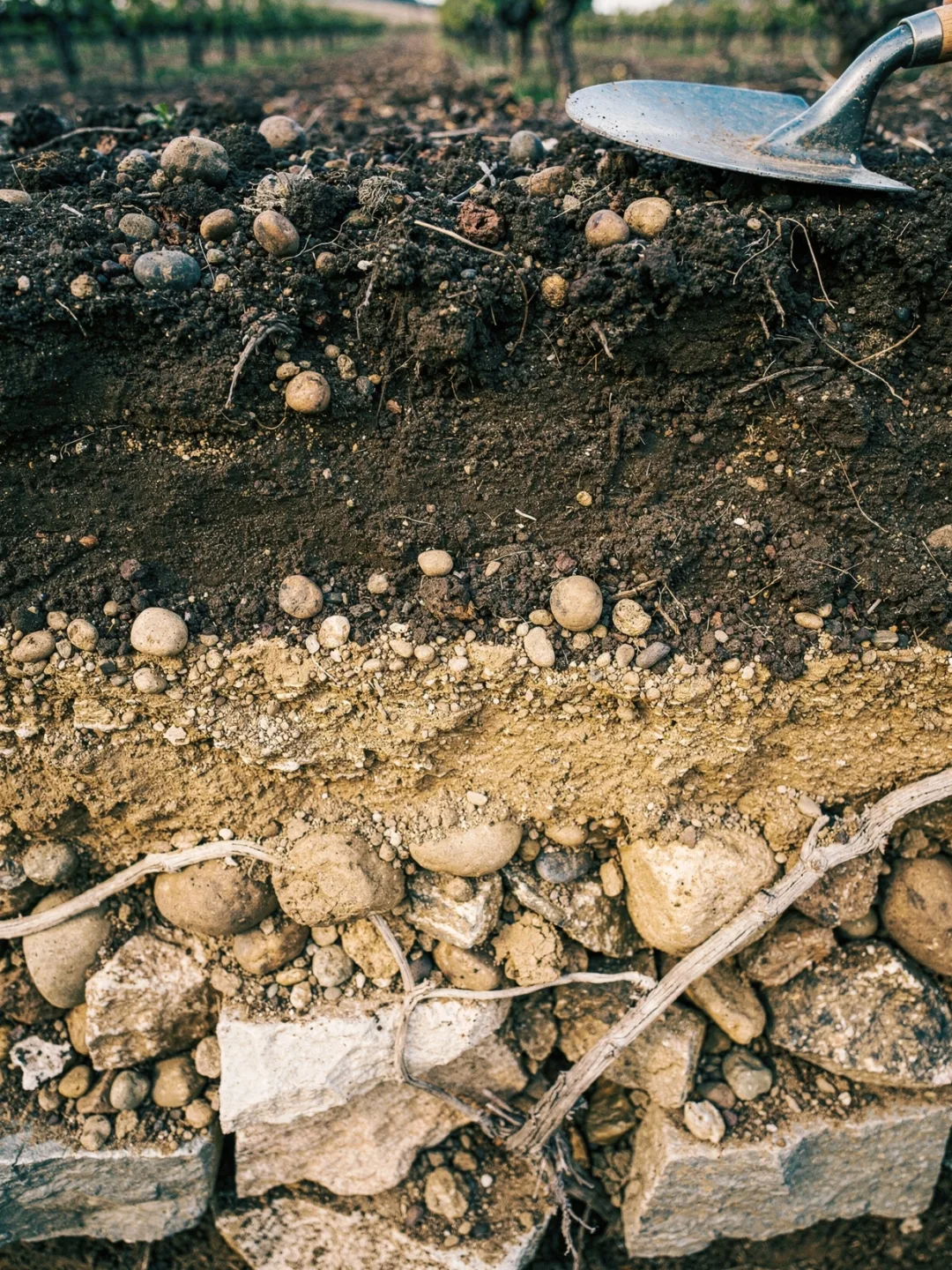
Dig a hole in a vineyard near Rutherford. After just a few inches, the dark, sandy loam on top turns stonier, and you hit rounded pebbles that look as if they came from a riverbed. That's exactly where they came from. This is Rutherford Dust, named after the fine dust that settles over the grapes at harvest.
Rivers shaped this soil over thousands of years. They carried gravel and sand down from the Mayacamas to the west and deposited it repeatedly in fan-shaped layers, one on top of another, until it formed the bench where many of the valley's most celebrated Cabernet vineyards now stand. Water drains through quickly here. Roots find their footing between the pebbles rather than in dense clay, and that very stress forces the vine to grow deep.
Just a few kilometers east, the ground looks completely different. The Vaca Mountains to the east are volcanic in origin: chunks of basalt, deep red loam from weathered rock, and compacted white volcanic ash alternate with one another, along with coarse scree that has slid down steep slopes. Wine from these soils often tastes darker and rougher in its tannins than the softer Rutherford style. Yet both vineyards belong to the same grape variety.
South of the Mayacamas comes a third story. There lies ancient rock, lifted from the sea millions of years ago, sedimentary and shaped by saltwater long before any valley, let alone a single vine, existed here. American soil scientists have counted with real precision. They now tally close to one hundred distinct soil series across an area smaller than many an English county.
This diversity explains why two vineyards separated by nothing more than a dirt track can taste completely different. One sits on gravel from a river long since vanished. The other on cooled volcanic rock. Both are called Napa Valley.
Dark, loose loam with fine sand, threaded through with small rounded pebbles from ancient river gravel.
The root: Only the fine roots live here — this layer is the first to dry out after every rain.