Loess, Flood, Basalt
Soils
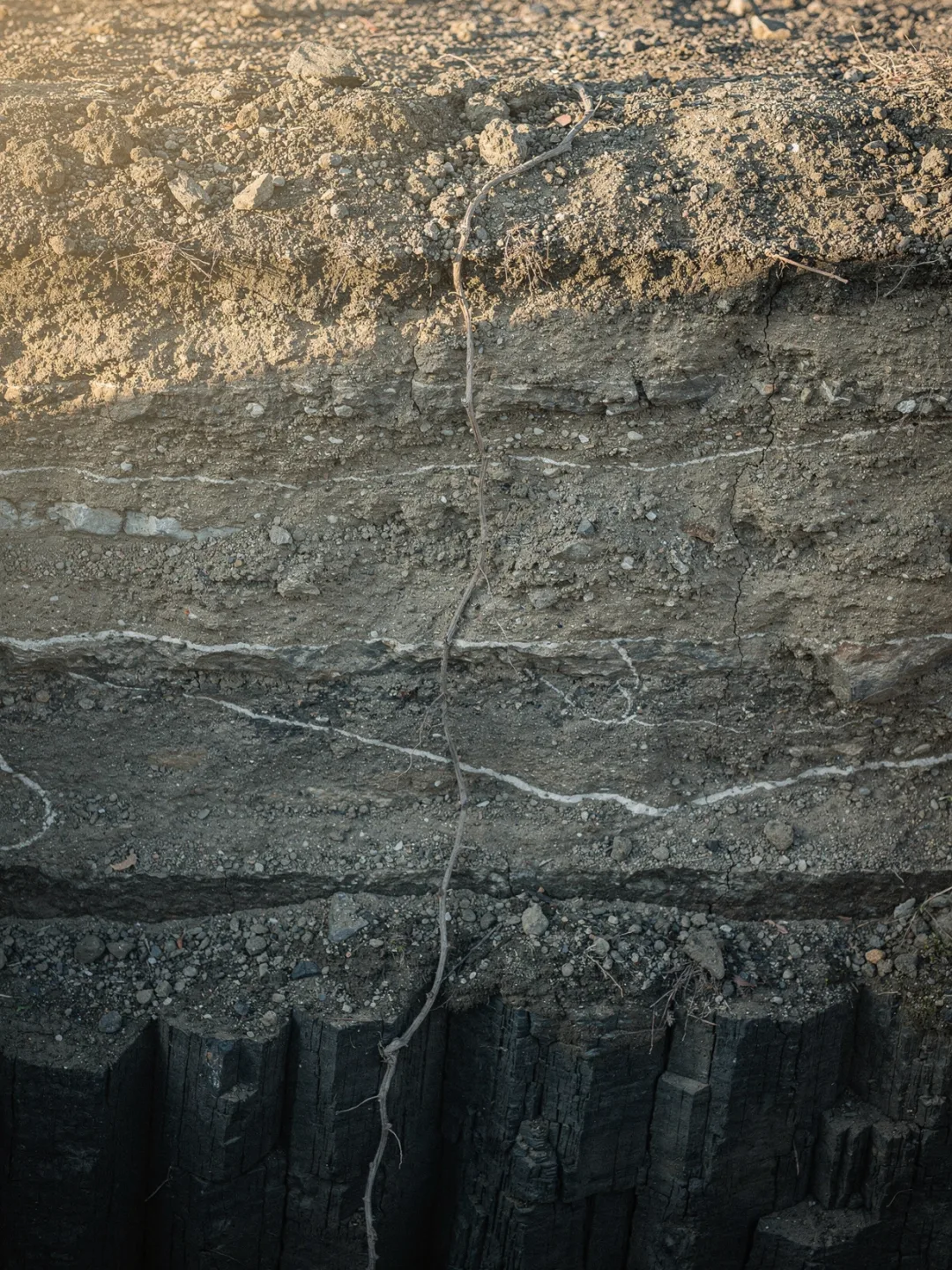
Dig a hole anywhere in the Columbia Valley and you'll first hit fine, pale dust: loess, blown in over millennia by wind from the riverbed. It's as fine as powdered sugar and holds almost no water, but it lets roots pass through with ease. This very combination makes it the ideal base for precision irrigation, since it's the winemaker, not the rain, who decides how much water a vine gets.
Beneath it lies an entirely different story. At the end of the last Ice Age, roughly fifteen to eight thousand years ago, a huge ice dam in Montana kept breaking apart. Each time, a lake of enormous size burst through eastern Washington as a flash flood. These events are known as the Missoula Floods. They left behind layers of sand, silt, and gravel that today lie several meters thick beneath the loess. There, they store water like a sponge, deep down where summer's heat can't reach.
The foundation beneath all of this is basalt, dark volcanic rock that welled up through cracks in the earth's crust. Millions of years ago it surged forth and settled in thick layers across much of the Northwest. Roots rarely reach it. If a vine does happen to hit bare rock, its growth stops abruptly right there. Winemakers know exactly where in the vineyard this happens, because the vines there stay noticeably smaller.
Each layer here has its own job. The loess on top makes the vine thirst, the flood deposit beneath holds an emergency reserve, and the basalt at the very bottom sets a hard limit no root can cross. Under this stress the vine produces smaller berries with thicker skins, and it's in the skin that color and tannin sit, that furry sensation you feel on your gums after a sip of red wine. That's why so many wines from the Columbia Valley taste so dense, even though the soil itself looks bare and unremarkable.
Fine, wind-blown silt from the deposits of the Missoula Floods, loose as powdered sugar and holding very little water.
The root: Roots pass through here with ease but find hardly any water, and are quickly pushed downward.